
The nozzle choice isn’t just about durability. For the Bambu Lab P1 Series, a Bambu Lab hardened steel nozzle upgrade is a complete hotend with a 0.4 mm nozzle, and hardened steel is required for Bambu PLA-CF and PETG-CF. Other nozzle diameters suit different priorities, so match your choice to the materials and results you want.
If you’re considering a Bambu Lab hardened steel nozzle upgrade, the key question is whether your filament and printing needs justify it. Abrasive composite filaments can wear softer nozzles, while nozzle diameter affects the balance between fine detail and extrusion throughput.
This guide explains which P1 Series options are available, when hardened steel is the right fit, and how to choose a nozzle diameter for your work. You’ll also find out what to consider if your printer needs attention during the upgrade.
Key Takeaways
- Choose a nozzle diameter based on your print priorities: finer detail, everyday balance, or higher filament flow.
- Compare the P1 Series options before changing your setup, since nozzle material and diameter both affect the choice.
- Consider how your filament’s abrasiveness influences nozzle wear when planning regular prints.
- If a hotend issue is making upgrades difficult, 3D Printing Canada’s 3D Printer Repair Services can help address printer hardware problems.
- Use the article’s compatibility and setup guidance to make a more informed upgrade decision for your printer and materials.
Bambu lab hardened steel nozzle upgrade
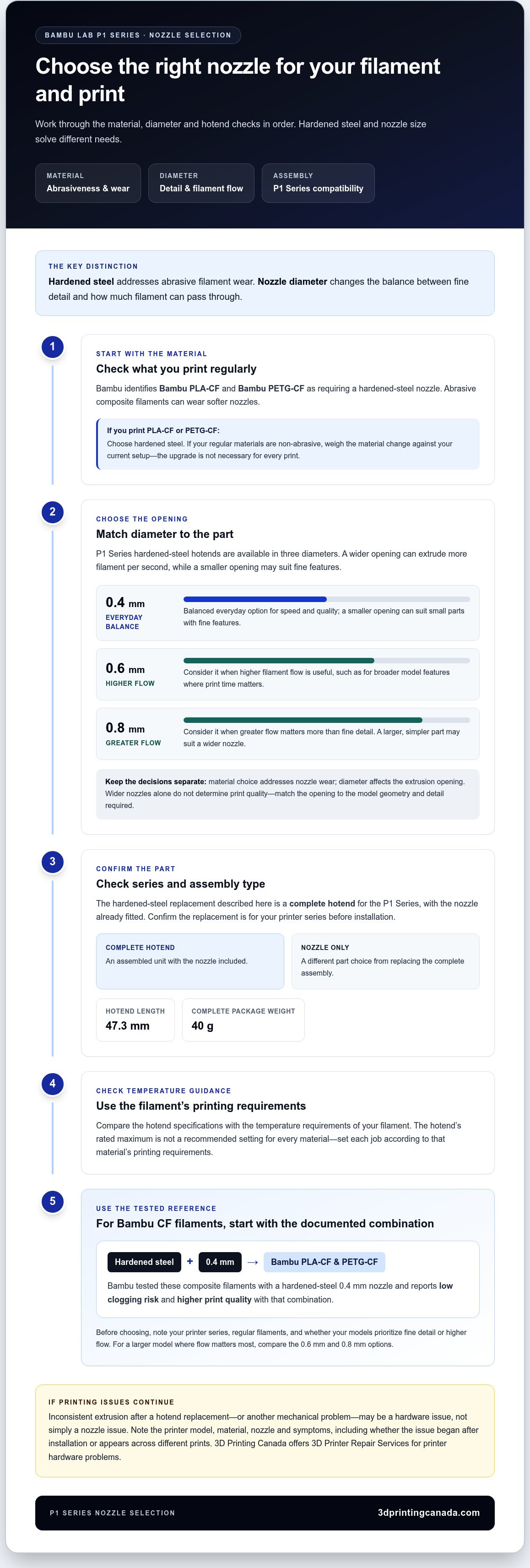
A Bambu Lab hardened steel nozzle upgrade for the P1 Series uses a complete hotend with a 0.4 mm nozzle. Hardened steel matters most when printing abrasive filaments, including Bambu PLA-CF and Bambu PETG-CF. Bambu marks hardened steel as required for both materials. If your usual filament is non-abrasive, decide whether the material change justifies replacing your current nozzle.
The P1 Series hotend comes with hardened-steel nozzles in 0.4 mm, 0.6 mm, and 0.8 mm diameters. The diameter changes how much filament can pass through the nozzle and the level of detail you can produce. A 0.4 mm nozzle offers a practical balance for everyday printing. A 0.6 mm or 0.8 mm nozzle can extrude more filament per second, which can support faster printing.
Match the nozzle to the filament and print
Start with the filament, then consider the part. For Bambu PLA-CF or PETG-CF, choose hardened steel, which Bambu identifies as required. With other materials, consider their abrasiveness and the finish you want. The upgrade isn’t necessary for every print, so base the decision on the filaments you use regularly.
Use the diameter as a separate decision from the nozzle material. Hardened steel addresses the material requirement; diameter affects the extrusion opening. For example, a 0.4 mm nozzle is the everyday option when you want balanced speed and quality. If the model has broader features and print time matters, consider whether a 0.6 mm or 0.8 mm opening suits the job.
- 0.4 mm: Choose this for the P1 Series’ balanced everyday option.
- 0.6 mm: Consider it when higher filament flow is useful.
- 0.8 mm: Consider it for jobs where greater flow matters more than fine detail.
Your choice also depends on the model. A small part with fine features may benefit from a smaller nozzle opening, while a larger, simpler part may suit a wider one. Wider nozzles can extrude more filament, but that alone doesn’t determine print quality. Match the nozzle to the geometry and the level of detail the design needs.
Check the hotend before changing parts
Confirm that the replacement is for the P1 Series before installing it. The hardened-steel complete hotend is compatible with that series, and its nozzle is already fitted as part of the assembly. This differs from buying a nozzle alone. A complete hotend provides the assembled unit, while a nozzle-only replacement involves a different part choice.
Check the hotend’s specifications against the temperature requirements of the filament you plan to use. That specification describes the hotend’s rated maximum, not a recommended setting for every filament. Use the material’s printing requirements when setting a job. The hotend is 47.3 mm long, and the complete package weighs 40 g, useful details when identifying the part and handling its replacement.
Bambu’s testing provides a specific reference for two composite filaments: Bambu PLA-CF and Bambu PETG-CF were tested with a hardened-steel 0.4 mm nozzle. Bambu reports low clogging risk and higher print quality with that combination. This gives P1 Series owners a clear starting point for those materials, while 0.6 mm and 0.8 mm hardened-steel options remain available for other flow priorities.
Before choosing, write down your printer series, the filaments you use, and the detail or speed your models need. For a P1 Series owner printing Bambu PETG-CF, hardened steel is the required material choice, and 0.4 mm is the tested nozzle reference. For a larger model where flow is the priority, compare the 0.6 mm and 0.8 mm options. That simple check helps align the upgrade with the work.
Compare the listed price with the typical price before buying. These figures can help you assess the purchase, but the right choice depends on whether hardened steel suits the materials you print. If you regularly use abrasive filament, the upgrade may make more sense than it would for occasional printing with non-abrasive materials.
Consider the full assembly and nozzle diameter together, rather than deciding on price alone. Choose a configuration that suits your filament and the detail your parts require. Avoid replacing a working setup unless you have a clear reason to do so.
3D Printing Canada: 3D Printer Repair Services
3D Printing Canada offers 3D Printer Repair Services for printer hardware issues that can interrupt an upgrade or affect printing. If a hotend replacement doesn’t resolve inconsistent extrusion, or the printer develops another mechanical problem, repair support can help address the equipment issue rather than treating every print fault as a nozzle problem.
Before seeking repair, note your printer model, the material and nozzle you’re using, and the symptoms. For example, record whether extrusion problems started after installing a new hotend or occur across different prints. These details help you describe the issue and connect troubleshooting to your setup.
For help with a printer hardware problem, contact 3D Printing Canada.
Make your next print a deliberate choice
Plan the upgrade around your upcoming projects. A Bambu Lab hardened steel nozzle upgrade is most useful when it suits your filament choices and the detail or throughput your prints require. Keep a note of which materials and nozzle setups work for each project. This gives you a practical reference when you adjust your workflow or take on a different design.
If you’re deciding which Bambu Lab accessory suits your setup, get guidance before choosing. If the printer has a hardware problem alongside the upgrade, 3D Printing Canada also offers 3D Printer Repair Services. Start with the issue you’re trying to solve and the materials you plan to print, then take the next step with confidence.
Contact 3D Printing Canada for nozzle advice and keep your next project moving.