
What if the most expensive handheld 3D scanner on the market is actually the worst investment for your specific Canadian workshop? It's easy to get caught up in flashy marketing specs, but finding a reliable handheld 3D scanner Canada professionals can actually use involves more than just reading a datasheet. You need a tool that delivers repeatable accuracy, not a high-tech paperweight that lacks local technical support when a project is on the line.
We know the pressure of choosing hardware that fits your specific workflow and budget. This guide simplifies your decision by comparing the top 2026 models based on real-world performance and object size. We'll show you how to secure a reliable scan-to-CAD workflow while keeping your investment protected by domestic expertise. From hobbyist-friendly setups to industrial metrology series, we're breaking down exactly what you need to know to scan with confidence and avoid the hidden costs of ordering from abroad.
Key Takeaways
- Identify why 2026 is the breakthrough year for mobile scanning and how these handheld units now compete with traditional stationary systems.
- Learn to tell the difference between metrology-grade accuracy and visual-grade resolution so you don't overpay for specs you don't need.
- Secure the best handheld 3D scanner Canada offers by understanding how local support and domestic shipping eliminate surprise import fees.
- Compare blue laser and structured light technologies to find the perfect balance of speed, precision, and colour capture for your specific workflow.
- Ensure long-term success with your hardware through a reliable scan-to-CAD process and access to in-house Canadian repair services.
The Evolution of Handheld 3D Scanning in Canada
2026 marks a massive shift in how we capture the physical world. For years, high-quality scanning was locked behind the high walls of industrial metrology labs, requiring heavy tripods and static setups. Today, the tipping point has arrived. We've seen a surge in truly mobile freedom, where a handheld 3D scanner Canada professionals use can produce professional results in a fraction of the time. This shift empowers professionals across various sectors, from automotive restorers to heritage preservationists, to digitize objects right where they stand, anywhere in the country. With the global handheld market projected to reach $1.9 billion in 2026, Canada's growing share represents a community of makers and engineers who demand precision on the go.
Local availability has rewritten the script for small businesses and hobbyists. You no longer need a massive capital expenditure or a dedicated scanning room to get started. Modern 3D scanning technology allows you to walk around a part, capturing every angle with a level of ease that was unthinkable just a few years ago. This democratization of tech means that custom manufacturing and rapid prototyping are now accessible to shops of all sizes across the country.
Why Move from Desktop to Handheld?
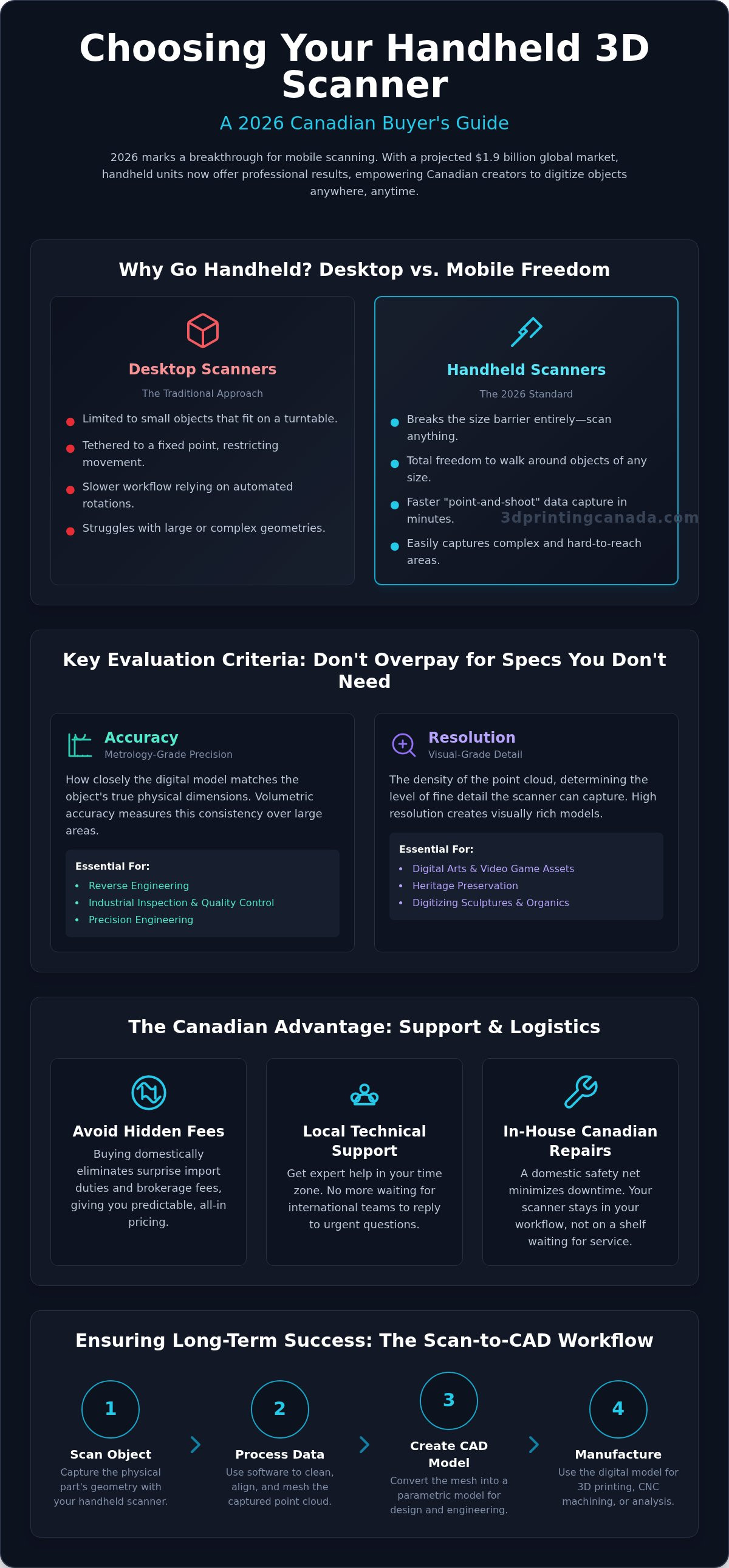
Desktop scanners are fantastic for small, manageable parts that fit on a turntable. However, they hit a hard wall when you need to scan anything larger than a breadbox. Handheld units break this size barrier entirely. Whether you're scanning a custom motorcycle frame or a large architectural feature, you aren't tethered to a fixed point. This mobility is essential for capturing complex geometries and hard-to-reach internal cavities that a stationary camera would miss.
The speed advantage is another game-changer. Instead of waiting for a turntable to complete several slow rotations, you can use a point and shoot approach to get the data you need. This makes the design cycle much faster, allowing you to move from a physical part to a digital model in minutes rather than hours. It's about spending less time troubleshooting your setup and more time actually creating.
The Current State of the Canadian 3D Market
The Canadian landscape has matured significantly. Domestic retailers like 3D Printing Canada have closed the gap on international giants by providing a national ecosystem of support. This is a huge win for anyone tired of the duty trap. Ordering high-value electronics from outside the country often leads to surprise import fees that can add hundreds of dollars to your bill. Buying a handheld 3D scanner Canada-wide from a trusted domestic supplier keeps those costs predictable and keeps your budget on track.
Beyond the price tag, having a Canadian-based support team is invaluable. When you're dealing with complex hardware, you don't want to wait for a 12-hour time-zone difference to get a technical question answered. We provide that local safety net, offering in-house repairs and expert guidance that ensures your scanner stays an active part of your workflow, not a dusty ornament on a shelf. We realize that your success depends on reliable tools, and we're here to make sure they stay that way.
Key Evaluation Criteria for Your Handheld 3D Scanner
Choosing a handheld 3D scanner Canada professionals can trust involves more than comparing price tags. You have to look at the data output. If your goal is reverse engineering a mechanical part, you need metrology-grade accuracy. If you're digitizing a sculpture for a video game, visual-grade resolution is your priority. Understanding these technical nuances prevents you from overspending on precision you'll never use or buying a tool that underperforms when faced with complex geometries.
Understanding Accuracy and Resolution
Accuracy tells you how closely the digital model matches the physical object's true dimensions. Resolution, on the other hand, describes the density of the point cloud; essentially the level of fine detail the scanner can "see." You can have a high-resolution scan that looks beautiful but is dimensionally inaccurate. This distinction is vital for quality control and precision engineering. In 2026 industrial inspection, volumetric accuracy refers to the relationship between the accuracy of a single scan and the cumulative error that develops as the scanner moves across larger object volumes. Precision matters most when these points are aligned across a large surface area without drifting, ensuring your digital twin is a faithful representation of the original.
Light Sources and Material Compatibility
The type of light your handheld 3D scanner Canada setup utilizes determines what materials it can handle. The Evolution of Handheld 3D Scanning has led to a split between blue laser and structured light systems. Blue lasers are the workhorses for industrial shops because they handle dark or shiny surfaces, like machined steel or black plastic, without much fuss. Structured light is often faster and captures vibrant colour, making it the go-to for heritage preservation or organic shapes. If you’re working with highly reflective chrome, you might still need a temporary scanning spray to help the light bounce back correctly. For large-scale environments or human scanning, infrared and LiDAR options provide the necessary safety and range. If you’re unsure which light source suits your project, browse our expert-curated collection of 3D scanners to find your match.
Never ignore the software ecosystem. The hardware captures the points, but the software turns those points into a usable mesh. A scanner is only as good as its ability to process data, fill holes, and align multiple scans. Look for a workflow that supports a seamless scan-to-CAD transition. This ensures your data is ready for engineering software without hours of manual cleanup. We've tested these workflows in-house to ensure they meet the practical needs of our Canadian community, providing the support you need to turn raw data into finished products.
Handheld Scanner Comparison: Entry-Level vs. Professional
When you're browsing for a handheld 3D scanner Canada has to offer, the price gap can feel like a canyon. You'll see units for $1,000 sitting alongside professional systems costing $10,000 or more. It's natural to wonder where that extra money goes. While entry-level scanners have become impressively capable, the difference lies in the reliability of the data and the ruggedness of the hardware. Professional units aren't just faster; they're built to maintain their calibration in the heat of a busy shop floor, whereas consumer-grade plastic shells are better suited for controlled home environments.
Tracking reliability is the real "hidden" feature of high-end scanners. Professional hardware uses superior sensors and auxiliary cameras to handle rapid movement without losing orientation. If you've ever had a scan "break" halfway through because you moved too fast, you know the frustration of starting over. Higher-end systems also offer sophisticated post-processing. Instead of basic auto-meshing that might smooth over critical details, professional software allows for precise manual point-cloud alignment, ensuring every scan layer fits together perfectly.
Entry-Level Powerhouses for Hobbyists
Makers today have access to incredible tools that balance cost with genuinely usable data. These entry-level scanners are perfect for organic shapes, cosplay parts, or simple automotive trim. They do have limitations, though. They often struggle in bright outdoor light or when trying to capture tiny, high-precision features like fine screw threads. If you're looking to create custom mods, integrating your scans with Bambu Lab accessories Canada enthusiasts use can streamline your whole process. You can scan a part, design a custom mounting bracket, and print it with perfect fitment on the same day.
Professional Metrology Solutions
In the world of reverse engineering and quality control, "close enough" doesn't cut it. Professional metrology scanners often carry ISO certifications, providing a verified paper trail for their accuracy. These tools are the backbone of modern manufacturing, allowing engineers to inspect machined parts against original CAD files with micron-level precision. They handle the "tough" materials, like dark plastics and shiny metals, with much more grace than budget alternatives. For a deeper look at which specific technology fits your industrial needs, visit our 3D scanner Canada guide. Choosing the right tier from the start ensures your equipment supports your ambitions rather than limiting them.
Navigating the Canadian Market: Support and Logistics
Buying a handheld 3D scanner Canada businesses can rely on involves looking past the initial sticker price. Many buyers get lured in by lower prices on international sites, only to get hit with a "duty trap" that adds 20% to 30% in hidden import fees. When you factor in the exchange rate, brokerage fees, and GST/HST, that "deal" quickly evaporates. Buying domestically ensures your price is transparent from the start, keeping your project budget predictable and your accounting simple.
The Reality of Technical Support
A scanner is a sophisticated piece of optical equipment, not a "set it and forget it" tool. Eventually, you'll need a firmware update or a technical recalibration to maintain metrology-grade accuracy. If your supplier is overseas, you're stuck waiting for a response in a completely different time zone. We provide "Made for Canada" support, meaning you talk to a technician who understands your local manufacturing climate and timeline. Our deep background in 3D printer repair services Canada trusts translates directly to scanner maintenance. We don't just sell the box; we have the in-house expertise to troubleshoot hardware issues right here in Hamilton.
Domestic Shipping vs. International Import
Calculating the true "land cost" of your equipment is essential for any small business or hobbyist. Beyond the exchange rate, international warranty claims are a logistical nightmare. Shipping a sensitive, high-value scanner back overseas for a simple repair can cost hundreds of dollars and weeks of downtime. International shipments of specialized hardware often face three to four weeks of customs delays, whereas domestic shipping across the provinces typically arrives within three to five business days. We ensure safe transit across the country from our domestic hub, so you can start scanning sooner with the peace of mind that local help is just a phone call away. If you're ready to invest in hardware that comes with a local safety net, browse our collection at 3D Printing Canada and join our community of makers.
Finding Your Ideal Scanning Solution at 3D Printing Canada
Finding a handheld 3D scanner Canada professionals and hobbyists can trust shouldn't feel like a gamble. At 3D Printing Canada, we take the guesswork out of the equation by putting every piece of hardware through its paces before it ever reaches our shelves. Our team of in-house experts doesn't just read the manuals; we use these tools for real-world projects, ensuring that the accuracy and speed claims on the box actually hold up in a workshop environment. We realize that your success depends on reliable data, so we only curate a selection that meets our high standards for performance and value.
The 3D Printing Canada difference is rooted in our commitment to being your long-term partner. Unlike big-box retailers or international marketplaces, we provide a domestic safety net for your investment. We repair what we sell. If your scanner needs maintenance or a technical tune-up, you aren't sending it across an ocean. Our Hamilton-based repair team is ready to help, keeping your downtime to a minimum and your projects on track. This proactive approach ensures you get more than just a tool; you get the comprehensive support required to use it effectively from day one.
Expert Consultations and Community Support
Think of us as your knowledgeable mentor in the scanning world. We understand that every project has unique requirements, whether you're scanning a tiny engine component or a large-scale piece of art. Our team is available for consultations to help you match a scanner to your specific object size and desired accuracy. We don't believe in one-size-fits-all solutions. Instead, we focus on your specific workflow to ensure you're getting the right technology for the job.
Beyond technical advice, you gain access to a vibrant community of Canadian makers and professionals. We believe in sharing knowledge and empowering our users to push the boundaries of what's possible with 3D technology. Whether you need troubleshooting tips or advice on a complex scan-to-CAD workflow, our Hamilton hub is a sophisticated resource of expertise with a down-to-earth, accessible personality. We're here to solve problems, not just process transactions.
Ready to Scan? Getting Started Today
If you're ready to take the next step, browsing our current inventory is the best place to start. We offer a variety of solutions tailored to different budgets and industrial needs. For Canadian enterprises looking to scale their operations, we also provide business solutions that make high-end technology more accessible. Our goal is to remove the barriers to entry, making sophisticated scanning feel approachable for everyone. Take a look at our curated collection and find the hardware that will transform your creative process. Explore our full range of 3D Scanners at 3D Printing Canada and start your journey with a partner you can depend on.
Master Your Scanning Workflow Today
Choosing the right hardware is just the first step in your creative journey. By understanding the balance between metrology-grade accuracy and real-world speed, you're now equipped to select a handheld 3D scanner Canada professionals can rely on for years. Don't let the "duty trap" or a lack of technical support stall your projects. Instead, prioritize a local ecosystem that offers expert in-house repair services and fast national shipping from Ontario to keep your downtime at zero. We've seen how the right technology transforms a workflow, taking you from a physical part to a digital model in minutes.
We're here to ensure your investment pays off through community-trusted technical support and a reliable scan-to-CAD process that actually works. Whether you're a hobbyist looking to mod parts or an industrial engineer requiring strict quality control, the right tools are finally within reach. Upgrade your workflow with a professional Handheld 3D Scanner from 3D Printing Canada and start digitizing your world with confidence. We can't wait to see what you create next.
Frequently Asked Questions
Do I need a powerful computer to use a handheld 3D scanner in Canada?
Yes, you generally need a high-performance workstation to handle the massive data flow from a scanner. Most systems require a dedicated NVIDIA GPU and at least 32GB of RAM to process point clouds in real-time. While some newer wireless models have onboard processing, a powerful PC remains essential for the complex post-processing required for your handheld 3D scanner Canada projects.
Is there a difference between a 3D scanner for 3D printing and one for reverse engineering?
The primary difference is found in dimensional accuracy and the software output. Scanners for 3D printing prioritize visual detail and watertight meshes that are ready for a slicer. Reverse engineering scanners require metrology-grade precision to ensure mechanical parts fit together perfectly. If you're building functional assemblies, you need a system that captures exact tolerances rather than just a high-resolution surface.
Can I use a handheld 3D scanner outdoors in the Canadian climate?
You can use specific scanners outdoors, but lighting and temperature are critical factors. Direct sunlight often washes out structured light scanners; blue laser models are the superior choice for outdoor work. Also, extreme Canadian cold can affect battery performance and sensor calibration. Always check the operating temperature range of your unit before scanning in an unheated winter workshop or on a job site.
What is the best handheld 3D scanner for small automotive parts?
A blue laser scanner is generally the best choice for automotive components like brackets, trim, or engine parts. These objects are often dark or metallic, which makes them difficult for standard light scanners to read. A laser-based handheld 3D scanner Canada auto shops use will capture these surfaces with high precision and minimal need for messy scanning sprays or surface preparation.
How much should I expect to pay for a professional handheld 3D scanner in Canada?
Professional-grade handheld scanners typically range from a few thousand dollars to well over C$50,000 for high-end metrology systems. The price depends on the level of certified accuracy and the software capabilities included. While entry-level units are great for hobbyists, industrial-grade reliability requires a higher investment. We recommend consulting with our team to find a balance that fits your specific project budget.
Do handheld 3D scanners require annual calibration or maintenance?
Yes, regular calibration is necessary to maintain the accuracy of your device. Most professional scanners come with a calibration plate that you should use before starting any high-precision project. Since these are sensitive optical instruments, occasional professional maintenance helps. Our Hamilton-based repair team can assist with hardware tune-ups to ensure your equipment continues to deliver the precise data your workflow demands.
Can I scan transparent or highly reflective objects with a handheld scanner?
Scanning transparent glass or chrome is challenging because the light passes through or bounces away from the sensor. To solve this, you should apply a temporary, vanishing scanning spray to the surface. This creates a thin, matte coating that allows the scanner to see the object clearly. Once the scan is complete, the spray evaporates or can be wiped off without damaging the part.
What software do I need to convert my 3D scan into a CAD file?
You'll need specialized reverse engineering software to bridge the gap between a scan mesh and a CAD model. While most scanners include basic processing software, tools like Geomagic or specialized plugins for SolidWorks are the standard for professional work. These programs allow you to extract geometric features from the point cloud, creating a functional, editable file that is ready for manufacturing.