
The easiest filament to print isn’t always the right spool for your project. If you’re searching “buy 3d printer filament canada,” start with two essentials: what the finished part needs to do and what your printer can handle. A colour you like or an appealing product description won’t help if the material or spool doesn’t suit your setup.
With so many materials, brands and performance claims to compare, it helps to start with the basics. PLA is a popular option for visual prints and straightforward projects. PETG, ABS, ASA and higher-performance materials may suit other functional needs. Check your printer’s supported materials and filament diameter, then confirm that the spool fits your holder or feeder.
This guide explains how to match a material to your project, check compatibility before ordering and compare options in 3D Printing Canada’s filament selection. Use the practical checks below to narrow your choices by material, colour, spool size and brand.
Key Takeaways
- Match filament to the print’s purpose, appearance and expected environment before choosing a material.
- Compare PLA, PETG, ABS, ASA and high-performance options by their practical strengths and handling needs.
- Before you buy 3d printer filament canada, check your printer’s supported materials, filament diameter and spool requirements.
- Compare product details such as material, colour, spool size and brand instead of assuming one option suits every project.
- Use a project-and-printer checklist before checkout to make a more confident spool choice.
Buying 3D Printer Filament in Canada: Start With the Print
Before comparing colours or brands, decide what the printed part needs to do, where it will be used and which materials your printer supports. A decorative model on a shelf has different demands from an everyday object that gets handled or a functional component exposed to impact, heat or outdoor conditions. Start with the part’s intended use to narrow the options and avoid choosing a spool based on appearance alone.
Material affects more than strength. It can influence the settings needed for a successful print, the surface finish, how flexible or rigid the part feels and how it behaves in its intended environment. No material is best for every project. If you’re searching “buy 3d printer filament canada,” use your print’s requirements as the first filter, then compare products your printer supports.
What will the printed part need to do?
For a visual model or prototype, you may prioritize colour, surface appearance and how easily the shape prints. For an everyday object, consider how often it will be handled and whether it needs to flex or keep its form. A functional part may need to withstand impact, heat or outdoor exposure, so consider its operating conditions as well as its appearance.
Decide which qualities matter most: flexibility, rigidity, durability or finish. A material that suits a display piece may not be the right fit for a component under stress. Be realistic about the conditions the part will face, and don’t assume a general material description guarantees a particular result in every design or printer.
What should you check before shopping?
Start with your printer manufacturer’s guidance. Confirm which materials the printer supports and the filament diameter it accepts. A spool with the wrong diameter won’t be a suitable match. Then review any stated nozzle, build-surface or enclosure requirements for the material you’re considering. These details help you assess whether your setup is appropriate before adding a product to your cart.
Next, note the practical details for the job: the colour you need, how much filament the project calls for and how often you expect to print. A one-off model and a series of frequently printed parts may call for different spool quantities. Keep these requirements handy as you compare materials and products. A clear checklist makes it easier to find a spool that fits both your project and your printer.
Compare 3D Printer Filament Materials by Print and Project
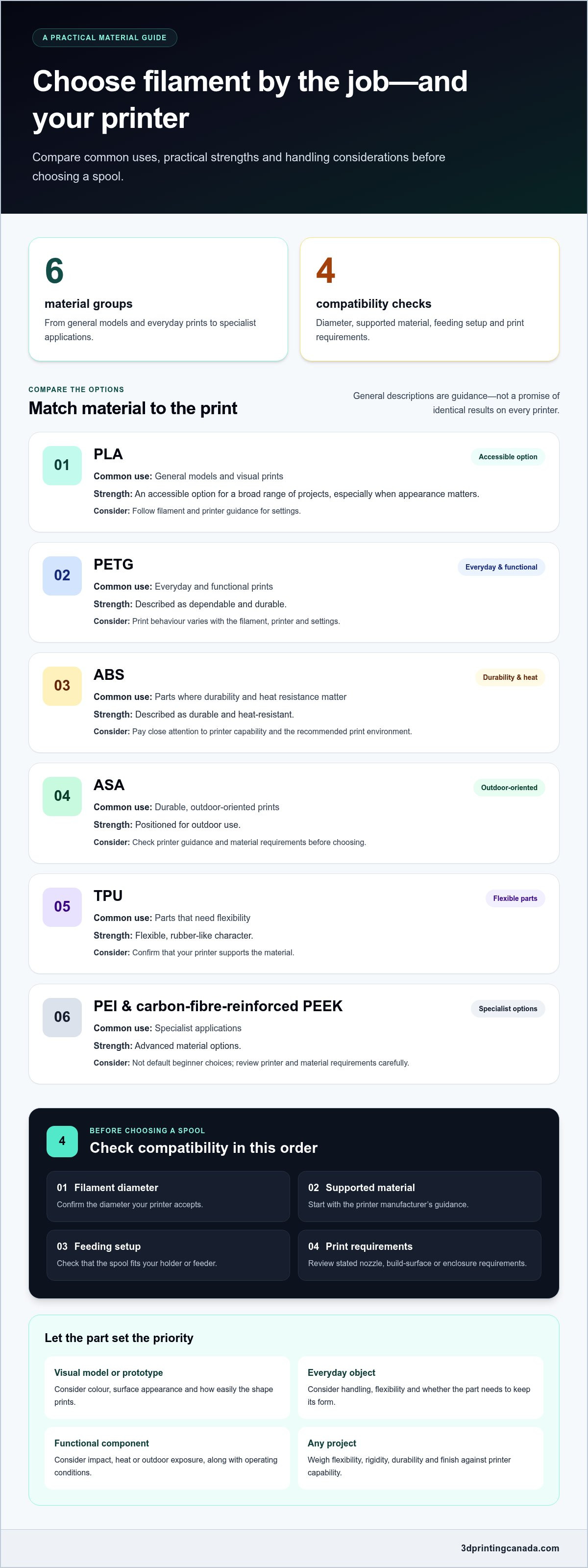
Material names are only a starting point. Compare what each filament is commonly used for, the qualities it offers and what your printer needs to handle it. The right fit depends on both the part and your setup, so treat general material descriptions as guidance rather than a promise of identical results on every printer.
| Material | Common use | Practical strengths | Handling consideration |
|---|---|---|---|
| PLA | General models and visual prints | Accessible option for a broad range of projects | Follow the filament and printer guidance for settings |
| PETG | Everyday and functional prints | Described as dependable and durable | Print behaviour varies with the filament, printer and settings |
| ABS | Parts where durability and heat resistance matter | Described as durable and heat-resistant | Pay close attention to printer capability and the recommended print environment |
| ASA | Durable, outdoor-oriented prints | Positioned for outdoor use | Check printer guidance and material requirements before choosing |
| TPU | Parts that need flexibility | Flexible, rubber-like character | Confirm your printer supports the material |
| PEI and carbon-fibre-reinforced PEEK | Specialist applications | Advanced material options | Not default beginner choices; review printer and material requirements carefully |
PLA and PETG: approachable options for many projects
PLA is an accessible choice for general models, especially when appearance is a priority. One example is Black Standard PLA. PETG is described as dependable and durable, making it an option to consider for projects that need more than a display finish. Red Standard PETG is one example, and a blue PETG option is also available. These descriptions don’t guarantee a particular result: the filament, printer and settings all affect print behaviour.
Think about the part’s purpose before choosing between them. A model intended to sit on a shelf may call for a different balance of finish and function than an object used regularly. As you buy 3d printer filament canada, compare the product description with your project needs and your printer’s requirements.
ABS, ASA and specialist materials: match capability to need
ABS is described as durable and heat-resistant. ASA is positioned for durable, outdoor-oriented prints. Both call for closer attention to printer capability and the stated print environment, so don’t choose them on material descriptions alone. TPU and PEI offer more specialized options, while carbon-fibre-reinforced PEEK is an advanced material rather than a default starting point.
Ready to compare by material? Browse the non-bulk filament selection and use the product descriptions to narrow your shortlist.
Check Printer Compatibility Before You Buy 3D Printer Filament
A filament can suit your project and still be the wrong choice for your printer. Before adding a spool to your cart, check compatibility in this order: diameter, supported material, feeding setup and print requirements. This sequence helps you compare products without relying on the material name alone.
Confirm diameter, printer support and feeding setup
Start with the filament diameter specified for your printer. The product examples here include 1.75 mm filament, but that diameter doesn’t fit every machine. Compare the number in the product description with your printer documentation. A mismatch can prevent proper feeding, even if the material itself is suitable.
Next, check the printer manufacturer’s guidance for supported materials and any limitations. A printer that handles one material may not be suited to every filament type. Then verify the spool and feeding system: review any listed spool-dimension requirements and confirm the spool can feed through your printer’s holder or system. Keep these details together as you shortlist products.
- Diameter: Match the product’s stated filament diameter to the printer specification.
- Material: Confirm the printer supports the filament and review manufacturer-listed limitations.
- Spool and feed: Check spool fit and feeding compatibility in the printer documentation.
Check printing conditions for the material
Once the basic fit checks out, read both the filament product guidance and your printer’s operating instructions. Compare any stated temperature and build-surface requirements with what your setup supports. Follow the recommendations for the specific material and product instead of treating a setting found elsewhere as universal.
Some specialty materials may call for suitable hardware or more controlled printing conditions, such as an enclosure. Check whether the printer maker or filament guidance specifies these needs before choosing a spool. If the requirements don’t match your setup, choose a compatible material rather than assuming a setting adjustment will solve the issue.
Use this workflow each time you shop. If you’re looking to buy 3d printer filament canada, check diameter, material support and print conditions before comparing colour or brand. The product description and printer documentation are the best references for the exact spool and setup you’re considering.
Which Filament Should You Buy? Compare Real Product Examples
There’s no single spool that suits every printer or project. Use these product examples to compare materials and colours, then match your choice to the part you’re making. The product name gives you useful starting details, including material, colour, diameter and spool size, but you still need to check your printer’s requirements.
Everyday models and durable general-purpose prints
- Black - Standard PLA Filament - 1.75mm, 1kg: Consider this standard PLA example for general models where you want black filament. Check that your printer supports the listed diameter and material.
- Red - Standard PETG Filament - 1.75mm, 1kg: This PETG example is described as a dependable all-around option. It may suit shoppers comparing PETG for everyday or functional projects, but results depend on the design, printer and settings.
- Blue - 1.75mm Performance PETG Filament - 1.75mm, 1kg: Compare this PETG option if you’re considering a different colour or product. Review its details alongside your printer’s material guidance before deciding.
These examples make it easier to compare familiar material choices without treating one as the automatic winner. If colour is important, consider how it suits the finished print. If function matters more, focus on the material description and the conditions the part will face.
Functional, outdoor and advanced material examples
- White - Standard ASA Filament - 1.75mm, 1kg: Consider ASA for an outdoor-oriented print, and check that your printer and print environment meet the material’s stated requirements.
- Transparent - Standard ABS Filament - 1.75mm, 1kg: This ABS example is described as heat-resistant. Treat that as a material consideration, not a guarantee that a finished part will suit every temperature or application.
- Natural - Ultem 1010 PEI Filament - 1.75mm, 0.5 kg: This is an advanced engineering material, not a default choice for a first spool. Review printer capability and product guidance carefully.
Before you buy 3d printer filament canada, verify the filament diameter, supported material and spool fit for your setup. Then compare filament options by what your next print needs.
Choose and Buy 3D Printer Filament in Canada With Confidence
A good spool choice comes down to fit. Before checkout, use this five-point check to connect your project requirements to the material and printer. That way, colour and product claims won’t distract from the practical details that matter.
Your five-point buying checklist
- Project: Decide what the printed part needs to do and whether appearance, flexibility, rigidity or durability matters most.
- Material: Choose a filament suited to the part’s intended use and environment. Treat product descriptions as guidance, not a guarantee of performance in every design.
- Printer: Use the printer maker’s documentation to confirm that your machine supports the material, including any stated limitations.
- Diameter and spool: Match the listed filament diameter to your printer specification, then check spool fit and feeding compatibility.
- Print conditions and quantity: Review material-specific requirements for temperature, build surface or enclosure, and consider how much filament your project and printing plans call for.
Before you buy 3d printer filament canada, compare the product description with your printer’s operating guidance. If print speed is part of your decision, explore the high-speed 3D printing trends guide for additional context. A printer’s speed capability doesn’t make every filament a suitable match; material and printer requirements still matter.
Browse the collection and choose your next spool
With your checklist in hand, compare options by material, colour, spool size and brand. Reviewing product details can help you narrow the selection to a spool that fits both your project and your setup. Keep the printer documentation open as you browse, especially if you’re considering a material with specific operating requirements.
Browse 3D printer filament and compare the available options for your next print.
Choose Your Next Spool With Confidence
The best filament for your print is the one that fits the part’s purpose and your printer’s requirements. Start with the finish or function you need, then confirm material support, filament diameter, spool fit and any stated print conditions before checkout.
3D Printing Canada’s filament selection includes standard and performance options, with examples across PLA, PETG, ABS, ASA and advanced PEI materials. Compare product details to narrow your choice, whether you’re making a visual model, an everyday object or a more specialized part. The online selection serves customers across Canada.
If you’re ready to buy 3d printer filament canada, browse the collection and find an option that aligns with your project and setup. Browse 3D printer filament, then compare the product description with your printer guidance before choosing. With the right match, you’ll be ready to bring your next idea to life.
Frequently Asked Questions
Which 3D printer filament is best for beginners?
PLA is a practical starting point for many beginners because it’s an accessible option for general models and visual prints. Choose it only if your printer supports the filament diameter and material, and follow the product and printer guidance for settings. If your project needs flexibility, outdoor use or greater heat resistance, compare other materials rather than assuming PLA will suit every part.
Is 1.75 mm filament compatible with every 3D printer?
No. A 1.75 mm spool is compatible only with printers designed to use that filament diameter. Check your printer documentation and compare its specification with the diameter stated in the product description before ordering. Also verify spool fit and feeding requirements. Product examples may use 1.75 mm filament, but that doesn’t mean every printer accepts it.
Can I use PETG filament in a printer set up for PLA?
Only if the printer supports PETG and your setup meets the material’s stated requirements. A printer that successfully prints PLA isn’t automatically ready for PETG. Check the printer maker’s guidance and the filament product description for operating and build-surface requirements, then use the recommended settings for that specific filament. Don’t assume PLA settings will produce the same results with PETG.
What is the difference between PLA, PETG, ABS and ASA filament?
PLA is an accessible option for general models and visual prints. PETG is described as dependable and durable, making it worth considering for some everyday or functional parts. ABS is described as durable and heat-resistant, while ASA is positioned for durable, outdoor-oriented prints. Each material has different printer and handling requirements, so compare its product guidance with your project needs and printer documentation.
How do I choose filament for outdoor 3D prints?
Start by considering the conditions the finished part will face and look for a material described for outdoor-oriented use. ASA is one option positioned for durable outdoor prints, but the material name alone doesn’t guarantee performance in every design or environment. Confirm that your printer supports ASA, then review the product guidance for the required print conditions before choosing a spool.
Does 3D printer filament need to be kept dry?
Yes, keeping filament dry helps protect its quality. PLA can absorb moisture from the air, which may affect print quality. Store it in a cool, dry place, preferably in a sealed bag with desiccant. Check the manufacturer’s storage guidance for the specific material you’re using, and protect opened spools between print jobs.
How much filament should I buy for a project?
Use your slicer’s material estimate as a starting point, then account for supports, test prints and possible reprints. The amount needed depends on the model, print settings and how many copies you plan to make. Compare that estimate with the spool quantity in the product description, and consider your expected print frequency before selecting a spool size.