
The wrong plastic can turn a useful jig into a static risk. Standard insulating plastics can store surface static charges up to 10,000 V, while an ESD-safe filament for electronics manufacturing jigs is designed to dissipate charge in a controlled way and help protect sensitive components. Choosing the right material means balancing that protection with the strength, heat resistance and fit your jig needs.
If you’re making PCB trays, assembly fixtures or work-holding tools, static control is only one part of the decision. The base polymer and printing process also affect how the finished part performs, so a material label alone doesn’t tell the whole story.
This guide explains why ESD protection matters, how anti-static, static-dissipative and conductive materials differ, and how printing settings can affect resistance. You’ll learn how to compare common filament types with the demands of an electronics manufacturing jig, including component contact, mechanical stress and operating temperature. Considering these factors together helps you choose a material for a functional, reliable tool.
Key Takeaways
- Match the jig’s static-control needs to the right resistance category; “anti-static” and “conductive” don’t mean the same thing.
- Choose a base polymer around the jig’s mechanical demands, contact surfaces and operating conditions, not just its ESD label.
- Print settings and part orientation can influence finished-part performance, so treat extrusion as part of material selection.
- Consider how a jig will hold, guide or protect components when deciding its geometry and intended use.
- Use these criteria to narrow your filament options before moving on to material selection and printing.
Why are ESD-safe materials important?
Electronics manufacturing depends on repeatable handling, from PCB assembly through inspection. A jig can locate a board, hold a component or guide a tool during a specific operation. If the fixture accumulates static charge, it can cause an electrostatic discharge near sensitive electronics. ESD-safe materials help manage this risk in tools that touch or work beside assemblies during routine production.
Consider a PCB assembly jig that holds a board steady during manual work. The fixture needs to position the board without introducing an uncontrolled static discharge. A handling tray serves a different purpose, but also supports safe movement between workstations. Both examples show why ESD protection belongs in the material decision, alongside the part’s shape, fit and mechanical requirements.
Electronics facilities may produce thousands of devices each day, with each station relying on repeatable tools. ESD-safe tooling can include PCB assembly jigs, work-holding tools, handling trays and custom assembly aids. Surface-mount technology also uses pick-and-place tooling, where a fixture helps guide or support components during automated work. The right design depends on what the tool contacts, how it positions parts and where it fits in production.
Material choice affects more than static control. ESD-PETG is used for fixtures, housings and industrial tooling that require durability and ESD protection. PETG-based tooling can suit applications needing a firm structure, such as a tray or locating fixture. Other base materials offer different mechanical properties, so match the material to the task rather than choosing by its ESD label alone. A housing, for example, has different requirements from a flexible component holder.
Consider the full use case before choosing a jig material. Determine whether the part contacts a PCB directly, supports a board during manual assembly or carries components between stations. Then assess the required fit and mechanical load. A PCBA fixture used after surface-mount assembly needs to hold the board for its next operation. A handling tray, by contrast, supports and organizes parts as they move through production. For facilities coordinating internal ESD trays with broader transit and supply chain protection, industrial packaging suppliers like OEM Materials & Supplies provide complementary solutions to safeguard sensitive components.
The practical goal is to protect electronics while keeping each tool fit for its job. ESD-safe materials are relevant wherever jigs, fixtures or trays work near sensitive components. For an electronics manufacturing jig, consider its contact points, role in assembly and mechanical requirements together. This gives you a sound starting point for choosing filament that suits both the production task and the need for controlled static protection.
Differences between anti-static, static dissipative and conductive materials
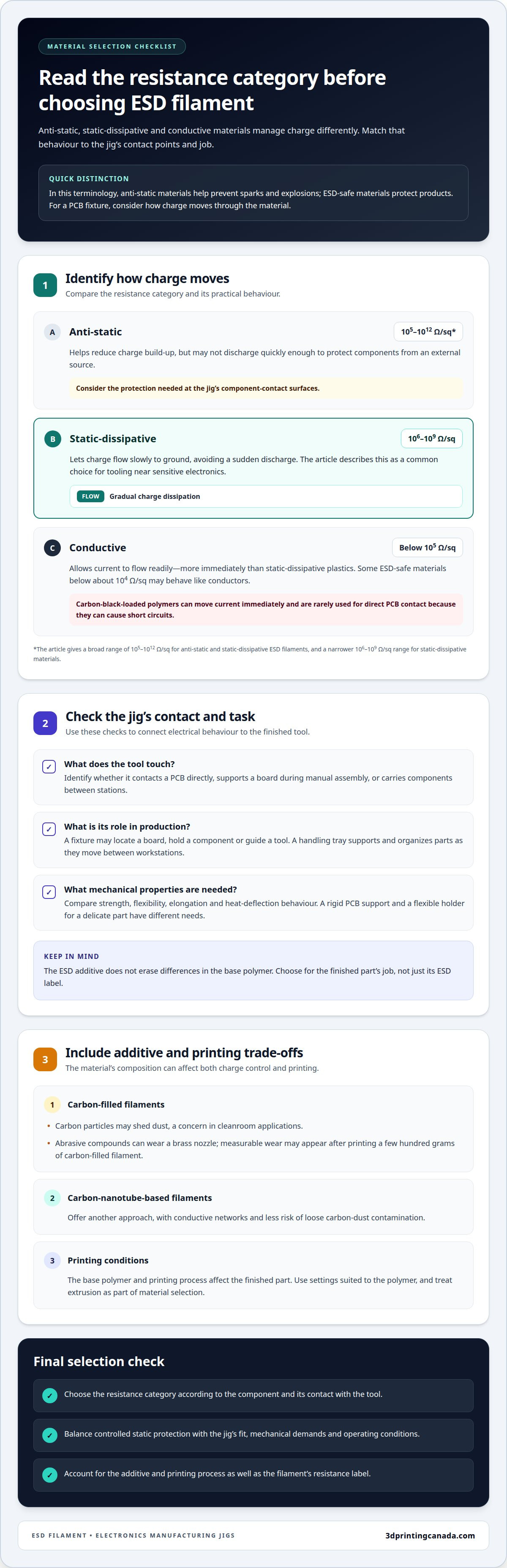
These terms describe different ways materials manage electrical charge. In this terminology, anti-static materials help prevent sparks and explosions, while ESD-safe materials protect products. Insulating materials address electrocution and can hold static charge instead of allowing it to dissipate. For a PCB fixture, the key question is how charge moves through the material and whether that behaviour is suitable for component contact.
Surface resistivity gives a useful comparison. Anti-static and static-dissipative ESD filaments sit within a broad range of 10⁵ to 10¹² Ω/sq. Static-dissipative materials are also described within the narrower range of 10⁶ to 10⁹ Ω/sq. They let charge flow slowly to ground, avoiding a sudden discharge. This controlled movement makes static-dissipative material a common choice for tooling near sensitive electronics.
Conductive materials have surface resistivity below 10⁵ Ω/sq. They allow current to flow readily, unlike static-dissipative plastics. Some ESD-safe materials below about 10⁴ Ω/sq may behave like conductors. Carbon-black-loaded polymers can move current immediately, so they’re rarely used for direct PCB contact because they can cause short circuits. Anti-static material reduces charge build-up, but may not discharge quickly enough to protect components from an external source.
Electrical performance isn’t the only consideration in 3D printing. The base polymer shapes mechanical properties, including strength, flexibility, elongation and heat-deflection behaviour. A rigid fixture that supports a PCB has different needs from a flexible holder that grips a delicate part. The ESD additive doesn’t erase those differences. Compare the material’s electrical behaviour with the demands of the finished part, rather than assuming every ESD filament performs alike.
Traditional carbon-filled filaments can involve practical trade-offs. Carbon particles may shed dust, which is a concern in cleanroom applications, and abrasive compounds can wear a brass nozzle. Measurable nozzle wear may appear after printing a few hundred grams of carbon-filled filament. Carbon nanotube-based filaments offer another approach, with conductive networks and less risk of loose carbon dust contamination. The additive type affects both charge control and printing considerations.
For an electronics jig, choose the resistance category according to the component and its contact with the tool. Static-dissipative material lets charge drain gradually; conductive material allows more immediate flow. That distinction matters for PCB contact surfaces and work-holding features. If printer hardware faults disrupt consistent extrusion during material trials, 3D printer repair services can address equipment issues that affect printing.
How extrusion temperature affects surface resistance
Printing conditions affect how well an ESD material performs, so use settings suited to its polymer. Test the completed jig’s surface resistance with an appropriate meter and compare the reading with the filament’s intended resistance range.
Temperature and Resistivity
Printing temperature is the nozzle setting used to melt and deposit filament, and it matters because correct settings support the material’s intended ESD performance. ESD-safe materials commonly have surface resistivity from 104 to 109 Ω/sq. Appropriate settings can enhance their effects and sometimes increase the degree of ESD protection, but the polymer determines the starting point.
Use the filament maker’s recommended profile as your baseline. Suggested nozzle ranges are 200-220°C for PLA-ESD, 230-250°C for PETG-ESD, 240-260°C for ABS-ESD, and 250-270°C for PA12-ESD. These ranges aren’t interchangeable. A temperature suited to PETG-ESD may not suit ABS-ESD, even when both contain a conductive additive.
Printing Settings and Handling
Consistent settings and careful filament handling help produce a jig whose electrical and mechanical properties suit its task. ESD filament can absorb moisture, so dry it for 4-8 hours to address moisture-related defects. Print at 30-50 mm/s as a recommended starting range, then use the filament’s material-specific profile for nozzle and bed temperatures.
Bed temperature also varies by polymer: suggested ranges are 50-60°C for PLA-ESD, 70-90°C for PA12-ESD, and 80-90°C for ABS-ESD. Keep the material dry between printing and storage, and avoid mixing profile values across polymers. Poor extrusion can affect part quality, so a finished jig should be assessed as printed, not judged by filament type alone.
Layer Orientation and Surface Checks
Layer orientation matters because a jig’s printed structure and its critical contact faces need to work together. For consistent conductivity, orient critical PCB locator surfaces parallel to the print bed. This aligns the key locating geometry with the layers and can support consistent performance where the board rests against the jig.
To assess ESD performance, measure the finished part’s surface resistance with an appropriate meter and compare the reading with the material’s target. Check functional contact and locator surfaces, since they interact directly with sensitive components. Record the material and print settings alongside the results so a later jig can be made using the same process.
Material Choice for Demanding Tooling
ESD-PC combines strength, heat resistance and electrostatic protection, making it an option for tooling exposed to mechanical stress and sensitive environments. Its properties may suit demanding applications, but temperature control during printing still matters. Choose the polymer based on the jig’s heat exposure and load, then print within the material’s recommended range to support its structural role and ESD function.
ESD filament and controlled static dissipation
ESD filament combines a polymer base with an additive that manages charge on a printed part’s surface. For custom electronics tooling, both the base material and the charge-control approach affect what the finished component can do.
Static-Dissipative Filament Compositions
Static-dissipative filament pairs a base polymer with an additive that helps charges move through the material in a controlled way. Common bases include ABS, PLA, PET-G and PC, while carbon black and carbon nanotubes are common additives. The polymer influences the part’s mechanical properties; the additive supports its ESD function. Together, they determine whether a filament suits a particular jig or fixture.
Some filaments use carbon nanotube networks or other non-sloughing conductive additives in PETG, ABS and TPU matrix polymers. The additive type matters when loose carbon dust is a concern, such as in cleanroom work. Composition also helps explain why ESD filaments can behave differently during printing and in use. Match the base polymer and intended charge-control regime to the tool’s contact points and mechanical role.
Static-dissipative material allows charges to flow slowly to ground rather than releasing them suddenly. This controlled path can suit tooling designed for sensitive components, where immediate current flow is not the goal. Conductive material is different: carbon-black-loaded polymers can allow immediate current flow and are rarely used for direct PCB contact because of short-circuit risk. Choose the regime based on the component and how the printed surface interacts with it.
FDM Filament Applications
FDM creates parts by depositing filament in layers, making it useful for custom tooling shapes. Static-dissipative filaments can be used for PCB assembly holding trays, wave-soldering carrier frames, testing jigs and benchtop organizers. Each application has a distinct purpose: a carrier supports a board during processing, while an organizer keeps tools or components arranged at a workstation.
For a test jig, consider the points that locate or touch the board, then choose a suitable base polymer and ESD regime. For example, PETG-ESD can be used for PCB assembly holding trays and testing jigs. A TPU-based part may better suit a flexible component-gripping feature. Let the required shape and mechanical behaviour guide the polymer choice, while controlled dissipation manages charge.
Apply the same reasoning to other custom FDM tools. A benchtop organizer may need different mechanical properties from a carrier frame, even if both operate near electronics. Choose the filament composition for the actual task, then design the printed surface and contact areas around the parts they will handle. This ties material selection to the tool’s function instead of treating all ESD filaments as interchangeable.
Choosing filament for electronics manufacturing jigs
Choose filament by matching ESD performance to the jig’s operating conditions. An ESD-safe filament for electronics manufacturing jigs must also suit the tool’s contact points, mechanical load, temperature and required shape. A PCB locator near sensitive components has different requirements from a flexible holder or a tray exposed to heat. Weigh these factors together rather than choosing by the ESD label alone.
Start with the task. Standard PLA, PETG, TPU, and ABS are insulating materials with surface resistivity above 1011 Ω/sq, so standard versions aren’t substitutes for ESD grades. ESD-PLA is described as easy to print for prototypes and fixtures. Its limitation matters: PLA-ESD softens above 60°C, making it less suitable for hotter applications.
For a stronger or warmer-working tool, compare the base polymer’s limits. PETG-ESD handles temperatures to around 80°C, while ABS-ESD has a heat deflection temperature of up to 85-95°C. ABS-ESD suits functional tooling where impact resistance and stability matter. ESD-PC is another option when high strength and heat resistance are priorities, especially for tooling subject to mechanical stress.
- Prototype or light-duty fixture: Consider ESD-PLA when ease of printing fits the application and the tool stays below its heat limitation.
- General-purpose tray: Consider PETG-ESD where its temperature range, dimensional accuracy, and chemical resistance suit the work area.
- Impact-resistant tooling: Consider ABS-ESD for functional parts that need impact resistance and stability.
- Flexible contact feature: TPU-ESD at Shore 95A can suit flexible grips or protective features.
- Extreme operating environment: ESD-Ultem 1010 offers high heat deflection, chemical resistance, and inherent flame retardancy.
Next, consider production volume and contact points. A tray carrying boards through a process may prioritize stable support and repeatable placement. A jig that touches a component needs material and geometry suited to that contact. For cleanroom use, carbon-nanotube-based ESD filament is recommended over carbon-powder formulations to reduce loose carbon dust contamination. Choose the additive for the application, not just the resistance rating.
Finally, account for printing and equipment. Carbon-filled ESD filament can wear a brass nozzle after a few hundred grams, so nozzle material matters during repeated production. Choosing an ESD-safe filament for electronics manufacturing jigs means balancing ESD behaviour, heat limits, strength, and printing demands against the tool’s actual use. Explore filament options for your manufacturing application.
3D Printing Canada: Filaments
3D Printing Canada offers filaments for makers and professionals choosing material for functional prints. If your electronics jig needs ESD properties, use the material criteria in this guide to narrow your options, including the base polymer, resistance behaviour, temperature demands, and mechanical load. The right choice depends on how the printed part will be used, not just its label.
Turn to 3D Printing Canada when you’re ready to explore filament options for your project or need support with a printer issue affecting your work. The available range also includes Bambu Lab accessories and 3D printer repair services.
Contact 3D Printing Canada to discuss your filament needs.
Put your jig requirements into action
Before your next design, turn the production task into a clear material brief. Note which surfaces contact components, how the jig supports or guides them, and the conditions it will face in use. This practical record connects the choice of an ESD-safe filament for electronics manufacturing jigs to the finished tool’s real job, rather than treating material selection as an isolated printing decision.
Bring those requirements into your next filament decision, especially if you’re adapting an existing jig or developing a new fixture for your workflow. A focused discussion can help you consider the material alongside your printing setup and intended application. Contact 3D Printing Canada today to discuss your filament needs and keep your next electronics tooling project moving.
With a clearly defined use case, you can approach the next design step with greater clarity and confidence.
Frequently Asked Questions
Why Choose ESD-Safe Filaments?
Choose ESD-safe filament when a printed tool will operate near components vulnerable to electrostatic discharge. A static event can damage a component without leaving obvious physical marks, so prevention is part of fixture design. For example, a board-loading aid used beside exposed electronic parts has different material requirements from a display stand. Select filament based on the tool’s contact with electronics and its role in production.
How does 3D printing improve cost efficiency for static-safe production?
3D printing can make custom tooling more economical by producing a jig for a specific station without conventional tooling setups. Additive manufacturing can typically reduce material and labour costs for electronics-manufacturing jigs and fixtures by more than 90%, and can shorten lead times from weeks to hours. These advantages are most relevant when a production team needs a specialized fixture, replacement part, or design revision.
What Can You Print with ESD Filament?
ESD filament can be used to make custom tools for component handling, assembly, testing and automated production. Examples include pick-and-place end-effectors, burn-in test sockets, thermal-chamber trays and automated testing fixtures. Similar static-safe fixtures and organizers are also practical in computer servicing workshops like stealthpctechnology.com, where technicians handle delicate PC and Mac logic boards. A small benchtop organizer can also keep tools in place near electronics. Choose the application first, then consider which surfaces touch components and what mechanical demands the printed part must meet.
What is the lifespan of an ESD-safe 3D printed component?
An ESD-safe printed component has no single fixed lifespan; service life depends on how it is used. Repeated clamping, abrasion at locating points, heat exposure and contact with cleaning solvents can affect a fixture in different ways. A lightly used organizer and a production jig handled throughout each shift face different wear. Inspect contact surfaces and fit during routine tooling maintenance, and replace the part when wear affects its function.
Which 3D printing filaments are ESD-safe for electronics manufacturing jigs?
ESD-PLA, ESD-PETG, ESD-ABS, ESD-PC, ESD-TPU, and ESD-PA12 are examples of filament grades used for ESD applications. Their base polymers give them different properties, so select by the jig’s job. For instance, a flexible gripper calls for different material behaviour than a rigid locator. Look for an ESD grade rather than assuming standard PLA, PETG, ABS, or TPU provides static control.
What surface resistivity or resistance range is required for ESD-safe 3D-printed fixtures?
ESD-safe materials commonly have surface resistivity from 104 to 109 Ω/sq, while static-dissipative materials are described within 106 to 109 Ω/sq. The suitable range depends on the fixture’s intended charge-control behaviour and component contact. A conductive material below 105 Ω/sq behaves differently from a dissipative one, so don’t treat the categories as interchangeable.
How do ESD-safe PLA, PETG, ABS, ASA, and nylon filaments compare for manufacturing jigs?
ESD-PLA is suited to prototypes and fixtures where its heat limit is acceptable. PETG-ESD offers impact strength and chemical resistance to isopropyl alcohol circuit-board cleaners. ABS-ESD is used for functional tooling requiring impact resistance and stability, while PA12-ESD is a nylon option. ASA grades should be assessed using their specific ESD and mechanical properties, since formulations can differ.
What are the mechanical strength, heat resistance, and chemical resistance of ESD-safe filaments?
Those properties vary with the base polymer and filament formulation. For reference, PLA-ESD softens above 60°C, PETG-ESD handles temperatures to around 80°C, and ABS-ESD has a heat deflection temperature up to 85-95°C. PETG-ESD also offers impact strength and resistance to isopropyl alcohol board cleaners. Match these traits to the jig’s load, operating temperature, and cleaning routine.