
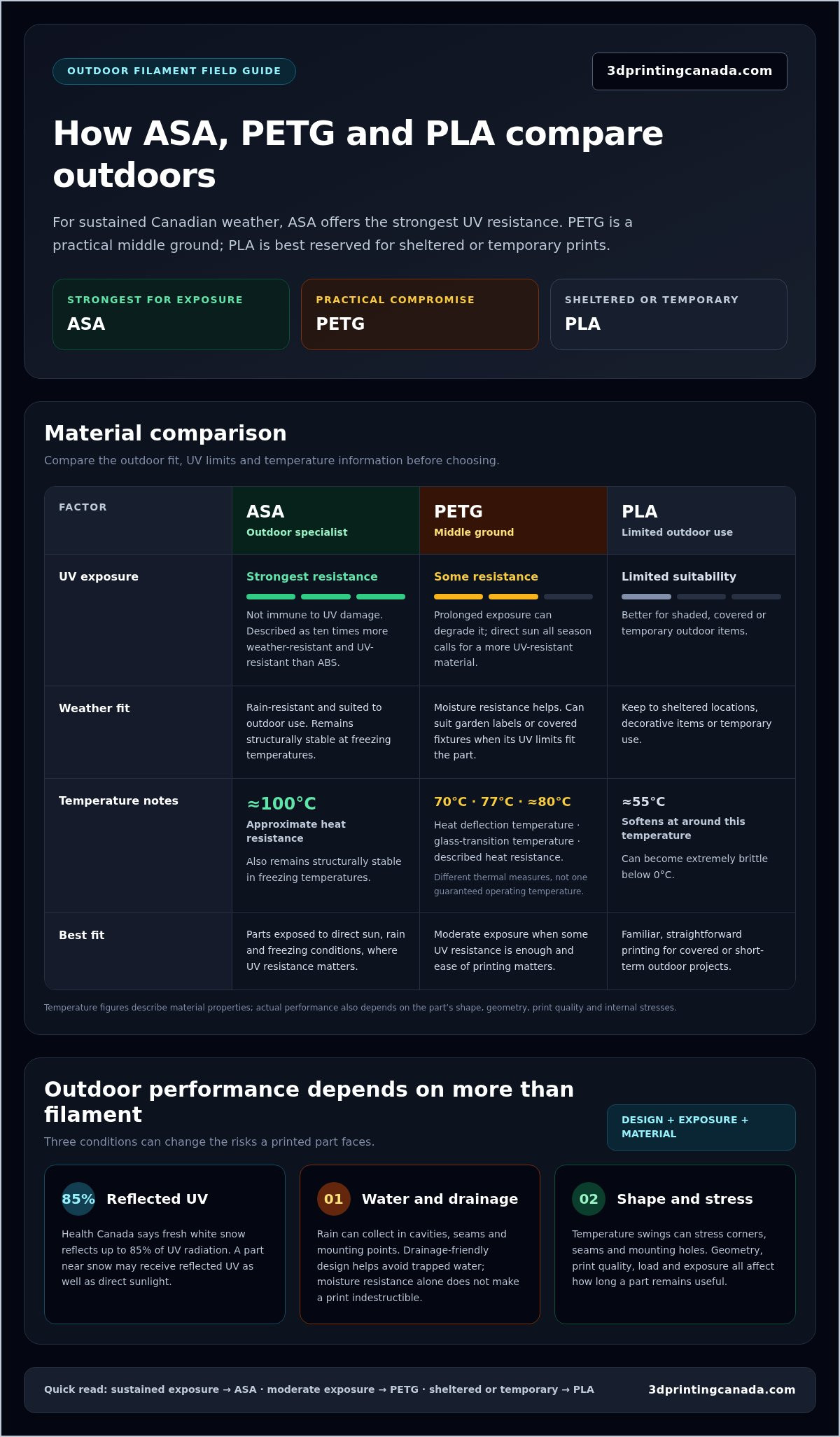
PLA can work outdoors, but it’s the weakest choice of the three for sustained Canadian weather. For a UV-resistant filament for outdoor Canadian weather, ASA is the strongest option; PETG offers a practical middle ground, while PLA is best kept to shaded, covered or temporary uses. PLA softens at around 55°C and can become extremely brittle below 0°C, so sunlight and winter cold can both put a printed part at risk.
PLA is familiar and straightforward to print, so it can be tempting for outdoor projects. But sunlight is only one cause of failure: moisture, temperature swings, part shape and print settings also affect how long a part remains useful. Choose a material by balancing weather resistance with the demands of the part.
This guide compares ASA, PETG and PLA for UV exposure, rain and changing temperatures in Canada. Learn where each material fits, what can cause a part to fade, warp or crack, and how to make a more informed choice for your outdoor print.
Key Takeaways
- Match filament to the part’s exposure: ASA suits sustained outdoor use, PETG can be a practical compromise, and PLA is better for sheltered or temporary prints.
- ASA resists UV damage better than PETG, but it isn’t immune. Part design and exposure still matter.
- Expect prolonged sunlight to affect PETG over time; consider how much direct sun the part will receive before choosing it.
- Don’t judge Canadian UV exposure by the forecast alone: according to Health Canada, fresh white snow reflects up to 85% of UV radiation.
- Think beyond sunlight when planning a print’s outdoor use. Moisture, temperature changes and the part’s design can all contribute to failure.
PETG weather and moisture resistance
PETG can suit outdoor prints that need more heat tolerance than PLA, without ASA’s more demanding printing behaviour. It offers some UV resistance, but prolonged exposure can degrade it. PETG may work for a garden label or covered fixture; for a part in direct sun all season, choose a more UV-resistant material.
How do ASA, PETG, polycarbonate and UV-resistant PLA compare outdoors? ASA offers the strongest UV resistance among these options, while polycarbonate with UV stabilizers also resists UV-related degradation. PETG provides some UV resistance, and PLA is better suited to limited, sheltered or temporary use.
| Filament | UV exposure | Heat and weather fit |
|---|---|---|
| ASA | High resistance; not immune to damage | Rain-resistant and suited to outdoor use |
| PETG | Some resistance; prolonged exposure can degrade it | Heat deflection temperature: 70°C |
| Polycarbonate | UV stabilizers help prevent UV-related degradation | Consider for demanding outdoor parts |
| PLA | Limited outdoor suitability | Better for sheltered or temporary items |
For PETG, distinguish its heat ratings before designing a part. Its heat deflection temperature is 70°C, and its glass-transition temperature is 77°C. PETG is also described as having heat resistance of approximately 80°C. These figures describe different thermal measures, not a single guaranteed operating temperature. A dark print in direct summer sun can warm beyond the surrounding air, so avoid relying on a thin PETG bracket near a heat source.
Moisture resistance helps, but it doesn’t make a print indestructible. Rain can collect in cavities, seams and mounting points. Design parts with drainage and avoid thin sections that concentrate stress. In Canada, snow adds another exposure factor: according to Health Canada, fresh white snow reflects up to 85% of UV radiation. A part near snowy ground may receive reflected UV as well as direct sunlight.
- Choose PETG for moderate exposure when its UV limits suit the part.
- Use ASA for longer direct-sun exposure or greater temperature demands.
- Keep PLA for covered locations, decorative items or temporary use.
Before choosing filament, consider the part’s location, load and expected heat. PETG is a practical middle ground, but it is not a substitute for ASA in every outdoor setting. If the print must carry a load through changing seasons, prioritize UV resistance and structural design over ease of printing.
PETG can be an alternative to ASA when ease of printing matters and some UV resistance is enough. It suits parts for which ASA’s stronger UV performance is not essential, but exposure over time still matters. This is a trade-off, not a claim that the materials perform equally outdoors.
ASA is more resistant than ABS or PETG to UV effects, colour fading, warping and cracking. PETG’s UV resistance has limits: prolonged exposure can degrade it. For a part that will remain outdoors, weigh ease of printing against the risk of fading or material degradation. Choose ASA when those effects matter more than printability; PETG remains an option when practical printing and some UV resistance are sufficient.
ASA UV resistance and outdoor durability
ASA is a strong choice for outdoor prints exposed to direct sun, rain and freezing conditions. It remains structurally stable at freezing temperatures, although freeze-thaw performance also depends on part design and print quality.
ASA’s key advantage is UV resistance. It is described as ten times more weather-resistant and UV-resistant than ABS. Its acrylate rubber phase lacks the carbon-carbon double bonds found in ABS’s butadiene rubber phase, making ASA less susceptible to UV-driven degradation. In practical terms, this helps reduce sun-related fading, warping and cracking compared with ABS or PETG.
ASA also handles heat better than PLA and PETG. Its heat resistance is approximately 100°C, making it a stronger candidate for parts that may warm in direct sunlight. That figure is a material property, not a guarantee that every printed shape will perform at that temperature. A thin clip and a thick enclosure respond differently because their geometry and internal stresses differ.
Rain is another factor in Canadian weather. ASA resists moisture from rain and other water sources, making it suitable for applications such as outdoor housings and garden fixtures. Water resistance does not prevent mechanical failure, though. Design drainage paths, avoid water-trapping pockets and orient layer lines to support the forces the part will face.
For freeze-thaw conditions, prioritize a robust print rather than relying on filament choice alone. Repeated temperature changes can stress corners, seams and mounting holes. Use rounded transitions where possible, reinforce load-bearing areas and keep fasteners away from edges. These choices help a part manage stress as its temperature changes.
- Direct sun: ASA is better suited than PETG or PLA for prolonged UV exposure.
- Outdoor moisture: Its rain resistance supports exposed uses, especially with drainage-friendly design.
- Cold conditions: ASA remains structurally stable in freezing temperatures.
- Heat: Its approximate 100°C heat resistance gives it an advantage for warm outdoor settings.
ASA isn’t immune to UV damage, and a part’s lifespan depends on exposure, geometry, print quality and the forces it carries. Choose it for outdoor parts where colour retention and strength matter, then design for the actual mounting and load conditions. For a project that calls for this material, explore ASA and other filament options.
Outdoor lifespan by filament and conditions
An outdoor print’s lifespan depends on its material, location, geometry and purpose. A decorative cover and a loaded bracket face different demands, even when mounted side by side. Choose for the toughest condition the part will encounter. A UV-resistant filament for outdoor Canadian weather should suit the actual exposure, not just the intended colour or ease of printing.
Canadian UV exposure risk is highest from April to September, and risk is highest when the UV index is 3 or higher. Bright conditions with snow on the ground can result in almost twice as much UV exposure, even at a low index. A part near a snowy walkway can receive reflected sunlight as well as direct exposure.
ASA suits parts exposed to direct sun and changing temperatures. PETG offers some UV resistance, but prolonged exposure can degrade it. Limit PLA to sheltered or temporary uses. Polycarbonate with UV stabilizers can resist UV-related degradation, while TPU is a poor fit for applications with extended UV exposure.
- Direct sun: Consider ASA or UV-stabilized polycarbonate for prolonged exposure.
- Partial shelter: PETG may suit a part receiving less direct sunlight.
- Temporary use: Reserve PLA for replaceable, sheltered items.
- Flexible parts: Avoid TPU for long-term exposure to sunlight.
UV damage can appear as fading, yellowing or reduced toughness. Prolonged exposure can make nylon slightly brittle and change its colour. TPU can also become brittle or discoloured and lose physical properties. Inspect exposed parts for cracks, colour changes and loose fasteners, especially after seasonal weather shifts.
What Canadian outdoor conditions should you consider when choosing UV-resistant filament? Account for direct sunlight, seasonal UV exposure, snow reflection, rain, freezing temperatures and summer heat. Also consider shade, mounting direction, structural load and the consequences of failure.
What printer settings and ventilation precautions are needed when printing ASA filament? Use an extruder temperature of 240±10 °C and a bed temperature of 95±10 °C. Provide room ventilation, use an enclosure where appropriate, and follow the filament maker’s handling instructions.
Print quality and design also affect durability. Layer bonding, wall thickness and sharp corners influence how a part handles stress. For a bracket, orient layers to support its load and reinforce fastener holes. For a cover, add drainage and avoid thin edges. Choosing a UV-resistant filament for outdoor Canadian weather is only one part of planning a durable print; match the design and print setup to the location as well.
PLA UV resistance and outdoor limitations
PLA is best for sheltered, temporary outdoor items, not parts that must carry a critical load. A covered plant label or seasonal decoration may suit it; an exposed bracket holding equipment does not. Sunlight, rain and temperature changes can combine, so assess the whole setting rather than UV resistance alone.
Heat is a key weakness. PLA softens at around 55°C, and its glass-transition temperature is around 57°C. Direct sun can heat a dark print enough to deform it, especially if it’s thin or under load. A small clip attached to a sun-facing fence may bend even when the surrounding air feels comfortable.
Cold creates a different risk. PLA tends to become extremely brittle below 0°C. A garden ornament may survive in a sheltered spot, but a thin tab or snap-fit feature can crack when handled in winter. Avoid relying on PLA for outdoor components that must flex or withstand impact in freezing conditions.
UV exposure can also affect colour and material performance over time. A covered porch reduces direct exposure compared with an open fence, but reflected light still matters. In Canada, fresh snow can reflect up to 85% of UV radiation, according to Health Canada. A print beside a snowy path may receive reflected exposure despite partial shade.
- Use PLA for: temporary labels, sheltered decorations and covered garden markers.
- Avoid PLA for: structural parts, outdoor clips under stress and components exposed to winter impacts.
- Reduce heat exposure: place prints out of direct sun and away from hot surfaces.
- Improve the design: use rounded corners and thicker sections where handling could create stress.
Before printing, assess the part’s location and purpose. A decorative number plate under an awning gets less exposure than one fixed to an open mailbox. Check whether sunlight reaches it throughout the day, whether rain can collect in openings and whether someone will handle it in cold weather. Each condition changes the risk.
Treat an outdoor PLA print as a limited-use part from the start. Make it replaceable, keep it sheltered and avoid designs where a crack could cause damage. If it must retain strength through direct sun, summer heat and Canadian winter cold, choose a more weather-resistant material. PLA’s ease of printing does not remove its temperature limits.
PLA is therefore best limited to temporary or light outdoor applications in shaded or covered locations, not structurally critical components.
Weather-related causes of printed-part failure
Outdoor prints usually fail when several stresses act together. Sunlight can weaken or discolour a material, while rain, heat and cold add further demands. For example, a bracket on an exposed fence faces several potential failure mechanisms at once. UV-resistant filament helps, but cannot compensate for poor geometry or weak layer bonding.
UV damage varies by polymer. ASA resists weathering well, but it isn’t immune to UV damage. Prolonged exposure can degrade PETG. Nylon can become yellowish and slightly brittle, while TPU may discolour, turn brittle and lose physical properties. Raw ABS is vulnerable to ultraviolet degradation, though additives in 3D-printing ABS formulas improve its UV resistance.
Moisture and temperature changes can reveal design weaknesses. Rain entering a closed cavity may remain trapped, while temperature swings can stress corners and joints. ASA resists moisture from rain and other water sources, but drainage still matters. Add openings where water could collect and avoid narrow seams that hold moisture against the print.
How should 3D printed parts be designed to reduce cracking and failure outdoors? Round sharp corners, reinforce screw holes, and orient layer lines to support the part’s load. Add drainage, avoid thin stress points, and choose a filament suited to the part’s sunlight and temperature exposure.
- Cracks at corners: Replace sharp internal angles with rounded transitions that spread stress.
- Splits near fasteners: Add material around mounting holes and keep them away from edges.
- Layer separation: Orient the print so its layers support the main force, rather than pulling apart.
- Water damage: Design covers and housings to shed rain instead of trapping it.
- Fading or brittleness: Select a UV-suited filament for the part’s actual exposure.
Signs of damage can help identify the cause. Fading or yellowing points to changes from exposure; a crack beside a screw suggests concentrated stress. A split along layer lines may indicate that print orientation or bonding does not support the load. Inspect outdoor parts after seasonal changes, especially around fasteners, corners and exposed edges.
Start with the consequence of failure. A decorative cover can tolerate cosmetic change more readily than a support holding equipment. For a load-bearing part, prioritize material suitability, generous transitions and layer orientation. If your printer produces inconsistent layers or weak bonding, explore 3D printer repair services to address possible hardware issues.
3D Printing Canada: 3D Printer Repair Services
3D Printing Canada offers 3D Printer Repair Services for equipment issues that can affect outdoor-print quality. If ASA parts show inconsistent layers, weak bonding or uneven extrusion, printer problems may be contributing to the failure. Repair support can help address hardware issues, so your machine can produce more consistent prints.
Material choice and part design still matter: a well-maintained printer won’t make PLA suitable for a sun-exposed structural component. But reliable printing helps you put your chosen filament and design into practice. For printer repair support, contact 3D Printing Canada.
Turn your outdoor-print plan into a reliable build
Treat the first version as a way to test the design in its intended setting. Note how it mounts, what loads it carries and where water or dirt could collect. Use those observations to guide adjustments, such as reinforcing a joint or changing the part’s orientation.
Choosing a UV-resistant filament for outdoor Canadian weather is one part of planning a dependable result. The printer’s condition and the way you prepare each job also shape the finished part. 3D Printing Canada offers Bambu Lab Accessories, 3D Printer Repair Services and 3D printers to support different 3D printing needs.
Ready to plan your next project or address a printer issue? Contact 3D Printing Canada. Keep refining your design, and let each print move you closer to an outdoor part that works for its intended purpose.
Frequently Asked Questions
How UV resistant is PLA?
PLA has limited suitability for prolonged outdoor UV exposure. It can work for a replaceable decoration under a covered porch, where direct sunlight is reduced and the part carries no load. For a sun-facing sign or outdoor fitting, choose a more weather-resistant material. Consider heat and winter handling too: UV is only one part of the exposure that can affect a printed part.
What is the best 3D printing filament for outdoor use?
ASA is a strong general choice for outdoor parts exposed to sunlight and changing weather. UV-stabilized polycarbonate may also suit a large cover. Choose for the part’s purpose: a decorative cover has different demands from a bracket supporting equipment. Consider direct exposure, moisture, temperature changes and the consequences of failure before selecting filament.
How long does PLA last outside?
There is no single outdoor lifespan for every PLA print. A sheltered decorative part can remain useful longer than a thin component exposed to direct sun, heat and winter handling. Colour, shape, print quality and mechanical load all affect its condition. Check for bending, cracks or changes that affect its purpose, and replace it if it can no longer do its job.
Is PETG good for outdoor use?
PETG can suit outdoor parts with moderate exposure, such as a removable garden marker under an overhang. It offers some UV resistance, but prolonged sunlight can degrade it. For longer exposure, choose ASA. If you use PETG, design the part to let rain drain away, do not rely on a damaged or weakened print, and inspect it for changes that affect its function.
How can outdoor 3D prints be protected with coatings, paint, or UV-resistant clear finishes?
Choose paint or a clear finish labelled for exterior use and UV exposure, then follow its preparation and application instructions. Test the coating on a sample print first to check adhesion and whether the finish suits the part’s colour and texture. Coat exposed surfaces evenly, including the edges. A coating can add a protective surface, but it does not change the filament’s heat limits or make an unsuitable part safe for critical use.