
What if the biggest bottleneck in your product development cycle isn't your design team, but your shipping carrier? In 2026, waiting weeks for a third-party service bureau to return a plastic part is no longer just an inconvenience; it's a strategic liability. Modern 3D printing for prototyping Canada has evolved into a high-speed, AI-driven powerhouse that allows you to iterate in hours, not days. You've likely felt the sting of high service fees and the nagging worry about IP security when sending your sensitive files to external labs.
We believe you should have total control over your creative process. This guide will show you exactly how to build an in-house prototyping lab that accelerates your design cycle and slashes your cost-per-part using the latest 2026 technology. We'll walk you through top-performing hardware like the Bambu Lab X2D and the Creality K2 series, compare the newest high-flow filaments, and help you organize a workflow that keeps your intellectual property right where it belongs. It's time to stop waiting for deliveries and start building your future.
Key Takeaways
- Identify how to close the "iteration gap" by calculating the ROI of moving from outsourced services to an efficient in-house prototyping lab.
- Distinguish between FDM and resin technologies to ensure your hardware choice matches your specific needs for mechanical durability or visual precision.
- Learn why reliability features like automatic bed levelling and vibration compensation are non-negotiable for professional 3D printing for prototyping Canada.
- Explore engineering-grade filaments beyond standard PLA, including carbon fibre-reinforced options for creating high-strength functional jigs and fixtures.
- Understand how sourcing from a local Canadian partner ensures access to the repair services and spare parts needed to eliminate hardware downtime.
Why In-House 3D Printing for Prototyping is the Smartest Move for Canadian Innovators
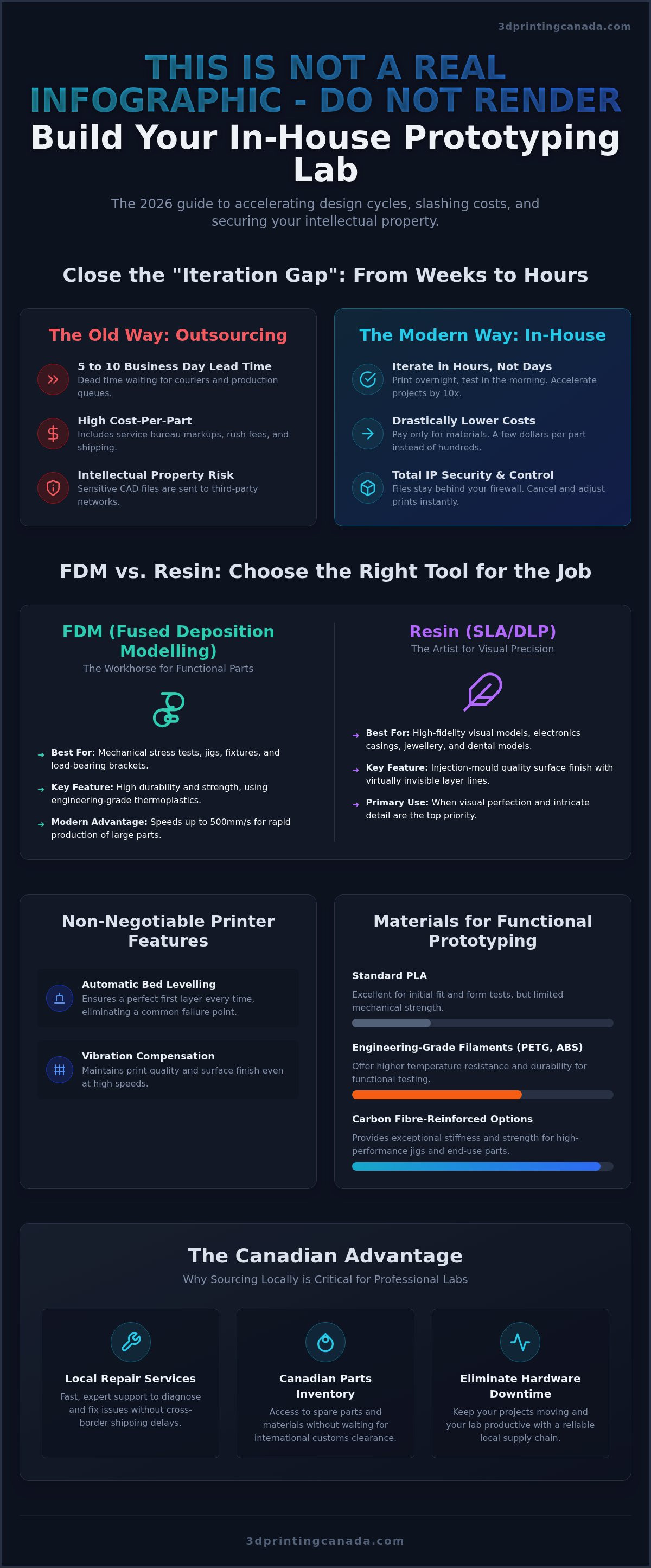
Waiting for a courier shouldn't be the longest part of your design cycle. When you rely on third-party service bureaus, you're often stuck in the "Iteration Gap." This is the dead time between sending a CAD file and holding a physical part. For many Canadian startups, this gap can last five to ten business days. In a competitive market, that's time you can't afford to lose. By bringing 3D printing for prototyping Canada in-house, you turn those weeks into hours.
Look at the math. The cost of just five or six high-quality outsourced prints often equals the price of a professional-grade desktop 3D printer. When you invest in 3D printing for prototyping Canada, you gain the freedom to test "failed" designs immediately. You don't have to worry about paying service-bureau overhead for a part you know might need a revision. Consider these benefits of the transition:
- Hardware Amortization: Professional units often pay for themselves within the first few months of active development.
- Reduced Markup: You eliminate the 300% markup typically charged by external providers.
- Zero Shipping Fees: You stop paying for overnight couriers and potential customs duties.
Speed vs. Cost: The True Price of Outsourcing
Outsourcing often comes with hidden fees that don't show up on the initial quote. Between cross-border shipping delays and "rush" surcharges to get a part within 48 hours, the bills add up fast. In-house rapid prototyping techniques allow you to start a print at 5:00 PM and have a functional part ready for testing by morning. This shift can shorten a typical six-month project to just six weeks. It also changes your team's mindset. When the cost of failure is just a few dollars of filament, your designers are more likely to take risks and find the breakthrough that defines your product. Failing fast is a luxury that's only affordable when you own the tools.
IP Security and Design Control
Keeping your sensitive CAD files behind your own firewall is a massive advantage. For aerospace or medical startups in Canada, intellectual property is the most valuable asset. Sending files to external labs increases the risk of data breaches or accidental leaks. When you manage your own lab, your data stays local. You also gain complete control over the production process. If you notice a minor flaw during the first few layers of a print, you can cancel it, adjust the design, and restart instantly. You aren't stuck waiting for an external provider to realize there's an issue and call you back. You become your own service bureau, with the agility to pivot exactly when you need to.
FDM vs. Resin: Choosing the Right Technology for Your Prototype
Success in 3D printing for prototyping Canada starts with a simple question: what is this part supposed to do? If you need a bracket to survive a stress test, your hardware needs are vastly different than if you're presenting a sleek consumer product to a board of directors. Most professional labs categorize their needs into fit, form, or function. Fused Deposition Modelling (FDM) and resin-based systems like SLA or DLP each own a specific corner of this triangle. Choosing the wrong one doesn't just waste filament; it stalls your development cycle.
FDM for Functional and Mechanical Testing
FDM is the undisputed workhorse for durable prototyping. It uses spools of thermoplastic filament, making it ideal for load-bearing parts, jigs, and fixtures. If your prototype needs to be drilled, sanded, or bolted into an assembly, FDM is your best bet. The technology has leaped forward recently. Modern systems now reach speeds of 500mm/s, allowing you to produce mechanical parts in a fraction of the time. You can learn more about these advancements in our guide to the latest fast 3D printer Canada trends. For engineering teams, the low maintenance and wide material variety make FDM the primary choice for daily operations.
Resin for High-Precision Visual Models
When "smooth surface finish" is your top priority, resin is the answer. These printers use a liquid photopolymer cured by light to create layers so thin they're virtually invisible to the naked eye. This produces injection-mould quality parts right off the build plate. It's the standard for jewellery, dental models, and high-fidelity electronics casings. However, resin comes with a trade-off. You'll need to manage post-processing steps like washing parts in isopropyl alcohol and curing them under UV light. It's a messier process than FDM, but for visual presentations where every micron counts, it's indispensable.
Many Canadian shops no longer choose just one. They build hybrid labs. This approach allows you to use FDM for the internal mechanical structure and resin for the outer "hero" components. While academic researchers advance the field of metal additive manufacturing for specialized industries, the combination of FDM and resin remains the gold standard for most commercial 3D printing for prototyping Canada. If you're ready to upgrade your shop's capabilities, you can browse our selection of professional hardware to find the right fit for your next project.
Key Features to Prioritize in a Prototyping-Grade 3D Printer
Don't get distracted by flashy touchscreens or RGB lighting. In a professional setting, the most important feature is reliability. If your printer can't achieve consistent first-layer adhesion, it's just an expensive paperweight. For 3D printing for prototyping Canada, you need hardware that manages the variables for you. Automatic bed levelling and active vibration compensation are no longer optional extras; they're the foundation of high-speed accuracy. These features allow you to print complex geometries without worrying about ghosting or ringing artifacts that could ruin a tolerance test.
This focus on precision aligns with the broader Advanced manufacturing initiative, which emphasizes using technology to boost national productivity. Beyond the mechanics of the print head, consider the environment. An enclosed build chamber is essential if you plan to use warp-prone engineering filaments like ABS or ASA. Without a controlled internal temperature, your functional prototypes will lift and crack before they're finished. You should also look for systems that offer multi-material capabilities. Being able to print dissolvable supports or combine different material properties in a single assembly saves hours of tedious post-processing.
Speed and Throughput for Rapid Iteration
By 2026, the benchmark for "fast" has moved to 500mm/s or higher. This isn't just about bragging rights. High-speed printing paired with high-flow extruders means you can run three design revisions in a single workday. You can test a fitment in the morning, adjust the CAD by noon, and have the final functional prototype ready for a 4:00 PM meeting. This level of throughput transforms your design cycle from a linear process into a dynamic, responsive one. It empowers your team to explore more creative solutions because the cost of testing a new idea is so low.
Maintenance and Technical Support in Canada
Think about what happens when things go wrong. Buying an unbranded printer from a generic big-box store might save money upfront, but it's a disaster when a proprietary nozzle clogs or a control board fails. You need a partner that stocks spare parts and offers expert 3D printer repair services Canada. A mentor-style retailer provides the technical safety net you need to keep your lab running. When your prototyping schedule is on the line, having a local resource that understands your hardware is more valuable than any initial discount. It ensures your 3D printing for prototyping Canada remains a reliable asset rather than a maintenance headache.
The Best Materials for Functional Prototyping
Choosing the right material is the difference between a prototype that looks good on a shelf and one that survives a field test. While PLA is the standard for visual models, it often fails under mechanical stress or heat. For professional 3D printing for prototyping Canada, you need to match the polymer to the environment. If your part will sit inside a hot engine bay or endure the Canadian summer sun, you need engineering-grade stability.
- PETG: The perfect balance of ease and durability. It offers better impact resistance than PLA and doesn't warp as easily as ABS.
- ABS and ASA: These are the gold standards for heat resistance. ASA specifically adds UV stability, making it ideal for outdoor enclosures.
- Carbon Fibre-Reinforced Filaments: These materials provide incredible stiffness and a professional matte finish. They're perfect for lightweight jigs and fixtures that won't flex under load.
- TPU: Essential for simulating rubber gaskets, seals, or impact-resistant bumpers.
Engineering-Grade Filaments
When you move into advanced materials, storage becomes a critical factor. Many high-performance filaments are hygroscopic, meaning they absorb moisture from the air. In the varying Canadian climate, a damp spool leads to brittle prints and failed surfaces. Use dedicated dry boxes to maintain material integrity. If you're unsure which polymer fits your specific mechanical requirements, check out our 3D printer filament Canada guide for a deep dive into chemical properties and print settings.
Optimizing for Post-Processing
Functional prototypes often require a specific finish to mimic final production parts. Materials like ABS allow for vapour smoothing to reach a mirror-like finish, while others are better suited for sanding and painting. Designing with post-processing in mind saves hours of manual labour. For example, using dissolvable supports like PVA or BVOH allows you to print complex, moving-part assemblies that are impossible to clean by hand. Managing these specialized materials is much easier with the right hardware upgrades. You can find specialized extruders and drying units in our collection of Bambu Lab accessories Canada to help you handle engineering-grade spools with confidence. Ready to stock your lab? Shop our full range of engineering filaments today and start building parts that actually work.
Standout 3D Printers and Scanners for Prototyping: 2026 Picks
Choosing the right hardware is the final piece of the puzzle. In 2026, the market is split between high-speed FDM workhorses for mechanical testing and ultra-fine resin systems for visual models. Sourcing your equipment from a Canadian partner isn't just about convenience; it's about avoiding the headache of cross-border duties and ensuring you have access to local technical support. When you buy locally, you get faster shipping and a direct line to experts who can help you organize your lab for maximum efficiency. It's the fastest way to transition from a hobbyist setup to a professional-grade environment.
Our Top Prototyping Hardware Recommendations
For FDM, the Bambu Lab X2D Combo has become a staple for professional 3D printing for prototyping Canada. Its integration with specialized Bambu Lab accessories allows for seamless multi-material prints, which is vital for complex functional testing. The machine's AI-driven LiDAR first-layer inspection ensures that your prints start perfectly every time, reducing the waste of expensive engineering filaments. If you need to scale up your projects, the Creality K2 Plus offers a massive build volume and high-speed capabilities that keep your design cycle moving. These machines aren't just tools; they're reliable partners that allow you to become your own service bureau, producing industrial-quality parts on your own schedule.
Reverse Engineering with 3D Scanners
Hardware isn't limited to printers. Integrating 3D scanners into your workflow is the secret to master-level reverse engineering and quality control. If you need to modify an existing part or verify the dimensional accuracy of a finished print against its original CAD file, a scanner is your best friend. It allows you to digitize physical objects in minutes, bringing them back into your digital workspace for refinement. This capability is essential for industries like automotive or aerospace where you often need to design components that fit perfectly onto existing machinery. You can explore the nuances of this technology in our guide to choosing a 3D scanner Canada.
Ultimately, your in-house lab is only as reliable as the support behind it. We provide the spare parts and repair expertise needed to keep your design momentum high. Don't let a broken belt or a clogged nozzle stop your progress for weeks. By choosing 3D printing for prototyping Canada through a local expert, you ensure that help is always just a phone call away. Browse our latest professional 3D printers and scanners today! and take full control of your design and testing process.
Take Control of Your Design Cycle
Moving your prototyping in-house is the most effective way to eliminate the iteration gap and protect your intellectual property. By selecting hardware that balances high-speed FDM for mechanical testing with precision resin for visual models, you empower your team to innovate faster than ever. We've explored how 3D printing for prototyping Canada has evolved into a reliable, high-throughput solution that puts professional manufacturing tools directly on your desktop.
Success requires more than just a printer; it requires a dependable partner. We support your lab with a comprehensive range of engineering-grade materials and expert Canadian technical support to ensure your machines stay productive. With fast national shipping on all orders, you can get the filaments and spare parts you need without the headache of cross-border delays. Stop waiting for the courier and start realizing your vision today. Shop the Latest Prototyping 3D Printers and Accessories to build the in-house lab your business deserves.
Frequently Asked Questions
Is it cheaper to buy a 3D printer or use a service for prototyping?
Owning a printer is significantly more cost-effective if you plan to iterate more than a handful of times. While service bureaus charge for labour, overhead, and shipping, an in-house setup only costs you the price of the filament and electricity. Most Canadian businesses realize a full return on investment after just five to ten prototype iterations. This shift eliminates recurring service fees and allows you to test new ideas without a financial penalty.
What is the best 3D printing technology for functional prototyping?
Fused Deposition Modelling (FDM) remains the gold standard for functional testing. It offers the widest range of engineering-grade materials, such as PETG, ABS, and carbon fibre-reinforced filaments. These materials provide the structural integrity and heat resistance needed for mechanical parts. While resin is excellent for visual detail, FDM is the workhorse for load-bearing components and jigs. It is the most versatile choice for 3D printing for prototyping Canada when durability is the priority.
Do I need a high-end industrial 3D printer for professional prototypes?
You don't necessarily need a six-figure industrial machine to achieve professional results. Modern professional desktop units, like the latest Bambu Lab or Creality K2 series, offer high-speed accuracy and AI-driven reliability that rival older industrial systems. These machines handle engineering filaments with ease and provide consistent results at a fraction of the cost. For most Canadian innovators, a well-equipped desktop lab provides all the precision and throughput required for commercial product development.
How long does it take to learn 3D printing for my business?
Most modern professional printers offer a plug-and-play experience that allows you to start your first print within an hour of unboxing. Learning the basics of slicing software and material selection typically takes a few days of hands-on use. Achieving mastery over complex geometries and advanced engineering filaments might take a few weeks. We recommend starting with PLA to understand the workflow before moving on to more challenging technical materials like ABS or Nylon.
What are the most durable materials for 3D printed prototypes?
For maximum durability, look toward carbon fibre-reinforced filaments or Polycarbonate blends. ASA is the best choice for outdoor prototypes due to its high UV stability and weather resistance. If your part needs to withstand high temperatures or impact, Nylon blends offer excellent toughness and flexibility. Always ensure your printer has a hardened steel nozzle and an enclosed build chamber to handle these advanced engineering materials effectively without warping or premature hardware wear.
Can I use 3D printing to create end-use parts, not just prototypes?
Yes, many businesses use 3D printing for low-volume production and bridge manufacturing. Once your design is finalized through 3D printing for prototyping Canada, you can use the same hardware to produce end-use jigs, fixtures, or even consumer-facing parts. Engineering-grade filaments like PETG and ASA are durable enough for long-term use in real-world environments. This allows you to fulfill initial orders while waiting for traditional injection-moulding tooling to be completed by your supplier.
How do I maintain a 3D printer in a professional environment?
Routine maintenance is simple but vital for professional reliability. Keep the guide rails lubricated and ensure the build plate remains clean and free of oils. Periodically check the nozzle for wear, especially if you are printing abrasive materials like carbon fibre. Updating your firmware and calibrating the bed regularly will prevent most common print failures. Keeping a small stock of spare parts, like extra nozzles and belts, ensures your lab stays operational without downtime.
Where can I get 3D printer repairs in Canada if my machine goes down?
You can access expert 3D printer repair services directly through our technical team. We understand that downtime kills design momentum; therefore, we provide professional maintenance and hardware troubleshooting to get you back up and running quickly. Whether you need a complex board replacement or a simple tune-up, our technicians have the experience to handle most professional hardware brands. We also stock a wide range of spare parts to ensure fast turnaround times for all repairs.