
Your 3D printer is a precision tool, not a disposable gadget. Yet, a single snapped belt or a mysterious motherboard error can suddenly turn your workshop centrepiece into a frustrating paperweight. When production stops, the pressure to fix it yourself is intense. You might worry that a DIY attempt will only lead to more damage, especially with newer, sophisticated brands like Bambu Lab. Finding dependable 3D printer repair services Canada shouldn't be another part of the problem.
We understand the frustration of losing precious print time and the high costs of shipping heavy hardware across the country. This 2026 reference guide gives you the clarity you need to move forward. You'll learn how to accurately diagnose hardware failures, compare different service models, and realize which repair path fits your budget. We've mapped out the most reliable ways to access expert technicians who treat your machine with the same care you do. Let's get your hardware back in top shape and your projects back on schedule.
Key Takeaways
- Learn to spot early warning signs of hardware failure, from extruder clogs to motion system wear, before they halt your production.
- Evaluate the pros and cons of remote video support versus mail-in 3D printer repair services Canada to choose the fastest path back to printing.
- Identify the critical criteria for vetting a repair shop, including their access to genuine parts and specialized knowledge of brands like Bambu Lab.
- Realize when to transition from DIY troubleshooting to professional technical support for complex motherboard and firmware issues.
- Discover how expert-led repairs can revitalize your gear and ensure your hardware meets factory-standard performance.
What are Professional 3D Printer Repair Services?
Professional 3D printer repair is a specialized technical restoration that goes far beyond basic maintenance. It's the difference between guessing which part might be broken and knowing exactly why a component failed. These services focus on restoring both the physical hardware and the internal firmware to factory-spec performance. While many hobbyists enjoy the "tinker" phase of the hobby, 3D printer repair services Canada provide a level of precision that a home workshop usually cannot match. It involves using high-grade diagnostic software and specialized tools to identify root causes, ensuring a permanent fix rather than a temporary patch.
A modern repair centre operates as a dedicated hub for technical recovery. When a motherboard fails or an extruder develops a complex clog, technicians don't just swap parts blindly. They use oscilloscope testing and proprietary diagnostic suites to ensure electrical signals are clean and the code is executing correctly. This methodical approach is why professional service consistently outpaces DIY efforts for high-stakes projects. For Canadian users, these providers manage the logistics of national hardware maintenance through secure mail-in programs. This makes expert support accessible whether you're in a major city or a remote town.
The Scope of Modern Repair Solutions
Repairing a 3D printer in 2026 involves three distinct layers of technical work. Each layer requires a specific set of skills and specialized equipment:
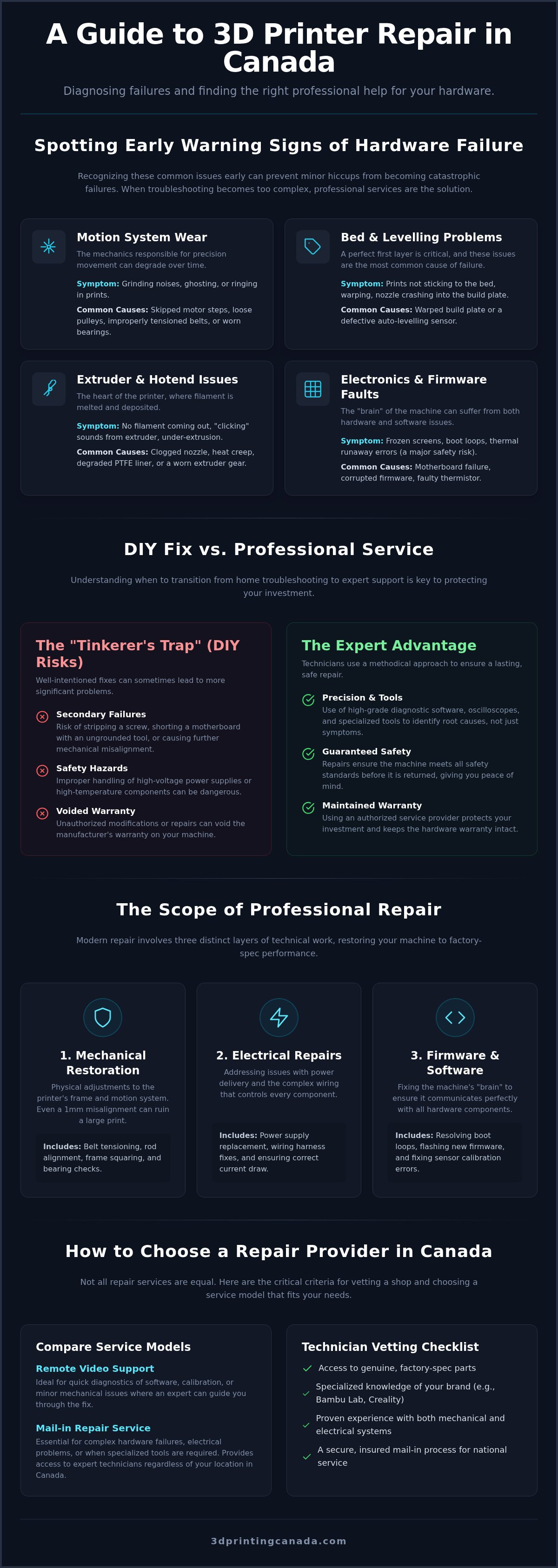
- Mechanical Restoration: This involves belt tensioning, rod alignment, and frame squaring. Even a single millimetre of misalignment can ruin a 50-hour print or cause premature wear on bearings.
- Electrical Repairs: Technicians handle power supply replacements and complex wiring harness fixes. This ensures your machine pulls the correct current without risking a short circuit.
- Firmware and Software: Experts resolve boot loops and sensor calibration errors. They ensure the machine's "brain" communicates perfectly with the hardware components.
Why Expertise Matters for Your Machine
Relying on a professional prevents the "tinkerer's trap." This happens when a well-intentioned DIY fix causes a secondary failure, such as stripping a screw while trying to reach a heater block or shorting a board with an ungrounded tool. Professional technicians understand the specific architecture of brands like Bambu Lab or Creality. They ensure every bolt is torqued to factory specifications.
Safety is a critical factor. Dealing with high-temperature components and high-voltage power supplies carries real risks. A professional service ensures your machine meets all safety standards before it returns to your desk. Using an authorized service provider also helps maintain your hardware warranty. It protects your investment for the long haul and gives you total confidence in your next big print.
Identifying Common 3D Printing Hardware Failures
Every 3D printer is a complex dance of thermodynamics and mechanical precision. Over time, that dance can lose its rhythm. Components wear down, screws vibrate loose, and sensors lose their calibration. Recognizing these issues early is the best way to prevent a minor hiccup from becoming a catastrophic failure. If you find yourself staring at a pile of spaghetti or a frozen screen, you aren't alone. Most hardware failures fall into a few predictable categories, and understanding them is the first step toward getting back to your creative work. For those who prefer a professional hand, 3D printer repair services Canada can step in when the troubleshooting becomes too complex for a home workshop.
Motion systems often signal their distress through sound. A grinding motor usually indicates a skipped step or a loose pulley, while a snapped belt is often the result of improper tensioning over hundreds of print hours. Worn bearings can cause subtle ghosting or ringing in your prints, ruining the surface finish of a high-detail model. Similarly, bed and levelling problems can be incredibly deceptive. A warped build plate might look flat to the naked eye, but it will cause first-layer failures every time. If your auto-levelling sensor is defective, the printer might drive the nozzle straight into the bed, causing damage to both the surface and the hotend. Electronic faults like thermal runaway errors are even more serious, as they indicate the printer has lost control of its heating elements, which is a significant safety risk.
Diagnosing the Infamous Clogged Nozzle
A nozzle clog is the most common hurdle in FDM printing. Sometimes a simple cold pull can clear the debris, but if you've been printing at high temperatures, the plastic might have carbonized inside the tip. In machines with a PTFE-lined hotend, the tube itself can degrade over time, creating a sticky gap where filament gets stuck. Heat creep occurs when the "cold" side of the hotend becomes too warm, causing filament to soften prematurely and jam before it reaches the melt zone, whereas a standard jam is usually caused by debris or carbonized plastic inside the nozzle tip. If your hotend is consistently failing, it might be time to consult our technical team for a deep-dive diagnostic.
Motherboard and Sensor Troubleshooting
When your printer stops moving entirely, the motherboard is often the culprit. You can identify a blown stepper driver by swapping the cables between two motors; if the problem stays with the same port on the board, the driver is likely dead. End-stop sensors are equally critical for print consistency. If they don't trigger accurately, your printer will never know its true "home" position, leading to shifted layers. While you are performing these repairs, it is a great time to consider performance boosts. Integrating high-quality Bambu Lab accessories Canada can often resolve recurring hardware issues while simultaneously improving your print speeds and reliability.
Service Models: Remote Diagnostics vs. Mail-in Repairs
Canada's vast geography means that local drop-off service isn't an option for every maker. Whether you're in a downtown Toronto loft or a workshop in rural Alberta, you need access to 3D printer repair services Canada that match your specific situation. Choosing the right service model depends on your technical comfort level and the severity of the hardware failure. Modern technical support has evolved to offer flexible paths that prioritize both your time and your budget. By understanding these different approaches, you can decide whether to keep the repair in-house or send it to a dedicated facility.
For schools or commercial production hubs with a fleet of machines, on-site service often makes the most sense to minimize downtime and avoid the logistics of moving heavy equipment. However, for individual hobbyists and small businesses, the choice usually boils down to a cost-benefit analysis of shipping fees versus remote labour rates. Shipping a large printer can be expensive, but it's often more cost-effective than paying for multiple hours of guided labour for a complex, multi-day fix. Conversely, a quick remote session can save you weeks of waiting for a courier to return your machine.
The Rise of Remote Technical Support
Remote repair sessions have changed the game for makers who live outside major urban centres. In these sessions, you connect with an expert technician via video call who guides you through the diagnostic and repair process in real-time. This isn't just about getting a fix. It's about realizing your own maintenance skills under the wing of a knowledgeable mentor. This model is ideal for firmware updates, software configuration, and replacing modular parts like fans or thermistors. To make a remote session successful, you'll need a few basics:
- Clear Communication: A stable internet connection and a high-definition webcam or smartphone.
- Proper Visibility: Bright, adjustable lighting to illuminate the printer's interior for the technician.
- The Right Tools: A standard set of hex keys, screwdrivers, and a multimeter.
When to Choose Mail-in Depot Repair
Sometimes, a video call isn't enough to save a machine. If your printer requires complex soldering, intricate component replacements, or a full-frame refurbishment, a mail-in depot service is the safest bet. Technicians in a centralized lab have access to professional-grade soldering stations and diagnostic rigs that simply aren't portable. This path is perfect for deep-cleaning and full machine overhauls after years of heavy use.
The mail-in process involves securely packing your hardware and shipping it to a specialized facility. A major advantage of this model is the final testing phase. Reputable shops won't just fix the broken part; they'll test your printer with high-quality filaments to ensure it meets factory performance standards before shipping it back to you. This guarantees that when the box arrives at your door, you can get straight back to printing without further troubleshooting.
A Buyer’s Guide to Choosing a Repair Provider in Canada
Choosing a partner to restore your hardware is a decision that impacts your long-term printing success. You aren't just looking for someone who can turn a wrench; you need a technician who understands the specific architecture of your machine. Whether you're running a hobbyist setup or a commercial fleet, the quality of 3D printer repair services Canada varies significantly between providers. A reputable shop should offer total transparency, providing a detailed diagnostic report before any work begins. This ensures you know exactly what failed and why, preventing "mystery charges" from appearing on your final bill.
Parts availability is another critical factor in your decision. A professional repair centre should stock genuine replacement components rather than relying on generic, off-brand alternatives that might fail within weeks. Using Canadian safety-compliant parts is non-negotiable for maintaining the electrical integrity of your machine. Beyond the technical specs, look at the community reputation. Reviews from fellow Canadian makers often reveal the true level of support you can expect. If you want to ensure your machine is handled by a team that lives and breathes additive manufacturing, book your diagnostic session with our experts today.
Evaluating Technical Authority and Experience
Technical expertise isn't universal across all types of 3D printing. A technician who excels at fixing basic bed-slingers might be completely lost when faced with the complex belt paths of a CoreXY system or the delicate optics of a resin printer. Before handing over your gear, ask direct questions to gauge their authority:
- "Do you have specific experience with CoreXY systems or SLA resin printers?"
- "Do you operate out of a physical storefront or a residential basement?"
- "What is your process for verifying that a repair meets factory safety standards?"
A physical storefront often indicates a higher level of accountability and professional equipment. It also means they have the space to properly test your machine under real-world conditions before it returns to your workshop.
The Repair vs. Replace Decision Matrix
Every maker eventually faces the "Repair vs. Replace" dilemma. We recommend using the "50% Rule" as your primary framework. If the estimated cost of a repair exceeds half the price of a brand-new machine, it's time to consider an upgrade. However, this rule isn't absolute. You must also factor in the value of specialized modifications you've already installed, such as high-end linear rails or custom hotends. A well-tuned, modified machine is often more capable than a stock entry-level replacement. Just be aware that very old machines may eventually face "end of life" status due to a lack of firmware support or proprietary parts that are no longer in production.
Revitalize Your Gear with 3D Printing Canada’s Expert Services
Our service lab is more than just a repair shop; it's a hub where technical expertise meets a passion for making. At 3D Printing Canada, our technician team brings years of hands-on experience in additive manufacturing to every project. We understand that your printer is an essential part of your creative or professional life. That's why we're committed to getting your machine back to factory-spec performance. We don't just aim for 'functional.' We want your hardware to run as smoothly as the day you first unboxed it. By choosing our 3D printer repair services Canada, you're partnering with experts who prioritize precision and long-term uptime.
Wait times are the enemy of productivity. To combat this, we maintain a massive inventory of parts and accessories right here in our facility. Whether you need specific Bambu Lab accessories or specialized components for a Creality build, we likely have it on the shelf. This allows us to minimize delays and get your machine back in your hands faster. Our "Problem Solver" approach means we look beyond the immediate failure. If a part broke due to poor maintenance or a specific usage habit, we'll explain the "why" and teach you how to maintain your gear moving forward. We want to empower you with the knowledge to prevent future downtime.
National Reach, Personal Support
We believe that high-quality technical support should be accessible to every maker in the country. Our mail-in program serves customers from coast to coast, providing a secure and reliable way to get expert help regardless of your location. If you prefer to handle the physical work yourself but need a professional eye, our online portal makes booking a remote session incredibly simple. These video calls allow us to support the Canadian 3D printing community by ensuring reliable uptime for everyone, from hobbyists in small towns to industrial hubs in major cities.
Get Back to Printing Today
Don't let a hardware failure stall your progress any longer. Start your diagnostic journey today by contacting our technical support team. We'll help you determine the best path forward, whether that's a quick remote fix or a deep-dive depot repair. To ensure your machine is truly ready for action, we recommend combining your repair with a fresh supply of our premium filaments. This allows us to calibrate your hardware using high-quality materials, guaranteeing perfect results the moment you restart your next project. We are here to ensure your creative journey continues without interruption.
Book your professional 3D printer repair service now
Get Your Creative Projects Back on Track
Restoring a machine to its prime performance doesn't have to be a source of stress. Throughout this guide, we've explored how identifying hardware failures early and choosing the right technical support can save you weeks of frustration. Whether you're navigating complex motherboard issues or simply need a precision tune-up, the right 3D printer repair services Canada make all the difference. You now have the framework to decide between remote guidance or a full depot overhaul, ensuring your hardware investment remains protected for years to come.
Our team at 3D Printing Canada is ready to help you realize your machine's full potential. With expert technicians specialized in Bambu Lab, Creality, and Anycubic, we provide the technical authority you need for a permanent fix. We back this expertise with a national mail-in service designed for fast turnaround and a comprehensive inventory of genuine replacement parts. Don't let a broken belt or a clogged nozzle stand between you and your next masterpiece. Book Your Professional 3D Printer Repair Service and let us handle the technical heavy lifting. We're here to help you get back to what you do best: creating incredible things.
Frequently Asked Questions
How much does 3D printer repair cost in Canada?
Repair costs vary depending on the complexity of the hardware failure and the specific parts required for the fix. Most professional service centres charge an initial diagnostic fee to identify the root cause, followed by an hourly labour rate and the cost of any replacement components. It is best to request a detailed quote after the initial assessment to understand the total investment needed to restore your machine to factory standards.
Can I get my Bambu Lab printer repaired professionally?
Yes, you can access specialized professional support for the entire Bambu Lab lineup. These machines utilize proprietary architecture that requires specific technical knowledge and genuine components. Our lab maintains a deep inventory of parts and accessories to ensure your high-speed printer returns to its peak performance levels without the long wait times often associated with international shipping.
How do I ship a 3D printer for repair without it breaking?
Secure the print head and gantry using zip ties or original shipping clips to prevent movement during transit. You should remove the build plate and any glass surfaces, wrapping them separately in bubble wrap. Ideally, use the original double-walled box and foam inserts; if those aren't available, use heavy-duty box-in-box packaging with at least two inches of dense padding on all sides of the frame.
Is it worth repairing a budget 3D printer under $300?
The decision depends on the cost of the required parts and the value of any modifications you've already installed. If a simple nozzle replacement or firmware calibration is all that's needed, a repair is highly cost-effective. However, if the motherboard and the entire motion system require replacement, it might be more practical to realize the value of a newer, more reliable model instead of over-investing in an entry-level machine.
What is the typical turnaround time for a professional repair?
Turnaround times fluctuate based on the current volume of the repair lab and the availability of specific replacement parts. Simple mechanical fixes are often completed within a few business days, while complex electrical troubleshooting or sourcing rare components can extend the timeline. Getting your machine into the diagnostic queue early is the fastest way to get an accurate estimate for your specific repair in 2026.
Do you offer remote 3D printer troubleshooting via video call?
Yes, remote video support is a vital part of our 3D printer repair services Canada. This service model allows you to work directly with a mentor who guides you through the diagnostic process in real-time. It's an excellent way to save on shipping costs while building your own technical skills, making it a favourite choice for makers located in rural or remote areas across the country.
What brands of 3D printers do you specialize in repairing?
Our technical team specializes in major industry brands including Bambu Lab, Creality, and Anycubic. We support both FDM and SLA resin technologies, ensuring we have the specialized tools and firmware expertise required for these different systems. Whether you're running a desktop hobbyist machine or a commercial production unit, our lab is equipped to handle the specific requirements of these popular manufacturers.
Will my 3D printer warranty be voided if I get it repaired?
Reputable professional repairs generally do not void your warranty, especially when the work is performed to manufacturer specifications using genuine parts. However, every brand has different policies regarding third-party technical intervention. It's always a good idea to check your specific warranty documentation or contact the manufacturer's support team to confirm their stance on professional service before you ship your machine.