
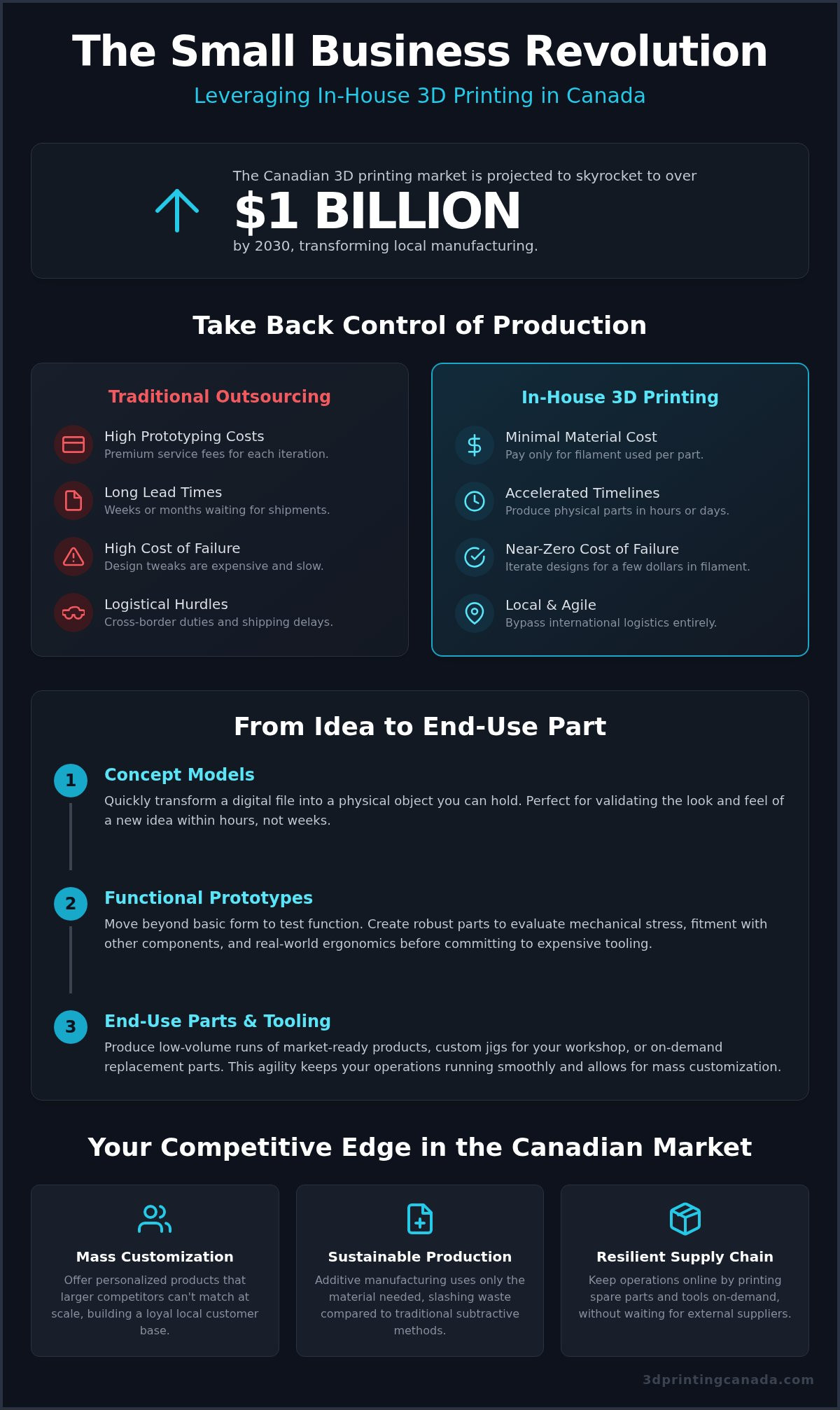
Did you know the Canadian 3D printing market is projected to skyrocket to over $1 billion by 2030? This rapid growth shows that 3D printing for small business Canada is no longer just for tech enthusiasts; it's a fundamental tool for any company that needs to stay agile. You've likely dealt with the high costs of traditional prototyping or felt the sting of long lead times when outsourcing parts. It's frustrating to watch your product development stall while you wait for a shipment to arrive at your business centre.
We're here to help you take back control of your production timeline. This guide will show you how to leverage in-house 3D printing to slash manufacturing costs and accelerate your path to market. We'll cover everything from selecting reliable Bambu Lab hardware to finding the right filaments and securing dependable national support for repairs. By the end of this article, you'll have a clear roadmap to build a more resilient, competitive business that can realize its full potential in the local market.
Key Takeaways
- Understand the shift from basic prototyping to low-volume production to help your business realize faster product development cycles.
- Learn how to select reliable hardware and scanners that prioritize professional performance over entry-level hobbyist specs.
- Identify the best materials for functional parts and discover how bulk filament ordering can significantly lower your operational costs.
- Master the strategic implementation of 3D printing for small business Canada to gain a competitive edge without the burden of cross-border shipping delays.
- Ensure your operations stay online with dependable national support, from expert hardware repairs to authorized Bambu Lab accessories.
Why 3D Printing is a Game-Changer for Canadian Small Business
In 2026, the technology behind what 3D printing is has evolved from a niche hobby into a powerhouse for local commerce. For a Canadian small business, additive manufacturing means building objects layer by layer from a digital file, right on your shop floor. This isn't just about making plastic toys anymore. We've seen a massive shift where SMEs use these machines for low-volume production of end-use parts. Instead of ordering 10,000 units from overseas, you print exactly what you need, when you need it. This agility is why 3D printing for small business Canada has become a tactical necessity for those looking to stay relevant.
Adopting this tech helps you bypass the headaches of international logistics. You eliminate cross-border duties and those soul-crushing shipping delays at the border. Because you only use the material required for the part itself, you also slash material waste compared to traditional subtractive methods like CNC machining. It's a cleaner, faster way to realize your vision and keep your overhead low. Canadian businesses are now using these tools to bring custom designs to life in days, ensuring their customers get exactly what they want without the typical wait times.
The ROI of In-House Additive Manufacturing
Think about the last time you outsourced a prototype. You likely paid a premium for the service, waited weeks for delivery, and then realized the fit was slightly off. Printing in-house changes that math entirely. The "cost of failure" drops to nearly zero because a design tweak only costs a few dollars in filament and a few hours of machine time. You can afford to be wrong, iterate, and get it right by lunch. Beyond prototyping, you can print your own spare parts or custom jigs on-demand. This keeps your main production line running without waiting for a specialized technician or an expensive replacement part to arrive from a different province. Reliable hardware ensures this process is repeatable and efficient for any small team.
Gaining a Competitive Edge in the Canadian Market
Staying ahead means moving fast. If a new trend hits the Canadian market, you can have a physical product ready for sale in days, not months. This allows for "mass customization," where you offer personalized products that larger competitors simply can't match at scale. You aren't just a reseller; you're a creator with a local edge. Rapid Prototyping is the core business advantage of using 3D models to quickly create physical parts for testing and refinement before full-scale launch. By keeping your production local, you build a brand known for speed, precision, and dependable support that resonates with Canadian consumers.
Commercial Applications: From Prototyping to End-Use Parts
Moving beyond the initial excitement, let's look at how 3D printing for small business Canada actually works on the ground. Most businesses follow a three-stage progression: concept models, functional prototypes, and final end-use parts. Concept models allow you to hold a physical version of an idea within hours. Functional prototypes then let you test mechanical stress or fitment. Finally, many Canadian SMEs now produce end-use parts like custom brackets for construction or specialized enclosures for electronics. As highlighted in recent insights regarding Canada's additive manufacturing landscape, the ability to produce locally is a major growth driver for our economy.
This process is far more efficient than traditional manufacturing; you only use the plastic required for the part, which supports a more sustainable, low-waste business model. Unlike subtractive manufacturing that carves away from a large block, additive printing only consumes the material needed. This material efficiency doesn't just save money on filament; it aligns your business with modern green standards that Canadian consumers increasingly value. It's about being smart with your resources while delivering high-quality results.
Rapid Prototyping for Product Development
Stop waiting weeks for a factory to send a sample. Iterate your designs in a single afternoon. You can test ergonomics and fitment before you ever commit to expensive injection moulds. This speed allows you to realize errors early when they are cheap to fix. If you're working with existing physical objects, using a 3D scanner Canada allows you to reverse engineer parts with incredible precision. It’s a powerful way to bridge the gap between a physical object and a digital design file.
Custom Tooling and Shop Floor Efficiency
Efficiency on the shop floor often comes down to the small things. You can design bespoke organizational tools to centre your workspace workflow. Print specialized safety guards or alignment jigs for your existing machinery. These "jigs and fixtures" keep your production lines moving faster and safer. Small businesses often struggle with "off-the-shelf" tools that don't quite fit their unique production needs. 3D printing allows you to create a jig that holds a specific component at the exact angle required for assembly. It eliminates the "close enough" mentality and replaces it with absolute precision. If you’re ready to start building these custom solutions, take a look at our professional 3D scanners to see how they can streamline your design process.
Selecting Your Hardware: Printers, Scanners, and Accessories
Building in-house capacity is about choosing tools that work as hard as you do. While hobbyists might prioritize the lowest price point, professional 3D printing for small business Canada requires hardware that delivers consistent results without constant tinkering. You need to decide between FDM (Fused Deposition Modelling) and Resin printing. FDM uses filament and is ideal for the functional parts and jigs we discussed earlier. Resin, on the other hand, offers incredible detail for intricate prototypes but requires more post-processing. For most commercial shop floors, FDM is the standard due to its material range and durability.
High-speed printing has become the baseline in 2026. Machines now regularly hit speeds of 500mm/s, which drastically reduces the time between a digital file and a physical part. This shift towards Purposeful Production in 3D Printing allows Canadian SMEs to remain competitive through localized manufacturing. If your printer is down for repairs or requires constant calibration, you're losing money. Reliability is your most valuable feature. It’s better to invest in a machine that runs predictably than one that needs a weekend of troubleshooting just to finish a single print.
Bambu Lab: The SME Workhorse
Bambu Lab has redefined what's possible for small teams. Their machines are known for being ready to print right out of the box with minimal setup. One of the biggest advantages is the Automatic Material System (AMS). This allows for multi-colour branding or using specialized support materials that break away easily, saving you hours of manual cleanup. To keep these machines running at peak performance, sourcing Bambu Lab accessories Canada businesses trust ensures you have the right nozzles and build plates for any job. It’s about building a system that’s reliable enough to run overnight so you can focus on growing your business while the hardware handles the heavy lifting.
3D Scanners for Reverse Engineering
Hardware isn't just about the printer. 3D scanners are essential for businesses that need to digitize legacy parts or create custom-fit accessories for existing products. A handheld scanner can quickly capture the geometry of a machine component that’s no longer in production. Once digitized, you can modify the design and print a replacement in hours. Desktop scanners are perfect for smaller, high-precision items, while handheld units offer the flexibility to move around large equipment. This synergy between scanning and printing creates a closed-loop manufacturing system that keeps your operations independent and efficient. You don't have to rely on external suppliers when you can replicate and improve parts yourself.
Building a Sustainable Workflow: Maintenance and Supplies
Success with 3D printing for small business Canada doesn't end with the purchase of a machine. It's about the fuel and the upkeep. Choosing the right material for the specific job is the difference between a part that fails in the field and one that lasts for years. While PLA is perfect for those initial concept models we discussed, commercial applications often demand more. You should also prioritize bulk filament orders to save on overhead. Buying in volume reduces your cost per gram and ensures your production line never grinds to a halt because you ran out of stock during a busy week.
Establish a regular maintenance schedule to prevent hardware downtime. A simple routine of cleaning rails, checking belt tension, and clearing dust can extend the life of your equipment significantly. However, you must also recognize the signs that your printer needs professional technical intervention. If you hear grinding noises that don't go away after lubrication or see persistent layer shifts that calibration can't fix, it's time to stop. Forcing a machine to run when it's struggling only leads to more expensive repairs later.
Optimizing Your Material Selection
PETG is the workhorse for outdoor or heat-sensitive applications. It offers better UV resistance and toughness than PLA, making it ideal for the custom brackets and enclosures mentioned earlier. If your business operates in a niche that requires food contact, you'll need to source specific food-safe filaments and follow strict post-processing rules. For gaskets or vibration dampeners, TPU provides the flexibility you can't get from rigid plastics. Check out our 3D printer filament Canada guide to match the right plastic to your project goals.
Professional Maintenance and Repair
Realizing when a repair is beyond a DIY fix is a vital business skill. While you can change a nozzle yourself, complex electrical issues or deep mechanical failures require expert hands. Having a national partner for 3D printer repair services Canada provides a safety net for your operations. It reduces your business risk by ensuring you have access to expert technical support and genuine spare parts without waiting for international shipping. If your hardware is acting up, contact our repair team today to get back to production quickly.
Why 3D Printing Canada is Your National Growth Partner
Sourcing hardware shouldn't feel like a gamble. When you integrate 3D printing for small business Canada into your workflow, you need more than just a box on your doorstep; you need a partner that understands the unique hurdles of the Canadian market. We position ourselves as your mentor and problem solver, providing the technical expertise required to turn a single machine into a reliable production asset. Whether you're troubleshooting a complex print or looking to expand your capabilities, having a knowledgeable guide ensures you don't waste time on trial and error. We're invested in your success because your growth strengthens the entire local manufacturing community.
We don't just sell tools; we provide the comprehensive support needed to use them effectively. Small businesses often feel isolated when technical issues arise, but our role is to bridge that gap with reliable advice and professional resources. By choosing a specialized national partner, you gain access to a hub of expertise that prioritizes performance and utility over marketing hype. We understand the practical challenges you face on the shop floor and offer proactive solutions that keep your business moving forward.
National Support and Fast Shipping
Logistics can make or break a production schedule. Sourcing your printers, scanners, and filaments from one central Canadian resource eliminates the frustration of cross-border customs delays and unexpected duties. We provide fast national shipping across all provinces, ensuring your production line never grinds to a halt because you're waiting on a roll of PETG or a replacement nozzle. This proximity also means our national technical support is always within reach. If a machine requires professional attention, our expert in-house technicians can handle the repairs quickly, reducing the business risk associated with hardware downtime.
Scaling Your Production with Confidence
Growth often leads to a natural transition from a single prototype machine to a small print farm for batch production. This shift allows you to handle larger orders and diversify your product offerings without the massive overhead of traditional factories. We support your business at every stage of this journey, from selecting your first Bambu Lab unit to optimizing a multi-printer setup. Our team helps you realize the full potential of additive manufacturing by advising on workflow automation and material management. When you're ready to take the next step and increase your output, explore our commercial 3D printing solutions to find the hardware and support that fits your vision.
Future-Proof Your Manufacturing Strategy
Adopting in-house production is about more than just buying a machine; it's about building a more resilient and agile operation. By moving from outsourced prototypes to local, low-volume manufacturing, you've seen how easy it is to slash lead times and realize significant cost savings. Whether you're matching a specific brand colour or printing custom shop floor jigs, the right hardware and high-quality materials are your foundation for success. You don't need a massive industrial budget to start seeing results immediately.
Implementing 3D printing for small business Canada gives you the power to innovate at your own pace. As an authorized Bambu Lab retailer with expert technical repair services, we're here to ensure your equipment stays in peak condition. With fast national shipping across all provinces, you'll never have to worry about cross-border delays slowing down your progress. It's time to take control of your production cycle and gain the competitive edge you deserve. Scale your business with 3D Printing Canada's expert hardware and support and start creating with confidence today. Your next big innovation is just one print away.
Frequently Asked Questions
Is 3D printing cost-effective for a small business in Canada?
3D printing for small business Canada is highly cost-effective because it eliminates expensive outsourcing fees and minimizes material waste. You only pay for the filament consumed by the part itself. By purchasing filament in bulk, you can lower your overhead even further. This makes it affordable to iterate designs multiple times in a single day, ensuring your final product is perfect without the heavy financial burden of traditional manufacturing setups.
What is the best 3D printer for a small business starting in 2026?
For most Canadian SMEs in 2026, Bambu Lab printers are the gold standard for speed and reliability. These machines regularly achieve speeds of 500mm/s right out of the box, which is a massive leap over older hardware. They offer a great balance of professional performance and ease of use. When you pair them with authorized Bambu Lab accessories, you get a dependable production tool that doesn't require constant tinkering.
Do I need special permits to use a 3D printer for commercial production?
You don't typically need federal permits to operate a 3D printer, but you must follow the Canada Consumer Product Safety Act (CCPSA). If you sell products nationally, ensure your labels are in both English and French to comply with Bill 96. It's also wise to check your local municipal zoning if you're running a home-based business to ensure you're compliant with noise or safety regulations for commercial production.
How hard is it to maintain a 3D printer in a professional environment?
Maintenance is straightforward if you stick to a consistent schedule. You'll need to clean your guide rails, check belt tension, and ensure the build plate is free of oils. Most of these tasks take just a few minutes each week. However, if you encounter electrical failures or deep mechanical layer shifts, it's better to seek expert technical support rather than risking a DIY fix that could cause more damage.
Can I use 3D printing to create food-safe products for my business?
Creating food-safe items is challenging because FDM prints are naturally porous and can harbour bacteria. While you can buy food-safe filaments, the printing process itself creates tiny gaps where food particles can get trapped. To make a product truly safe for food contact, you must apply a food-grade sealant or coating. This extra step ensures the surface is smooth, non-porous, and easy to sanitize for professional use.
Where can I get professional 3D printer repairs in Canada?
You can access expert 3D printer repair services directly through 3D Printing Canada. Our in-house technicians specialize in resolving complex hardware issues for businesses across the country. Because we offer national shipping, you can send your equipment to our centre for professional intervention and receive it back quickly. Having a local Canadian partner for repairs helps you avoid the high costs and long wait times of international shipping.
What are the most common materials used for commercial 3D printing?
PLA, PETG, and TPU are the primary materials used in commercial settings. PLA is excellent for rapid prototyping due to its ease of use. PETG is the preferred choice for functional parts that need to withstand heat or outdoor conditions. TPU offers the flexibility required for gaskets or vibration dampeners. Choosing the right filament ensures your parts perform as expected in real-world environments while keeping your production costs predictable.
How long does it take to learn how to operate a business-grade 3D printer?
You can learn the basics of operating a modern printer in just a few days. Most machines now feature intuitive touchscreens and automated calibration that simplify the startup process. Mastering the nuances of slicing software and material properties takes a few weeks of consistent use. We provide the knowledge and human support required to help your team move from beginner status to confident production as you scale your operations.