
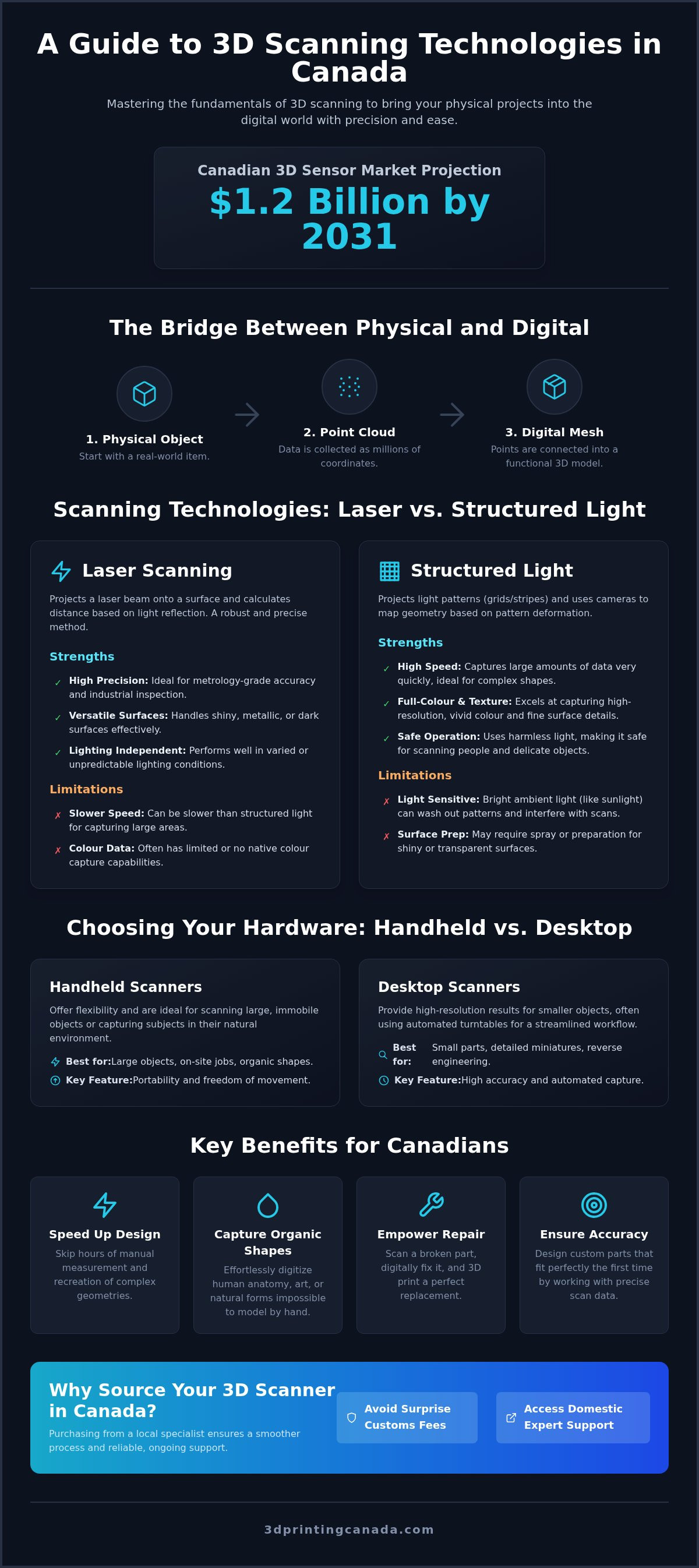
By 2031, the Canadian 3D sensor market is projected to reach a staggering $1.2 billion, proving that the ability to digitize the physical world is no longer reserved for high-end aerospace labs. It's a powerful shift, but searching for a 3D scanner Canada has to offer often leads to a wall of technical jargon like metrology, point clouds, and structured light. You might worry about the high cost of entry or whether the software will even talk to your existing CAD programs. We've all been there, staring at a spec sheet and wondering if the hardware actually delivers on its promises.
This guide will help you master the fundamentals of scanning technology and teach you how to select the perfect hardware for your Canadian projects. You'll learn to distinguish between different scanner types, identify the best fit for your specific workflow, and find a reliable local source for gear and support. We're breaking down the complex stuff so you can focus on what really matters: bringing your creative and industrial ideas to life with precision and ease.
Key Takeaways
- Understand how 3D scanners transform physical objects into digital point clouds and functional meshes.
- Compare laser and structured light technologies to pick the right precision level for your specific environment.
- Evaluate handheld versus desktop models to find hardware that fits your budget and workspace.
- Master surface preparation and data acquisition steps to ensure your scans are CAD-ready every time.
- Source your next 3D scanner Canada from a local specialist to avoid surprise customs fees and access domestic expert support.
What is a 3D Scanner and How Does it Benefit Canadians?
At its core, a 3D scanner is a device that analyzes a real-world object to collect data on its shape and appearance. It's the ultimate tool for anyone looking to bring physical items into a digital workspace. While a traditional camera captures a flat image, this 3D scanning technology captures volume and depth. The data is first gathered as a "point cloud," which is essentially a massive collection of individual coordinates in space. Once processed, these points are connected to form a "mesh," a digital surface that you can modify, measure, or 3D print. Finding the right 3D scanner Canada has to offer means choosing a tool that replaces slow, manual measurements with high-speed digital precision. If you've ever tried to measure a complex curve with a set of calipers, you know how frustratingly imprecise it can feel.
This technology is currently driving innovation across the country. In Ontario, automotive manufacturers use it for rapid prototyping and quality control. Healthcare professionals in Vancouver use scanning to create custom-fit orthotics and prosthetics that match a patient's unique anatomy perfectly. Even our cultural institutions are getting involved, using high-resolution scans to archive Indigenous carvings and historic architecture in digital formats that will last forever.
The Bridge Between Physical and Digital
For many of our customers, scanning is the missing link in their creative workflow. It complements 3D printing by allowing you to digitize an existing part, modify it in CAD software, and then print a new version. This is vital for preserving Canadian history. Museums use it to create high-detail digital records of fragile artifacts, ensuring our heritage is protected from physical decay. In industrial settings, scanners create "digital twins" of complex machinery. These virtual models allow engineers to plan maintenance or design upgrades without taking the actual equipment offline for weeks.
Key Benefits for Hobbyists and Professionals
Whether you're a professional engineer or a dedicated maker, the advantages of owning a 3D scanner Canada are clear. It turns "I wish I could fix this" into "I can scan and print this today."
- Speed up your design: Skip the hours spent trying to recreate complex geometries from scratch.
- Capture organic shapes: Human anatomy or sculpted art is nearly impossible to model manually; scanning makes it effortless.
- Empowerment to repair: Scan a cracked housing for an old appliance, fix the digital mesh, and print a replacement that fits perfectly.
- Accuracy and reliability: Ensure your custom parts fit the first time by designing directly around a digital scan of the original environment.
Understanding 3D Scanning Technologies: Laser vs. Structured Light
Selecting a 3D scanner Canada professionals trust involves matching the sensor technology to your specific environment. Most modern hardware falls into two main camps: laser triangulation or structured light. If you're aiming to produce highly accurate 3D CAD models for industrial inspection or failure analysis, understanding these differences is vital. While photogrammetry offers a software-based alternative by stitching together standard photographs, it often lacks the metrology-grade precision required for tight engineering tolerances. Choosing the right tech ensures your digital data is actually useful for the job at hand.
Laser Scanning: Precision in Varied Lighting
Laser scanners work by projecting a concentrated beam or line onto a surface. A sensor then calculates the distance between the source and the object based on the angle of the reflected light. This method is incredibly robust. Because lasers are focused, high-energy light sources, they handle shiny, metallic, or dark surfaces much better than light-based patterns. In a workshop or industrial setting, you'll need to be aware of laser safety classes to ensure a safe environment for everyone. These tools are the gold standard for scanning industrial parts, large-scale objects, or anything located in a space with unpredictable lighting.
Structured Light: Speed and High-Resolution Colour
Structured light scanners project a series of light patterns, such as stripes or grids, across an object. The scanner's cameras observe how those patterns deform to map the geometry in real-time. It's an incredibly fast process that captures fine surface textures and vivid colour data with stunning detail. However, this technology has a notable limitation. Bright light, especially the intense glare of high-noon Canadian sunlight, can wash out the projected patterns. This makes it difficult to get a clean read outdoors. These scanners are your best bet for capturing human faces, intricate art pieces, or small objects where resolution is your top priority.
If you're still unsure which technology fits your specific project, take a look at the latest 3D scanners to see how these specifications translate to real-world performance. Finding the right balance between speed and precision is what turns a raw scan into a professional-grade digital asset.
Choosing the Right 3D Scanner for Your Application
Finding the right 3D scanner Canada has available starts with a clear look at your intended projects. There isn't a one-size-fits-all solution; instead, you need to balance your budget with your technical requirements. Most buyers fall into three main categories. Entry-level scanners are perfect for hobbyists learning the ropes. Mid-range units provide the reliability needed for small business reverse engineering. Professional, industrial-grade scanners offer the absolute precision required for aerospace or automotive manufacturing. Always verify your software ecosystem before committing. Most scanning applications are optimized for Windows and require a dedicated GPU; Mac users will find their options are much more limited.
Handheld Scanners for Maximum Versatility
Handheld scanners offer the freedom to walk around your subject, making them the best choice for large or fixed objects. Whether you're digitizing a car engine or a piece of custom furniture, these devices use "tracking" to stay oriented. They look for unique geometric features or small physical markers to understand their position in space. This rapid data capture is so effective that experts even utilize 3D scanning technology for crime scene investigation to document entire rooms in minutes. For the 3D printing community, handhelds are a game changer. You can scan your printer's chassis to design perfectly fitted Bambu Lab accessories Canada makers use to personalize their setups. You get the flexibility to scan almost anything, anywhere, though you might trade off a tiny fraction of accuracy compared to fixed units.
Desktop Scanners for Small, Intricate Parts
When your projects involve tiny mechanical components, jewellery, or dental molds, a desktop 3D scanner Canada specialists recommend is usually the winner. These units typically use an automated turntable that rotates the object while the scanner remains stationary. This controlled environment eliminates the "shaky hand" factor, resulting in much higher resolution for microscopic details. You won't be scanning a car door with one of these, but for a ring or a small gear, the precision is unmatched. The workflow is often more "set it and forget it," as the software handles the rotation and stitching automatically. It's a specialized tool for those who prioritize absolute detail over the ability to scan on the move.
The 3D Scanning Workflow: From Physical Object to CAD File
Owning a 3D scanner Canada is the first step, but mastering the workflow is what actually delivers results. The process is a logical progression that turns a physical object into a usable digital file. It starts with surface preparation, moves into data acquisition, and finishes with processing and reverse engineering. Each stage requires attention to detail to ensure your final CAD file is accurate and printable. Skipping steps or rushing the prep work usually leads to a messy point cloud that's impossible to use in your design software.
Mastering Surface Preparation
Many newcomers are surprised to find that shiny, transparent, or deep black objects are the natural enemies of most scanners. These surfaces either absorb the light or reflect it in unpredictable directions, creating "noise" or holes in your data. Use vanishing scanning sprays to create a temporary matte surface. These sprays evaporate on their own, so you won't damage the original part. If you're scanning a featureless, flat surface, place physical tracking markers. These stickers give the scanner a reference point to orient itself during the move, ensuring the software doesn't lose its place.
During acquisition, move the scanner steadily while ensuring each frame overlaps with the previous one. Think of it like painting a wall; you don't want to miss a spot. Once the scan is complete, your software generates a point cloud. You'll need to clean up any stray data points and align multiple scans if you had to flip the object over to capture the bottom. This alignment process creates a complete, watertight digital representation of your physical part.
Reverse Engineering for Practical Use
Reverse engineering is where you turn raw data into a functional reality. A common mistake is thinking a raw scan is ready for manufacturing immediately. Scanners produce meshes, usually in STL format, which are just a "skin" of triangles. To make a real mechanical part, you must convert this into a solid STEP file. You do this by using the mesh as a reference "ghost" in your CAD software, drawing your new geometry over it to ensure a perfect fit. This bridge between a raw scan and a final CAD file is what separates a hobbyist result from a professional one.
If you run into hardware trouble while trying to print your newly engineered parts, our 3D printer repair services Canada team can help get your machine back in top shape. Start your scanning journey today by exploring our professional 3D scanners and bring your physical parts into the digital world.
Why Buy Your 3D Scanner from a Canadian Specialist?
Buying a 3D scanner Canada is a major investment in your workflow. Don't complicate the process by ordering from across the globe. When you choose a Canadian specialist, you bypass the "border headache" entirely. There are no surprise customs fees or hidden import duties waiting at your doorstep. We realize that unexpected costs can derail a project's budget. By purchasing domestically, the price you see is exactly what you'll pay, plus standard GST or HST. This transparency helps you organize your finances without fear of a 10.5% duty rate suddenly appearing on your invoice. It's the simplest way to ensure your hardware arrives without logistical friction.
Expert Support and Community Knowledge
Our support isn't a faceless international ticket system located in a different time zone. We act as a friendly, knowledgeable mentor invested in your creative success. Because we also handle a massive inventory of filaments and offer expert 3D printer repair services, we see the whole picture of your project. If you're struggling to turn a complex scan into a functional print, we've likely solved that exact problem before. This peer-to-peer support is invaluable when you're mastering new technology. We don't just sell you a box; we provide the human support required to use the tools effectively. You're joining a community of Canadian makers and professionals who value reliable, local results.
Fast National Shipping and Reliable Inventory
We ship every 3D scanner Canada order from our central Canadian hub. This means fast delivery to your workshop, office, or lab without waiting weeks for a container to clear a port. We keep the hardware and the necessary accessories in stock. You can get your scanner, your vanishing spray, and your tracking markers all in one shipment. This allows you to start your project immediately rather than waiting for separate international packages. Local warranty handling provides essential peace of mind. You won't have to ship a delicate, high-value scanner back across an ocean for a simple repair or calibration. We handle the technical details so you can focus on your innovation.
Ready to digitize your world? Explore our collection of 3D scanners and start your project today.
Start Your Digital Transformation Today
Choosing a 3D scanner Canada offers is about more than just reading a spec sheet. It's about finding a tool that fits your specific workflow, whether you're capturing high-resolution art or reverse engineering industrial components. Remember that successful scanning starts with proper surface preparation and ends with a functional CAD model that you can actually use. By sourcing your hardware domestically, you skip the customs delays and gain a partner who understands the local landscape and your technical needs.
As an authorized dealer for top 3D hardware brands, we provide fast national shipping across Canada and expert technical support from our Hamilton-based team. We're here to ensure your hardware stays running and your projects stay on track. Whether you're a hobbyist or an industrial professional, we have the tools and the expertise to help you succeed. Browse our full range of 3D Scanners at 3D Printing Canada and take the first step toward digitizing your world. We can't wait to see what you'll create next.
Frequently Asked Questions
Do I need a powerful computer to use a 3D scanner in Canada?
Yes, you definitely need a high-performance computer to handle the massive data flow. Real-time point cloud processing requires a dedicated NVIDIA GPU and at least 16GB to 32GB of RAM. Using a standard office laptop will likely result in lag or software crashes. If you're investing in a 3D scanner Canada professionals use, ensure your workstation is up to the task to avoid a frustrating experience.
Can I 3D scan a person with these handheld devices?
You can absolutely scan a person using handheld devices, but safety is the priority. Ensure the scanner uses eye-safe technology, such as Class 1 lasers or structured light. The person must remain completely still during the process to avoid alignment errors. This application is increasingly common in the Canadian healthcare industry for creating custom-fit medical devices and high-detail digital doubles for media production.
What is the best 3D scanner for beginners on a budget?
The Creality CR-Scan series is currently one of the best entry points for a 3D scanner Canada beginner on a budget. These devices provide a solid balance between cost and performance for hobbyists and small workshops. While they don't offer the extreme metrology-grade precision of high-end industrial units, they're perfect for learning the fundamentals of the scanning workflow without a massive initial investment.
Is 3D scanning software usually included with the hardware?
Most hardware comes with proprietary scanning software to help you capture and align your data. This software usually handles the initial point cloud processing and basic mesh creation. Keep in mind that specialized reverse engineering tools for advanced CAD work often require separate, paid licenses. Always verify if the manufacturer includes lifetime software updates or if there are recurring subscription fees before you finalize your purchase.
Can I scan an object and 3D print it immediately?
You generally can't go straight from a scan to a print without some digital intervention. Raw scans often contain digital "noise" or small holes that need to be closed to create a watertight mesh. You'll need to use software to clean up the data and ensure the object is properly scaled. Once the mesh is repaired, you can export it to your slicer just like any other model.
How accurate are modern handheld 3D scanners?
Modern handheld scanners are surprisingly precise, with many models offering accuracy between 0.02mm and 0.1mm. This level of detail is sufficient for most reverse engineering and quality control tasks in the automotive sector. While fixed desktop scanners are still better for tiny, intricate parts, the gap in performance has closed significantly. Handhelds now provide the best balance of mobility and professional-grade accuracy for most users.
Do 3D scanners work outdoors in Canadian weather?
Laser-based scanners can work outdoors, but structured light models often fail in bright Canadian sunlight. The intense glare of the sun washes out the light patterns projected by the scanner, making data capture impossible. If you must scan outside, choose an overcast day or set up a tent to create a shaded environment. Laser scanners are much more resilient to these ambient light challenges during outdoor projects.
What is the difference between photogrammetry and 3D scanning?
Photogrammetry creates 3D models by triangulating points from multiple 2D photographs, while 3D scanning uses active sensors to measure distance directly. Scanning is typically faster and provides higher accuracy for mechanical parts. Photogrammetry is a great software-based alternative for capturing large buildings or landscapes where a handheld scanner might be impractical. Both have their place in a modern Canadian digital workflow depending on the target size.