
Et si vos impressions 3D pour l’extérieur ne se contentaient pas de survivre à l’hiver canadien, mais restaient réellement professionnelles pendant des années ? La plupart des créateurs ont déjà subi les frais de livraison élevés des détaillants américains ou le casse-tête d’une bobine bon marché, sans marque, qui ruine une impression de douze heures. C’est frustrant d’essayer de faire passer vos projets à l’échelle supérieure tout en butant sans cesse sur des matériaux incohérents. Si vous cherchez une source fiable de filament ASA partout au Canada, il vous faut un partenaire qui comprend le marché local et les exigences techniques des machines modernes à grande vitesse.
Nous savons que choisir entre le PLA, le PETG ou des matériaux techniques spécialisés peut ressembler à un jeu de hasard. Vous voulez des résultats constants et de qualité professionnelle, sans approximations ni cauchemars d’entretien. Ce guide simplifie votre processus de sélection pour 2026. Vous vous rendrez vite compte qu’il est facile de trouver les filaments les plus performants disponibles ici même, chez vous, une fois que vous savez quoi chercher. Nous vous montrerons exactement comment les entretenir pour obtenir des performances optimales. Des économies en gros au dépannage technique, nous avons les informations qu’il vous faut pour garder vos imprimantes en parfait état de fonctionnement.
Points clés
- Évitez les frais de livraison élevés et les droits de douane inattendus en vous approvisionnant en matériaux auprès d’un centre canadien fiable.
- Sélectionnez le matériau idéal pour chaque projet en comprenant les différences de performance entre le PLA à haut débit, le PETG et les composites spécialisés.
- Apprenez à imprimer avec succès avec le filament ASA Canada pour des pièces durables et résistantes aux intempéries, conçues pour résister aux environnements extérieurs.
- Identifier les signes d'absorption d'humidité et mettre en œuvre des techniques de stockage appropriées afin de maintenir une qualité d'impression constante, de niveau professionnel.
- Faites équipe avec un fournisseur qui offre bien plus que de simples bobines, en proposant l’assistance technique et les services de réparation nécessaires pour maintenir la fluidité de votre flux de travail créatif.
Comprendre le paysage des filaments d'impression 3D au Canada
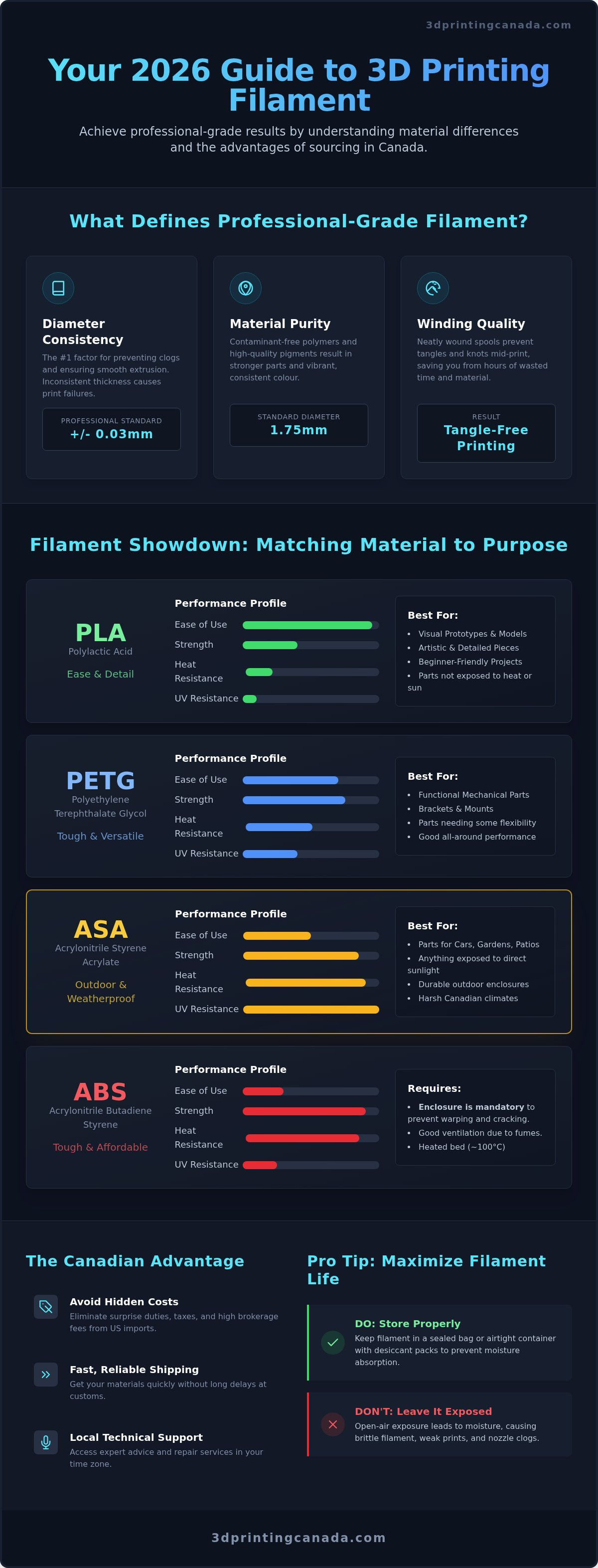
Choisir le bon filament d’impression 3D ne se résume pas à sélectionner une couleur. Il s’agit de fiabilité. Sur le marché canadien, le meilleur filament se définit par trois piliers : la constance du diamètre, la qualité de l’enroulement et la pureté du matériau. Tandis que les fabricants s’occupent de la chimie, votre détaillant agit comme le dernier garde-fou du contrôle qualité. Il veille à ce que ce qui arrive à votre porte n’ait pas séjourné pendant des mois dans un entrepôt humide. La plupart des imprimantes modernes au Canada utilisent désormais du filament de 1,75 mm. Cela fait de l’ancien standard de 2,85 mm un choix de niche pour des configurations industrielles spécifiques. Si vous utilisez une machine moderne à grande vitesse, privilégiez le 1,75 mm afin d’assurer la compatibilité avec la plus large gamme de matériel.
Pourquoi la qualité des matériaux détermine le succès de vos impressions
La qualité du matériau n’est pas qu’un simple argument marketing; c’est ce qui fait la différence entre une pièce finie et un amas de plastique enchevêtré. La variation du diamètre est la principale cause de la plupart des impressions ratées. Si l’épaisseur de votre filament fluctue trop, votre extrudeur ne peut pas maintenir une pression constante. Cela entraîne des espaces inesthétiques ou, pire encore, une buse obstruée qui met votre projet à l’arrêt. Des pigments de haute qualité jouent également un rôle essentiel, garantissant que le rouge éclatant que vous voyez sur la bobine est exactement celui qui apparaît sur votre plateau d’impression. Des tolérances de diamètre du filament de +/- 0.03 mm ou mieux constituent la norme professionnelle requise pour une extrusion constante. Les matériaux bon marché, sans marque, négligent souvent ces contrôles stricts, ce qui entraîne des résultats irréguliers qui vous font perdre du temps et de l’argent.
L’avantage d’une expertise canadienne locale
Acheter vos fournitures auprès d'une source nationale est une décision commerciale intelligente. Lorsque vous commandez ASA filament Canada partout au pays auprès d'un centre local, vous ne faites pas qu'économiser sur les délais d'expédition. Vous évitez aussi les « pièges » cachés comme les frais de courtage et les droits d'importation, qui peuvent doubler le coût d'une seule bobine en provenance des États-Unis. L'expédition à travers la frontière implique souvent de longs retards à la douane, ce qui peut interrompre votre production pendant des semaines. Au-delà du portefeuille, il y a l'aspect humain. Si votre impression échoue ou que votre matériel commence à poser problème, un partenaire canadien vous offre un support technique dans votre fuseau horaire. Vous soutenez aussi une communauté de fabricants et d'innovateurs qui comprend nos défis climatiques spécifiques. C'est particulièrement vrai pour les matériaux techniques comme ASA filament Canada que les utilisateurs privilégient pour leur durabilité en extérieur. Avoir un expert local qui offre des services de réparation et des conseils sur les matériaux fait toute la différence pour la réussite de vos projets créatifs.
Comparaison des principaux types de filaments pour chaque projet
Le choix du bon matériau dépend de l’utilisation finale de votre pièce. Si vous utilisez une machine moderne à 500 mm/s ou plus, vous avez besoin de formulations à haut débit qui fondent et refroidissent rapidement. Ne laissez pas un mauvais choix de matériau ralentir votre projet. Adapter le plastique à l’usage est la première étape vers une impression réussie. Nous avons vu de nombreux créateurs rencontrer des difficultés parce qu’ils utilisaient un matériau cassant pour une pièce mécanique ou un plastique à basse température pour un accessoire automobile. Tenez aussi compte de l’impact environnemental. De nombreuses marques proposent désormais des options recyclées et des bobines en carton afin de réduire les déchets dans l’atelier.
PLA : l’option de référence pour la facilité d’utilisation et les détails
Le PLA est le point de départ pour la plupart. Il est tolérant, dégage une légère odeur sucrée et produit des détails nets sans nécessiter d’enceinte chauffée. Pour ceux qui débutent, l’utilisation de PLA filament Canada d’origine offre le meilleur équilibre entre prix et performance. Il est idéal pour les modèles visuels, les essais d’ajustement et les pièces artistiques où la résistance à la chaleur n’est pas une priorité. Pour obtenir une finition aussi lisse que possible, assurez-vous que vos ventilateurs de refroidissement fonctionnent à 100 % après les premières couches.
PETG et ASA : durabilité pour les pièces fonctionnelles et extérieures
Le PETG représente un juste milieu, offrant plus de résistance et de tenue à la chaleur que le PLA. Il est idéal pour les supports mécaniques, mais il peut être sujet au « stringing » si vos réglages de rétraction ne sont pas bien ajustés. Toutefois, pour tout objet exposé au soleil, ASA filament Canada est le grand gagnant. Contrairement au PETG ou à l'ABS, l'ASA ne se dégrade pas et ne jaunit pas sous les UV. Lorsque vous achetez ASA filament Canada, vous obtenez un matériau qui excelle dans nos climats extérieurs rigoureux. Utilisez un plateau chauffant à environ 100 °C et un peu d'adhésif pour vous assurer qu'il reste bien plat pendant l'impression.
Durabilité de l'ABS et de qualité technique
L'ABS est robuste et abordable, mais il est difficile à imprimer. Vous avez absolument besoin d'une enceinte pour maintenir l'air ambiant au chaud, sinon vos pièces se déformeront et se fissureront. La sécurité est également un facteur. Lorsque vous travaillez avec des plastiques à haute température qui dégagent des fumées, comprendre la sécurité du filament d'impression 3D est essentiel pour maintenir un espace de travail sain. L'ASA est souvent le meilleur choix pour les applications automobiles ou industrielles, car il offre une résistance similaire à celle de l'ABS sans les problèmes de jaunissement causés par les UV. Si vous ne savez pas quel matériau convient à votre projet spécifique, parcourez les options chez 3D Printing Canada pour comparer les spécifications techniques et les performances.
Filaments spécialisés pour des résultats professionnels et artistiques
Les filaments spécialisés font passer vos projets de simples prototypes à des composants de qualité industrielle ou à de superbes œuvres d’art. Même si vous pouvez compter sur ASA filament Canada pour sa robustesse en extérieur, des matériaux esthétiques comme les plastiques infusés de soie, de marbre et de bois offrent un effet visuel « wow » que les résines standard ne peuvent pas égaler. Les filaments de soie offrent un éclat métallique très brillant qui masque efficacement les lignes de couche ; les options marbrées donnent aux modèles architecturaux une finition pierre réaliste. Si vous reproduisez des objets du monde réel, l’association de ces matériaux avec la technologie d’un 3D scanner Canada sur laquelle les professionnels s’appuient vous permet de capturer et d’imprimer des textures complexes avec une fidélité incroyable.
Travailler avec ces matériaux nécessite souvent une adaptation matérielle. Les filaments abrasifs, comme ceux contenant des fibres de bois ou des particules phosphorescentes, agissent comme du papier de verre sur les composants internes de votre imprimante. Les buses standard en laiton s’usent rapidement sous cette friction, ce qui entraîne une mauvaise qualité d’impression et une extrusion irrégulière. Passer à une buse en acier trempé ou à pointe en rubis est un petit investissement qui évite ces désagréments et garantit que votre machine peut supporter l’abrasivité des matériaux spécialisés sans tomber en panne en cours d’impression.
Filaments flexibles : maîtriser le TPU et le TPE
Les matériaux flexibles comme le TPU (polyuréthane thermoplastique) et le TPE (élastomère thermoplastique) ouvrent la voie à des applications semblables au caoutchouc. La clé du succès ici est de comprendre la dureté Shore. Un indice de 95A est relativement rigide, semblable à une roue de chariot de supermarché, ce qui le rend plus facile à imprimer. Les filaments plus souples, comme le 85A, ressemblent davantage à un élastique et nécessitent un contrôle précis. Nous recommandons d’utiliser une extrudeuse à entraînement direct pour les matériaux flexibles ; le trajet plus court entre l’engrenage d’entraînement et la buse empêche le filament de s’agglutiner comme des spaghettis mouillés. Ces matériaux sont parfaits pour créer des joints sur mesure, des amortisseurs de vibrations ou des objets connectés à porter qui doivent se plier avec l’utilisateur.
Matériaux haute performance et composites
Lorsque votre projet exige une rigidité extrême ou une résistance à la chaleur élevée, les filaments composites sont la solution. Les renforcements en fibre de carbone et en fibre de verre augmentent considérablement le rapport résistance/poids d’une pièce, ce qui les rend idéaux pour les châssis de drones ou les supports automobiles. Le nylon (PA) demeure un choix de premier ordre pour les environnements à haute température, bien qu’il soit notoirement difficile à imprimer en raison de sa tendance au gauchissement. Une buse en acier trempé est essentielle pour les filaments composites, car les fibres intégrées éroderont rapidement les embouts en laiton standard. En choisissant le bon composite, vous pouvez produire des pièces qui rivalisent avec les composants traditionnels moulés par injection en matière de performance et de durabilité.
Optimiser les performances de votre filament : stockage et entretien
Avez-vous déjà entendu un petit bruit de claquement pendant l’impression ? C’est le son de la vapeur qui s’échappe. La plupart des plastiques d’impression 3D sont hygroscopiques, ce qui signifie qu’ils absorbent activement l’humidité de l’air. Lorsque ce filament humide atteint la tête chauffante, l’eau se met instantanément à bouillir. Cela crée de minuscules bulles qui ruinent l’état de surface et fragilisent la structure interne de votre pièce. C’est particulièrement vrai pour les matériaux techniques. Si vous utilisez ASA filament Canada, les fabricants constatent souvent que même quelques jours d’exposition dans un atelier humide peuvent dégrader la qualité d’impression. Si votre matériel tombe en panne parce qu’un filament cassant et humide s’est rompu à l’intérieur de l’extrudeuse, des experts en 3D printer repair services Canada professionnels peuvent vous aider à remettre votre machine en alignement.
Les sécheurs de filament actifs sont la référence pour redonner vie au plastique « humide ». Ces appareils utilisent une chaleur contrôlée pour extraire l’humidité du matériau pendant plusieurs heures. Pour ceux qui ont un budget limité, des boîtes de séchage avec beaucoup de dessiccant peuvent garder vos bobines en parfait état pendant les longues impressions. N’attendez pas de constater une mauvaise qualité d’impression pour agir. Une maintenance proactive vous évite de gaspiller des matériaux coûteux et des heures d’impressions ratées.
Lutte contre l’humidité : le défi de l’entreposage au Canada
Le climat du Canada varie énormément, et votre stratégie de rangement devrait en tenir compte. Vous pourriez faire face à un air très sec en hiver et à une humidité étouffante en été. Ces deux extrêmes ont une incidence sur vos bobines. Utilisez des bacs hermétiques avec beaucoup de dessiccant au gel de silice pour créer un environnement stable. Refermez toujours vos sacs immédiatement après une session. Pour ceux qui impriment du filament ASA Canada à l’extérieur, garder le matériau au sec est la seule façon de garantir que les propriétés résistantes aux UV restent intactes pendant le processus d’extrusion. Un simple bac DIY avec un joint en caoutchouc suffit souvent à prolonger la durée de vie de votre filament de plusieurs mois.
Dépannage des problèmes courants de filament
L'entretien ne consiste pas seulement à stocker le matériau ; il s'agit aussi de surveiller la manière dont le matériau interagit avec votre matériel. Le fluage thermique se produit lorsque le ventilateur de refroidissement ne parvient pas à maintenir l'extrémité froide de l'extrudeur à la bonne température. Cela provoque le gonflement du filament et un bourrage avant même qu'il n'atteigne la buse. Si vous remarquez de fins filaments filandreux sur vos pièces, vos paramètres de rétraction nécessitent probablement un ajustement pour tirer le plastique plus efficacement vers l'arrière pendant les déplacements.
- Éliminez les obstructions partielles à l’aide de la méthode du « cold pull » avec un morceau de filament de nettoyage.
- Inspectez régulièrement votre tube PTFE pour détecter des extrémités carbonisées ou des espaces qui provoquent des frottements.
- Nettoyez les engrenages d'entraînement de votre extrudeur pour éviter qu'ils ne glissent sur la surface du filament.
Prêt à améliorer l’aménagement de votre atelier ? Parcourez notre sélection de sécheurs actifs et de solutions de rangement hermétiques pour conserver l’aspect professionnel de vos impressions toute l’année.
Où acheter le meilleur filament pour imprimante 3D au Canada
Le choix d’un fournisseur est tout aussi important que le choix du matériau lui-même. Vous avez besoin d’un détaillant disposant d’un vaste inventaire, capable de suivre le rythme de vos besoins de production sans déclencher de messages « rupture de stock ». En 2026, la tendance s’oriente vers la production à grande vitesse. Pour tirer le meilleur parti d’une imprimante 3D rapide au Canada que les utilisateurs adoptent, vous avez besoin d’un filament capable de s’écouler de manière constante à grande vitesse. Que vous recherchiez un stock de filament ASA Canada spécialisé ou du PLA standard, avoir un partenaire qui comprend ces nuances techniques rend votre flux de travail beaucoup plus efficace.
Le bon fournisseur agit comme un mentor technique pour votre entreprise. Nous ne nous contentons pas de vous vendre une bobine puis de disparaître. Nous offrons le soutien complet nécessaire pour utiliser ces outils efficacement. Cela comprend tout, des conseils sur le choix des matériaux aux services de réparation professionnels lorsque votre matériel a besoin d’une remise au point. En vous approvisionnant localement, vous évitez les retards liés à la frontière et assurez le bon fonctionnement de votre atelier toute l’année.
L’avantage de 3D Printing Canada
Nous avons créé un centre qui répond aux besoins des amateurs comme des professionnels de l’industrie. Notre sélection ne se limite pas au plastique; nous proposons un écosystème complet comprenant des scanners 3D et des accessoires Bambu Lab. Cette variété vous permet de tout trouver au même endroit. Comme nous offrons également des services de réparation spécialisés, nous avons un point de vue unique sur les filaments qui offrent les meilleures performances dans des conditions réelles. Nous ne stockons que des matériaux que nous avons confiance de faire passer dans nos propres machines. Il s’agit d’offrir une ressource fiable sur laquelle la communauté des créateurs canadiens peut compter à chaque étape de son parcours créatif.
Expédition rapide et assistance partout au pays
Les temps d’arrêt sont l’ennemi de la productivité. Notre hub d’expédition centralisé garantit que vos commandes de filament ASA Canada et d’autres résines techniques sont traitées rapidement, afin que vos projets restent dans les délais, où que vous soyez au pays. Vous bénéficiez de la tranquillité d’esprit qu’offrent des matériaux sélectionnés par des experts et une équipe d’assistance à un simple message. Nous savons que votre réussite dépend de la fiabilité de vos fournitures. Cessez de vous contenter de résultats incohérents et des tracas liés à l’expédition internationale. Découvrez dès aujourd’hui notre gamme complète de filament pour imprimante 3D Canada et voyez la différence que des matériaux de qualité professionnelle et une expertise locale peuvent apporter à votre prochain projet.
Élevez vos projets d’impression 3D pour 2026
Maîtriser vos résultats d’impression 3D commence par le choix du bon matériau pour le travail. Que vous fabriquiez des équipements d’extérieur résistants aux intempéries avec ASA filament Canada ou que vous réalisiez des prototypes de modèles visuels avec du PLA, la qualité compte. N’oubliez pas qu’en gardant votre filament au sec et votre matériel bien entretenu, vous éviterez la frustration des impressions ratées. Vous n’avez pas à faire ces choix techniques seul. Avec l’accès à des services professionnels de réparation d’imprimantes 3D et à une vaste gamme d’accessoires Bambu Lab, vous disposez des outils pour repousser vos limites créatives. Notre expédition nationale fiable partout au Canada garantit que votre atelier reste approvisionné sans attendre.
Il est temps d’arrêter de vous inquiéter des délais d’expédition internationale et des bobines irrégulières. Concentrez-vous sur ce que vous faites le mieux : créer. Achetez le meilleur filament pour imprimante 3D au Canada chez 3D Printing Canada et voyez comment des matériaux de qualité professionnelle peuvent transformer votre flux de travail. Nous sommes là pour soutenir votre réussite créative à chaque étape. Bonne impression !
Foire aux questions
Quel est le meilleur filament pour imprimante 3D pour les débutants au Canada ?
Le PLA est la référence pour les débutants parce qu'il est incroyablement tolérant. Il s'imprime à des températures plus basses et ne nécessite pas d'enceinte chauffée, ce qui le rend compatible avec presque toutes les machines d'entrée de gamme. Bien que vous puissiez éventuellement passer au filament ASA Canada pour des projets extérieurs, commencer avec le PLA vous permet d'apprendre les bases du nivellement du plateau et des réglages du slicer sans avoir à lutter contre le gauchissement spécifique au matériau. C'est la manière la plus fiable de réussir dès le premier jour.
Comment dois-je stocker mon filament d'imprimante 3D pour éviter l'humidité ?
Un bon stockage consiste à conserver vos bobines dans des contenants hermétiques avec du gel de silice dessiccant. Comme le Canada connaît d’importantes variations saisonnières d’humidité, se fier au sachet sous vide d’origine ne suffit pas une fois qu’il a été ouvert. Nous recommandons d’utiliser des boîtes de séchage dédiées ou des sécheurs de filament actifs qui utilisent une chaleur contrôlée pour extraire l’humidité du cœur de la bobine. Cela évite les crépitements et les bulles en surface qui gâchent des impressions autrement parfaites. Refermez toujours vos matériaux immédiatement après avoir terminé un projet.
Le PETG est-il meilleur que le PLA pour les pièces fonctionnelles ?
Le PETG est généralement supérieur pour les pièces fonctionnelles, car il offre une meilleure résistance aux chocs et une meilleure déflexion à la chaleur. Bien que le PLA soit plus facile à imprimer, il peut ramollir et se déformer s’il est laissé dans une voiture chaude ou exposé à la lumière directe du soleil. Le PETG offre un compromis entre facilité d’utilisation et durabilité de qualité technique. Cependant, si votre pièce fonctionnelle doit rester à l’extérieur de façon permanente, ASA filament Canada est le meilleur choix en raison de sa meilleure résistance aux UV et aux intempéries.
Puis-je utiliser du filament haute vitesse dans une imprimante 3D classique ?
Vous pouvez tout à fait utiliser du filament à haute vitesse ou à haut débit dans une imprimante 3D standard. Ces matériaux sont formulés pour fondre plus rapidement et conserver une viscosité constante, ce qui peut en réalité améliorer la qualité d’impression même à des vitesses plus faibles. Même si vous n’atteindrez pas les références de 500 mm/s des machines les plus récentes, les meilleures propriétés d’écoulement donnent souvent des couches plus lisses et une meilleure adhérence entre les couches. C’est un excellent moyen de vous assurer que votre imprimante habituelle fonctionne au maximum de ses performances.
Où puis-je trouver du filament pour imprimante 3D alimentaire au Canada ?
Trouver de véritables matériaux sans danger pour les aliments exige de rechercher des résines conformes aux normes CFIA ou FDA. Chez 3D Printing Canada, nous proposons une variété de filaments qui répondent à des normes de haute pureté. Gardez à l'esprit que le processus d'impression 3D lui-même crée de minuscules stries où les bactéries peuvent se développer. Si vous imprimez des objets destinés au contact alimentaire, envisagez d'utiliser un revêtement époxy sans danger pour les aliments afin de sceller ces couches et de vous assurer que la pièce finale est réellement sûre pour une utilisation répétée.
Pourquoi mon filament d'imprimante 3D se casse-t-il ou devient-il cassant ?
Le filament devient cassant et se rompt principalement en raison de l’absorption d’humidité. Lorsque des plastiques comme le PLA ou le nylon restent dans un environnement humide, ils subissent un processus appelé hydrolyse, qui dégrade les chaînes polymères et rend le fil fragile. Si votre filament se casse simplement en le pliant, c’est un signe clair qu’il a besoin de temps dans un sécheur actif. La restauration du matériau par la chaleur corrige souvent la fragilité et rétablit la flexibilité d’origine ainsi que la qualité d’impression.
3D Printing Canada propose-t-elle des remises sur volume pour le filament ?
Nous accordons la priorité à aider la communauté des makers à développer ses projets de manière efficace. 3D Printing Canada propose des prix compétitifs sur notre vaste gamme de filaments, et nous proposons fréquemment des options en gros pour ceux qui souhaitent faire des réserves de leurs couleurs et matériaux les plus utilisés. Consultez notre boutique en ligne pour découvrir les offres actuelles multi-bobines et les lots professionnels. Acheter en gros est la façon la plus intelligente de réduire au minimum les frais de livraison tout en vous assurant de toujours disposer d’un stock fiable de matériau prêt pour votre prochaine impression.
Quelle est la différence entre un filament de 1,75 mm et un filament de 2,85 mm ?
La différence est uniquement une question de compatibilité matérielle. 1,75 mm est le standard moderne utilisé par la grande majorité des imprimantes grand public et semi-professionnelles, car il permet un contrôle plus précis de l’extrusion. 2,85 mm, souvent appelé 3 mm, était courant dans les anciennes machines industrielles et certaines marques héritées spécifiques. Vous ne pouvez pas les interchanger sans remplacer l’ensemble de votre extrudeur et de votre tête chaude, alors vérifiez toujours les spécifications de votre imprimante avant d’acheter une nouvelle bobine de matériau dans notre boutique.