
The most expensive mistake a new hobbyist can make isn't buying the wrong machine; it's buying a machine that leaves you stranded when the first nozzle clogs. You want to start creating immediately, not spend your weekends deciphering complex assembly manuals or waiting weeks for a replacement part to clear customs. It's a common worry that 3D printing requires an engineering degree, but the reality in 2026 is much more accessible. Finding the best 3d printer for beginners Canada offers means prioritizing automation and local reliability over raw specs.
We understand that you want a successful first print within an hour of unboxing, not a tech headache. This guide helps you choose your first 3D printer with total confidence by focusing on ease of use and the security of Canadian technical support. We'll preview the top-selling models of the year, explain how to avoid surprise import duties, and show you where to source high-quality filament and accessories nationwide. By the end of this guide, you'll have a clear path to turning your digital designs into physical reality without the frustration of international shipping delays or hardware paperweights.
Key Takeaways
- Start printing in under an hour by leveraging the latest plug-and-play automation that makes 2026 the easiest year to enter the hobby.
- Save money and time by avoiding international duties and exchange rates through a strategic focus on Canadian-based retailers and support.
- Prioritize "must-have" features like Automatic Bed Leveling to ensure you find the best 3d printer for beginners Canada for reliable, high-quality results.
- Determine whether FDM or resin technology fits your creative needs by comparing their ease of use, cleanup requirements, and detail levels.
- Secure your investment by choosing a hardware ecosystem backed by professional repair services and a steady supply of local accessories.
Starting Your 3D Printing Journey in Canada
The year 2026 marks a turning point for anyone looking to enter the world of digital fabrication. If you've been waiting for the technology to mature, your patience has finally paid off. Modern machines have shed the "tinkerer-only" reputation, replacing manual frustration with automated precision. For those searching for the best 3d printer for beginners Canada offers, the focus has shifted from complex assembly kits to robust, plug-and-play systems that arrive ready to run. This introduction to 3D printing has become much smoother thanks to features like AI-assisted error detection and high-speed motor controllers that were once reserved for industrial shops.
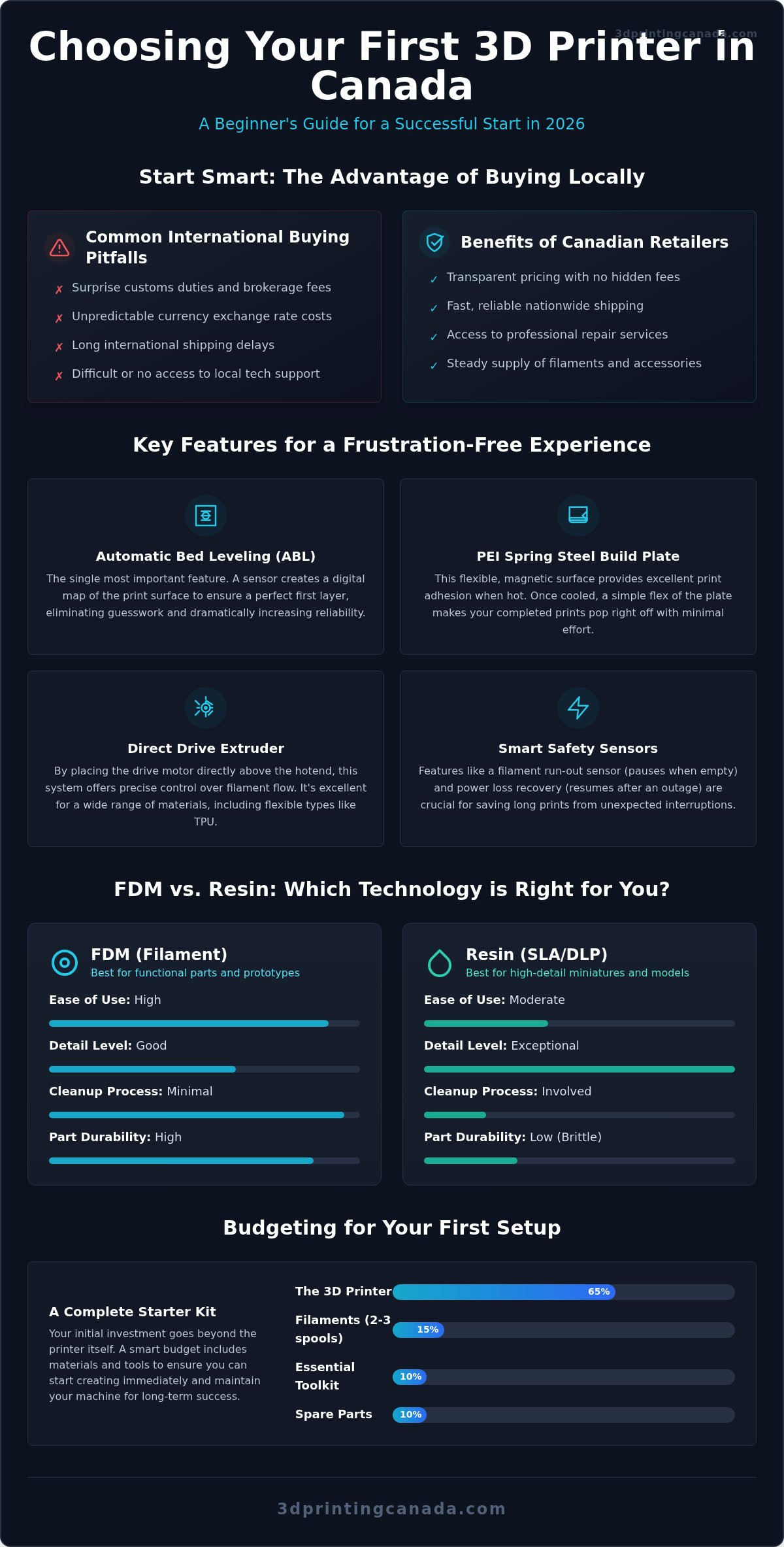
The logistical side of being a Canadian maker requires a bit of strategy. Buying from international retailers often leads to sticker shock once the exchange rate, shipping, and surprise customs duties hit your credit card statement. You don't want your first experience to be a three-week wait for a package that arrives with an unexpected brokerage bill. Starting locally ensures you get your gear faster and with transparent pricing. Set realistic expectations for your first week: you'll spend some time learning your slicing software, but with current tech, you should be holding your first physical part by the end of day one.
Why Local Support Matters for Beginners
When you're learning, things will occasionally go wrong. A nozzle might clog or a firmware update might stall. This is where local expertise becomes your biggest asset. Having access to professional 3D printer repair services Canada ensures that a minor hardware hiccup doesn't turn your new investment into a permanent desk ornament. Beyond repairs, you need a steady supply of 3D printer filament Canada that doesn't cost a fortune in shipping. Sourcing locally means you can experiment with different colours and materials without the logistical headache of cross-border commerce.
Budgeting for Your First Setup
Don't just look at the price tag on the box. A successful setup includes more than just the hardware. You should budget for at least two or three spools of PLA filament, a basic toolkit for post-processing, and perhaps a few spare nozzles. Investing slightly more in a printer from a vetted collection often pays for itself by including better components that won't need replacing in the first six months. Choosing the best 3d printer for beginners Canada provides also means finding a system with a strong accessory ecosystem. It's the difference between a tool that grows with you and one that limits your creativity as you gain experience.
Key Features to Look for in Your First Printer
Choosing the best 3d printer for beginners Canada offers isn't about finding the fastest machine on the market. It's about identifying features that automate the "boring" or difficult parts of the process. In the early days of the hobby, users spent hours turning knobs to level a bed or scraping plastic off glass plates with dangerous putty knives. Today, the focus has shifted toward a "set it and forget it" mentality. If a feature reduces the manual work required before you hit 'print,' it's a win for beginner success.
Automatic Bed Leveling (ABL) is the single most important feature you should look for. If your first layer of plastic doesn't adhere perfectly to the build surface, the entire print will eventually fail. ABL uses a sensor to measure the distance between the nozzle and the bed at multiple points, creating a digital map to compensate for any tiny imperfections. It eliminates the guesswork and ensures a reliable start every time.
Another game-changer is the PEI Spring Steel Build Plate. These flexible sheets provide excellent adhesion when hot and release the part naturally as they cool. You can simply remove the sheet, give it a slight flex, and your print pops right off. Combine this with a Direct Drive Extruder, which sits directly above the nozzle to push filament with more control, and you have a system that handles everything from standard PLA to flexible materials with ease. If you're ready to see these features in action, you can browse our vetted selection of beginner machines to find a model that fits your workspace.
The Power of Automation
Small sensors make a massive difference in your daily workflow. A filament run-out sensor acts like a "fuel gauge" for your printer; if the spool finishes mid-print, the machine pauses and waits for you to load more instead of continuing to print nothing. Similarly, power loss recovery ensures that a brief flicker in the grid doesn't ruin a 20-hour project. These automated safeguards turn potential disasters into minor pauses, protecting your time and your materials.
Connectivity and Software Ease
Modern workflows should be seamless. While older printers relied on physical SD cards, the best 3d printer for beginners Canada hobbyists choose in 2026 typically features Wi-Fi connectivity. This allows you to send files directly from your computer and monitor progress via a smartphone app. Pair this with a touchscreen interface and "one-click" slicer presets, and the technical barrier to entry virtually disappears. You don't need to be a software expert to get professional results right out of the box.
FDM vs. Resin: Which Technology Should You Choose?
The choice between FDM and resin is the first major fork in the road for any new maker. For most people hunting for the best 3d printer for beginners Canada has to offer, FDM (Fused Deposition Modeling) is the logical starting point. It's clean, the materials are affordable, and the machines are robust enough for a home office or garage. Resin, while capable of staggering detail, introduces a chemical workflow that requires a dedicated, well-ventilated space. Understanding what you want to create will dictate which path you take.
The Case for FDM as Your First Printer
FDM is the workhorse of the hobby. If you want to print a custom bracket for your desk, a phone stand, or functional parts for a workshop, filament is the way to go. You'll find a massive variety of PLA filament Canada wide, ranging from matte finishes to "silk" textures that shine like polished metal. The learning curve is gentle because troubleshooting usually involves mechanical adjustments you can see and feel. Plus, the prints are durable and ready to use the second they come off the build plate without any messy chemical baths.
When to Consider Resin Instead
Resin printing is the specialist's choice. If your goal is to produce tabletop miniatures with microscopic detail or intricate jewellery, a filament printer might leave you disappointed. Resin excels at capturing organic curves and sharp edges that FDM simply cannot match. This technology is often the final step in a digital workflow that begins with 3D scanners, allowing you to replicate real-world objects with incredible fidelity. However, you must account for the "mess factor." You'll need nitrile gloves, isopropyl alcohol for washing, and a UV station for curing. It's a more involved process that demands a dedicated, permanent workspace away from living areas.
Safety and cost are the final pieces of the puzzle. FDM is generally cheaper to run day-to-day; a standard 1kg spool of PLA is highly economical and widely available across the country. Resin requires ongoing purchases of chemicals and safety gear like filters and masks. While PLA is generally considered safe for indoor use, resin fumes require active ventilation to keep your home air clean. If you don't have a workshop or a room with a window and an exhaust fan, stick with FDM for your first machine. It's the most reliable way to ensure your search for the best 3d printer for beginners Canada leads to a hobby you actually enjoy rather than a chore you avoid.
Top-Rated Beginner 3D Printers for 2026
Choosing the best 3d printer for beginners Canada involves more than just reading a spec sheet. You need a machine that has been tested in real-world Canadian workshops and backed by a community that can help when you have questions. Our Best Selling collection serves as a vetted shortlist, featuring hardware that consistently delivers high success rates for first-time users. This curation ensures you find the best 3d printer for beginners Canada has available without the guesswork of trial and error.
The Bambu Lab Ecosystem
The Bambu Lab A1 series has redefined what people expect from an entry-level machine. These printers are essentially the "smartphones" of the 3D printing world; they arrive almost entirely assembled and perform a series of self-checks before every print. One of the most exciting features for beginners is the AMS Lite system, which allows for multi-colour printing without the need for manual filament swaps mid-project. It's a massive leap forward in accessibility. To keep these machines running at peak performance, having a local source for Bambu Lab accessories Canada is vital. You'll eventually need new build plates or hardened steel nozzles to experiment with different materials, and sourcing them within the country prevents long waits and high shipping costs.
Affordable Entry-Level Workhorses
If you're the type of maker who wants to understand the mechanics of your machine, the Creality Ender series remains a fantastic choice. While modern versions like the Ender 3 V3 SE include the auto-leveling features we discussed earlier, they still offer a more "hands-on" experience. These printers have a massive global community, meaning you can find a tutorial or a custom upgrade for almost any project you can imagine. They strike a perfect balance between price and performance, offering a reliable path into the hobby for those who might be budget-conscious but still want a machine that can produce professional-quality parts.
High-Speed Alternatives
Speed matters. In 2026, the industry has shifted toward machines that can complete a standard benchy test print in under 20 minutes. Investing in a fast 3D printer Canada allows you to iterate on your designs much quicker. Instead of waiting all day to see if a part fits, you can print, test, and adjust within a single afternoon. These high-speed models often include more robust frames and advanced vibration compensation to ensure that quality isn't sacrificed for velocity.
Ready to start your first project? Browse our Best Selling collection to find a machine that matches your creative goals and budget.
Setting Up for Long-Term Success
Your journey doesn't end once the first test print is sitting on your desk. To turn this hobby into a long-term passion, you need a workspace that supports your creativity. Find a sturdy, level surface in a well-ventilated room. Vibration is the enemy of print quality, so a wobbling desk will lead to visible artifacts on your models. Even the best 3d printer for beginners Canada offers will eventually require a bit of hands-on attention to keep it running like new. Beyond the hardware, immerse yourself in the Canadian 3D printing community. Sharing your projects on local forums or social media groups is the fastest way to find inspiration and solve unique challenges.
Essential Maintenance for Beginners
Consistent maintenance is the secret to a reliable machine. Get into the habit of cleaning your build plate with 99% isopropyl alcohol after every few prints. Finger oils are the primary cause of adhesion failure, and a quick wipe ensures your next project stays firmly attached. You should also monitor your nozzle for wear. If you notice inconsistent extrusion or "zits" on your print surface, it might be time for a replacement. Always perform nozzle swaps while the hotend is at its target temperature to prevent damage to the threads. Finally, protect your investment by keeping your filament dry. Canadian weather can be unpredictable, and high humidity leads to "wet" filament that pops and strings during a print. Use airtight containers with desiccant packs to maintain material quality.
Your Next Steps as a Maker
Once you've mastered the basics of PLA printing, it's time to expand your horizons. Start exploring functional materials like PETG for its heat resistance or TPU for its incredible flexibility. These materials open up new possibilities, from custom automotive parts to flexible gaskets for household repairs. Don't stop at downloading models from the web, either. Start learning basic 3D design using free, beginner-friendly CAD tools. Transitioning from a consumer to a creator is the most rewarding part of the maker experience. It allows you to solve specific problems around your home with custom-designed solutions. Finding the best 3d printer for beginners Canada provides is just the first step toward a lifetime of building and fixing.
Ready to start? Browse our Best Selling collection today!
Ready to Bring Your Ideas to Life?
Entering the world of 3D printing has never been more straightforward than it is right now. By choosing a machine with automated features like bed leveling and a flexible build plate, you remove the barriers that used to frustrate new makers. Whether you opt for the high-speed efficiency of a Bambu Lab model or the classic customizability of a Creality Ender, the best 3d printer for beginners Canada offers is the one that gets you printing successfully on day one. You've seen how automation and the right technology choice can turn a complex hobby into an accessible creative outlet.
Avoid the stress of international shipping and hidden fees by shopping locally with a partner who understands the Canadian market. We provide fast nationwide shipping and expert technical support to ensure you're never left troubleshooting alone. Our vetted beginner-friendly models are selected specifically to guarantee your long-term success. It's time to stop watching videos and start making your own functional parts, custom tools, and unique art. Shop the Best Selling 3D Printers in Canada and join a growing community of creators today. We're here to support every layer of your journey!
Frequently Asked Questions
What is the best 3D printer for a beginner in Canada for under $500?
The Bambu Lab A1 standalone printer is a standout choice for those seeking the best 3d printer for beginners Canada under $500. It arrives nearly fully assembled and features high-speed printing with automated calibration. If you want to spend even less, the Creality Ender 3 V3 SE offers automatic bed leveling at an entry-level price point. Both models ensure you spend more time creating and less time troubleshooting mechanical assembly issues during your first week.
How hard is it to assemble a 3D printer for the first time?
Modern printers have moved away from the complex "box of bolts" assembly of the past. Most beginner-friendly models in 2026 arrive as semi-assembled kits that require only a few screws and cable connections. You can typically have the machine ready for its first calibration in under 30 minutes. Manufacturers now include detailed video guides and clearly labeled toolsets to ensure that your first experience is rewarding rather than overwhelming or confusing for a new user.
Do I need a computer to use a 3D printer?
You will need a computer to run "slicer" software, which is the tool that translates 3D designs into instructions for your printer. While many modern machines allow you to start prints and monitor progress through a smartphone app, the initial file preparation still requires a desktop or laptop. Most slicing software is free to download and works on standard Windows or Mac systems, making it very accessible for anyone just starting their creative journey.
Is 3D printing an expensive hobby to maintain?
After the initial purchase of the hardware, 3D printing is surprisingly affordable to maintain. Your primary ongoing costs will be filament and the occasional replacement nozzle or build plate. A single 1kg spool of filament can produce dozens of small models or several large functional items. Electricity usage is minimal, comparable to running a small desktop computer. It's a hobby that offers significant value, especially when you begin designing your own custom household repairs.
Can I leave my 3D printer running while I am out of the house?
It is common for makers to leave their machines running, but you should always prioritize safety. Modern printers include thermal runaway protection to prevent overheating, yet it's wise to use a remote monitoring system. Many printers now feature built-in cameras and Wi-Fi connectivity so you can check the progress from your phone. For long-term peace of mind, ensure your "Maker Space" is equipped with a smoke detector and is clear of any flammable materials before you leave.
What is the easiest 3D printing software for beginners to use?
Bambu Studio and Creality Print are currently the most intuitive options for those new to the hobby. These programs feature "one-click" presets that automatically adjust settings based on the specific printer and filament you are using. This eliminates the need to learn complex technical jargon before you can start making. As you gain confidence, these tools also offer "expert modes" that allow you to fine-tune every detail of your printing process for even better results.
Where can I get my 3D printer repaired if I cannot fix it myself?
If you encounter a hardware issue you can't resolve, 3D Printing Canada offers professional 3D printer repair services for customers across the country. Our expert technicians understand the specific challenges beginner hobbyists face and can quickly diagnose everything from clogged extruders to firmware glitches. Accessing local Canadian support prevents your machine from becoming a permanent paperweight while ensuring you have a reliable partner to keep your maker journey on track for the long term.
How much does 3D printer filament cost in Canada?
Standard 1kg spools of PLA filament in Canada generally cost between $11.99 and $29.99 CAD depending on the brand and specific finish. Specialty materials like PETG or silk-textured filaments might sit at the higher end of that range. When budgeting for your first setup, we recommend starting with two or three spools of high-quality PLA. Buying from a domestic supplier ensures you get consistent material quality without the high shipping fees or duties of international orders.