
Why does it feel like your 3D printer spends more time on the repair bench than the workbench? If you've ever spent a Saturday afternoon fighting a stubborn nozzle clog or waiting weeks for a replacement part to clear customs, you know that technical specs don't mean much if the machine won't actually run. You want a tool that works as hard as you do, not a second job as a full-time repair technician.
We understand that frustration because we've lived it. You've likely realized that finding the most reliable 3d printer Canada offers involves more than just looking at print speeds; it's about finding a robust machine backed by local expertise. This 2026 guide promises to help you cut through the marketing noise and discover which printers deliver consistent, high-quality results in the Canadian climate. We will explore the latest hardware from leaders like Bambu Lab, show you how to avoid the failed print trap, and explain why having a local Canadian support team is your best defense against downtime. Get ready to spend your time creating instead of calibrating.
Key Takeaways
- Learn how to identify the most reliable 3d printer Canada has to offer by focusing on consistency and minimal assembly requirements.
- Discover which innovative printer designs and advanced systems are leading the market in automated reliability for 2026.
- Understand which technical features, from superior cooling to specific bed surfaces, are essential for preventing clogs and failed prints.
- Avoid the "border headache" by choosing machines that meet Canadian safety standards and offer accessible local technical support.
- Match your specific needs with a printer that prioritizes high-quality output and a "set it and forget it" user experience.
What Makes the Most Reliable 3D Printer in Canada?
Reliability isn't just about a successful first print. It's about the machine's ability to produce consistent quality over hundreds of operating hours without needing a complete teardown. When searching for the most reliable 3d printer Canada offers, you're looking for a tool that handles the heavy lifting while you focus on the creative side. The "out-of-the-box" factor is a major part of this; minimal assembly means fewer loose bolts or misaligned axes from the start. To truly understand What is 3D Printing? in a professional context, you must look past the marketing and examine the internal components that keep the filament moving. Essentially, 3D printer reliability is the intersection of mechanical precision and user-friendly software.
Mechanical Stability and Build Quality
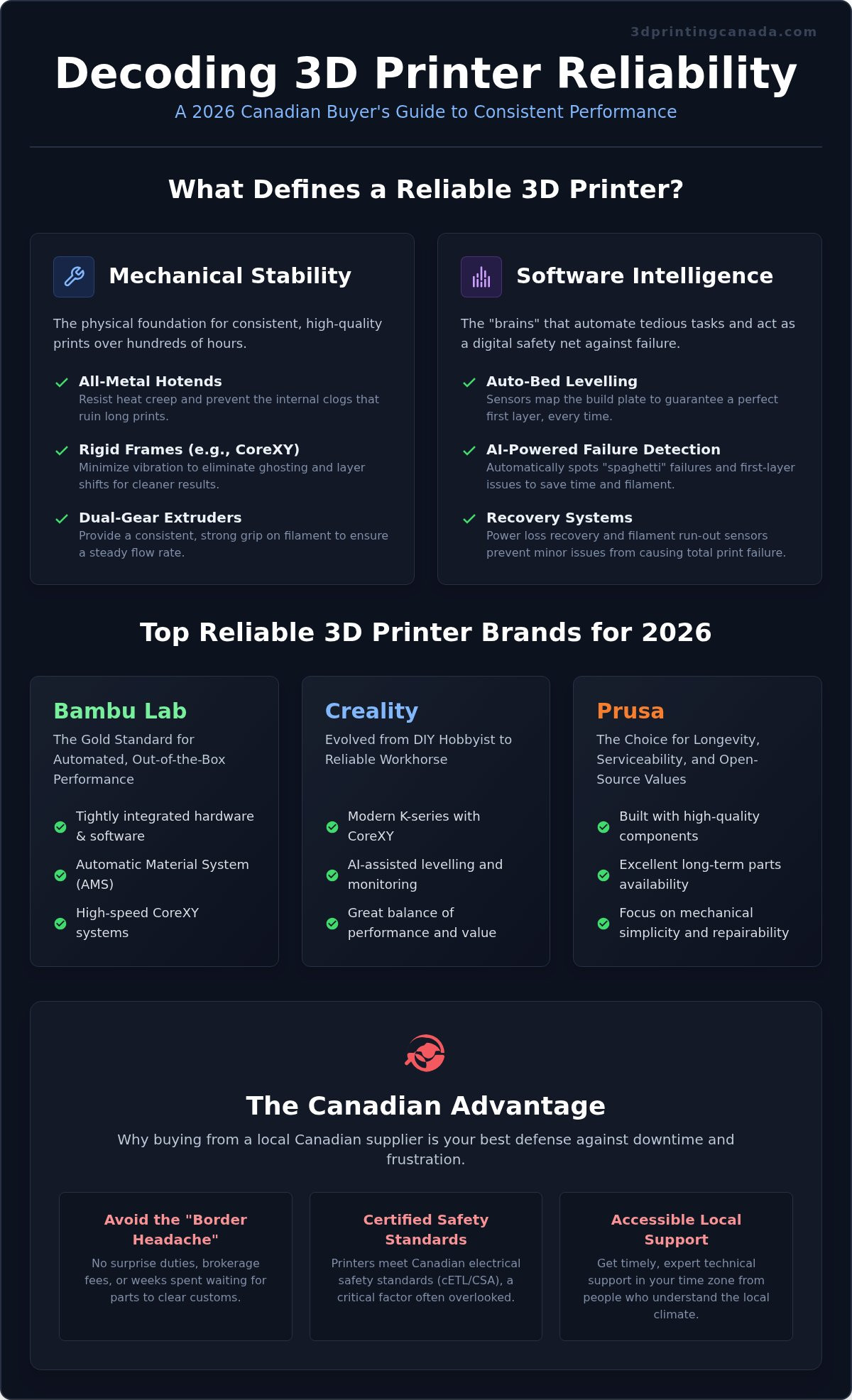
A machine's physical design dictates its longevity. All-metal hotends are a standard requirement for reliability because they resist the internal heat creep that causes mid-print clogs. Rigid frames, particularly CoreXY systems, minimize the vibrations that lead to ghosting or layer shifts. These systems remain square and true far longer than cheaper Cartesian kits. We also prioritize dual-gear extruders. They provide a consistent grip on the filament, ensuring the flow never stutters during a long overnight job. Choosing a printer with minimal assembly also cuts down on human error during setup, as factory-calibrated machines have fewer mechanical loose ends.
Software Intelligence and Failure Detection
Even the best hardware needs smart brains to stay operational. Manual bed levelling used to be a rite of passage, but now it's just a common point of failure. Modern auto-bed levelling systems use sensors to map the build plate, ensuring the first layer is perfect every single time. This is critical for the most reliable 3d printer Canada users can buy, as it removes the guesswork that leads to peeling parts. AI-powered features like spaghetti detection and first-layer inspection act as a digital safety net. Along with power loss recovery and filament run-out sensors, these software tools prevent a minor glitch from turning into a wasted roll of material.
Top Reliable 3D Printer Brands for 2026
Brand reputation in the 3D printing world has shifted dramatically over the last few years. It's no longer enough to offer the fastest print speeds or the largest build volumes. Users now demand machines that simply work every time they hit "print." Identifying the most reliable 3d printer Canada has available means looking at how these brands handle long-term wear and how easily you can find replacement parts when something eventually does wear out. In 2026, three names continue to dominate the conversation for those who value uptime over tinkering.
Bambu Lab: The Reliability Leader
Bambu Lab has set a new benchmark for what "out-of-the-box" performance looks like. Their X1 and P1 series machines are widely considered the gold standard for automated reliability. By integrating sophisticated sensors and a tightly controlled ecosystem, they've removed many of the manual hurdles that used to cause failed prints. One of their biggest advantages is the Automatic Material System (AMS). This system doesn't just allow for multi-colour prints; it acts as a sealed, moisture-controlled dry box that manages filament changes without human intervention. This significantly reduces the risk of jams caused by brittle or poorly loaded filament. To keep these machines running at peak performance, you'll want to stay stocked on genuine Bambu Lab accessories Canada offers, ensuring your sensors and nozzles remain in top shape.
Creality has also undergone a massive transformation. Once known as the brand for people who loved to spend weekends upgrading their machines, their newer K series and SparkX models have evolved into true workhorses. They've adopted the CoreXY motion system and integrated AI-assisted levelling, making them much more dependable for daily use. Meanwhile, Prusa remains the choice for those who value longevity. Their commitment to open-source designs and high-quality components means a Prusa machine bought today will likely still be serviceable five years from now. While Bambu Lab focuses on high-tech automation, Prusa focuses on mechanical simplicity and long-term part availability.
Professional-Grade Desktop Options
For small businesses and high-volume creators, the cost-to-reliability ratio is the most important metric. You need a machine that doesn't require a dedicated technician to stay operational. Professional-grade desktop units often feature user-replaceable parts, such as modular tool heads or quick-swap nozzles. This design philosophy minimizes downtime because you can fix common issues yourself in minutes rather than days. When your livelihood depends on your output, having a machine that is easy to maintain is just as important as having one that rarely breaks. If you ever find yourself facing a technical hurdle you can't clear on your own, our 3D printer repair services are available to help get your production line moving again.
Finding the most reliable 3d printer Canada provides involves balancing these brand strengths against your specific workload. Whether you choose the cutting-edge automation of Bambu Lab or the proven endurance of a Prusa, the key is choosing an ecosystem that supports your creative goals without adding unnecessary stress to your workflow.
Technical Features That Prevent Common Failures
Understanding the internal mechanics of your machine is the best way to ensure a "set it and forget it" experience. While many hobbyists focus on speed, the most reliable 3d printer Canada users can invest in is often defined by its ability to manage heat and maintain adhesion over long durations. Heat creep, where filament softens before reaching the melting zone, is a primary cause of mid-print clogs. Superior cooling designs, featuring high-static pressure fans and optimized heat breaks, solve this by keeping the "cold end" actually cold. This mechanical discipline prevents the jams that often ruin overnight projects.
Bed adhesion is another critical pillar of reliability. If your part moves by even a millimetre, the print is lost. We recommend textured PEI spring steel sheets for most users. They provide excellent grip when hot and allow parts to pop off effortlessly once cooled. While glass plates offer a perfectly flat surface, they often require messy adhesives that can build up over time. Beyond the hardware, the filament itself plays a massive role in machine longevity. Low-quality materials often have inconsistent diameters or hidden debris that wears down your extruder gears. At 3D Printing Canada, we prioritize tested, high-grade filaments because we know that consistent material is the first step toward a machine that spends more time printing than being repaired.
Extruder and Hotend Design
The debate between direct drive and Bowden extruders usually comes down to weight versus control. For maximum reliability, direct drive systems are the clear winner. By placing the motor directly above the hotend, the machine has much better control over filament retraction, which is essential for preventing stringing and jams with flexible materials. If you plan to print with abrasive filaments like carbon fibre or wood-fill, ensure your machine has a hardened steel nozzle. Standard brass nozzles can wear out in just a few hundred grams of abrasive material, leading to poor print quality. Quick-swap hotends are another feature to look for; they allow you to realize a full nozzle change in seconds, drastically reducing maintenance downtime.
The Role of Calibration and Sensors
Modern reliability is driven by smart sensors that catch errors before they become catastrophes. Vibration compensation and input shaping are now standard on high-end machines. These features allow the printer to "anticipate" the physical resonance of its own frame, keeping prints clean and sharp even at high speeds. The future of the most reliable 3d printer Canada market lies in AI-powered monitoring. Lidar sensors and built-in cameras can now detect the dreaded "spaghetti" effect or first-layer failures, pausing the print automatically to save your filament. To keep these systems sharp, always stay current with firmware updates. These software patches often include refined motor timings and better thermal runaway protections that keep your workspace safe and your machine running smoothly.
The Canadian Advantage: Why Local Support Matters
Reliability is often a logistical question. If your hotend fails and the replacement part is stuck in a customs warehouse in Ohio, your machine isn't reliable for your production needs. Choosing the most reliable 3d printer Canada has to offer means selecting a tool backed by a local ecosystem. This includes ensuring your machine is built for our 120V power standards and carries necessary CSA or UL safety certifications. Without these, you may face insurance hurdles or electrical instabilities that a generic international model won't account for.
Our diverse Canadian climate also plays a significant role in machine performance. Whether you're operating in a more humid environment or a drier setting, filament will react differently to ambient moisture levels. A reliable setup in Canada requires a partner who can advise on climate-specific settings and dry box solutions. When hardware eventually wears down from heavy use, having access to professional 3D printer repair services Canada provides ensures you aren't left stranded by international shipping delays. We believe reliability is a three-legged stool: robust hardware, smart software, and local technical support.
Shipping, Duties, and Spare Parts
Importing a printer might look like a deal on paper, but the hidden costs of duties and brokerage fees often erase those savings. More importantly, a reliable machine requires a steady supply of consumables like nozzles, belts, and fans. Having a Canadian stockist means you can get back to work in days, not weeks. We prioritize fast nationwide shipping from our domestic hub to keep your downtime to an absolute minimum. Whether you're in a busy city centre or a remote town, getting parts quickly is the only way to maintain a truly reliable workflow.
Technical Expertise and Community
There is immense value in a mentor-style support team that understands the Canadian market. A yearly professional tune-up can significantly extend the life of your printer, catching small mechanical misalignments before they cause a major failure. You can realise the benefit of a local repair centre when complex hardware issues arise that go beyond a simple nozzle swap. Our technicians bring years of hands-on experience to every machine they service, providing a safety net that international retailers simply cannot match. If you're ready to invest in a machine that is actually supported where you live, explore our range of 3D printers and local support services today.
Finding Your Match: Which Reliable Printer is Best for You?
Choosing a machine is the final step in your journey toward a hassle-free printing experience. Reliability isn't a one-size-fits-all label; it depends entirely on how you plan to use the technology. A hobbyist printing models on weekends has different needs than a professional running a production line 24/7. To find the most reliable 3d printer Canada offers for your specific situation, you must balance your budget against the level of automation you require. Don't just look at the price tag. Consider how much your time is worth when things go wrong.
For the best all-rounder, we typically point users toward machines like the Bambu Lab P1S. It balances high-speed output with a price point that makes sense for most serious makers. If you are a beginner, prioritize machines with fully automated calibration and enclosed build chambers to ensure safety and ease of use. Small businesses, however, should look for high-duty cycle workhorses. These machines are designed for 24/7 operation and often feature more robust motion systems that can handle thousands of hours of wear before needing a service. No matter your choice, ensure the machine fits your specific environment and technical comfort level.
Decision Framework: Questions to Ask
Before you hit the checkout button, ask yourself what materials will dominate your workflow. If you only plan to use PLA, a standard open-frame printer might suffice. If you need engineering-grade plastics like Nylon or Polycarbonate, an enclosure and a high-temperature hotend are non-negotiable for reliability. Be honest about your "tinkering" threshold. Do you want to build the machine from a kit, or do you need it to work five minutes after unboxing? Additionally, consider if your workflow requires more than just printing. If you are doing reverse engineering or quality control, check out our 3D scanner Canada guide to see how scanning technology integrates with your new printer.
Your Reliability Checklist
A smart purchase is one that considers the "what if" scenarios. Use this checklist to verify your choice:
- Local Spare Parts: Does your retailer stock nozzles, belts, and fans in Canada? Don't wait weeks for international shipping.
- Canadian Warranty: Verify that your machine is covered by a robust warranty that doesn't require shipping the unit back across an international border.
- Technical Safety Net: Choose a partner that offers both the hardware and the repair expertise. Knowing you can drop your machine off for a professional tune-up provides immense peace of mind.
Finding the most reliable 3d printer Canada has available is about more than the hardware. It's about picking a partner that supports your creative success. By focusing on local support and verified technical features, you can spend less time fixing your printer and more time bringing your ideas to life.
Start Your Next Project with Confidence
Reliability is more than a line on a spec sheet. It's the peace of mind that comes from knowing your machine will finish what it starts. You now know that finding the most reliable 3d printer Canada offers requires looking at robust hardware like the Bambu Lab ecosystem and ensuring you have a local safety net for parts and repairs. Focus on machines with automated calibration and high-quality cooling to avoid the common pitfalls of clogs and failed first layers.
Ready to upgrade your workflow? Shop the Most Reliable 3D Printers and Accessories at 3D Printing Canada. We support your creative success with expert on-site repair technicians, a wide range of Bambu Lab parts in stock, and fast national shipping with no hidden import duties. Stop fighting your hardware and start realizing your vision today. We are here to help you build something incredible.
Frequently Asked Questions
What is the most reliable 3D printer brand available in Canada?
Bambu Lab and Prusa are the current leaders in the Canadian market. Bambu Lab offers cutting-edge automation and speed, while Prusa provides long-term part availability and mechanical simplicity. For the most reliable 3d printer Canada users can buy, the choice depends on whether you prefer a high-tech ecosystem or a machine you can easily service yourself. Both brands have excellent local support networks to keep you printing.
Do I need to be a technician to maintain a reliable 3D printer?
You don't need to be a technician, but you should be comfortable with basic mechanical upkeep. Modern "plug-and-play" machines handle most of the calibration automatically, removing the steep learning curve of the past. However, knowing how to clear a nozzle or tighten a belt will save you time. If a problem feels too complex, you can always rely on professional repair services rather than trying to diagnose everything yourself.
Why should I buy a 3D printer from a Canadian retailer instead of overseas?
Buying locally eliminates the stress of hidden duties and brokerage fees at the border. A Canadian retailer ensures the machine meets national 120V electrical standards and safety certifications. Most importantly, you get access to a domestic supply of spare parts and technical support. If your machine needs a warranty claim, shipping it within the country is much faster and cheaper than sending it back overseas.
How often does a reliable 3D printer need maintenance or repair?
A reliable machine typically needs a basic check-up every 100 to 200 hours of printing. This involves cleaning the build plate, checking belt tension, and lubricating the rails. While these machines are built for endurance, a yearly professional tune-up can catch small issues before they cause a failure. Consistent maintenance ensures your printer stays in the "set it and forget it" category for years of productive use.
Is Bambu Lab the most reliable 3D printer for beginners in Canada?
Bambu Lab is widely considered the most reliable 3d printer Canada offers for newcomers. Their machines feature LiDAR sensors and AI monitoring that catch mistakes before they waste filament. This automation removes the steep learning curve traditionally associated with 3D printing. It allows beginners to focus on designing and creating rather than spending weeks learning how to manually level a bed or tune complex stepper drivers.
What are the most common reasons a 3D printer fails during a print?
Most failures stem from poor bed adhesion, wet filament, or heat creep. If the first layer doesn't stick properly, the entire print will eventually shift and fail. Using un-dried filament causes bubbles and weak layers that can snap mid-print. Heat creep happens when the cooling fans can't keep up, causing the filament to melt and clog the extruder. Choosing a machine with superior cooling and sensors helps mitigate these risks.
Can I get my 3D printer repaired professionally in Canada?
Yes, professional repair services are readily available within Canada. Our technicians specialize in diagnosing complex hardware issues and performing precision tune-ups. Whether it is a motherboard failure or a stubborn mechanical misalignment, getting your machine serviced by experts ensures it returns to factory-standard performance. This is a much safer alternative to following unverified online tutorials that might lead to further damage or safety risks.
Does the type of filament I use affect my printer’s reliability?
Material quality is a major factor in machine longevity. Low-grade filaments often have inconsistent diameters that lead to clogs and extruder wear. Abrasive materials like carbon fibre will quickly ruin a standard brass nozzle; you must use hardened steel components for those jobs. Using high-quality, tested filaments ensures your printer's internal sensors and motors don't have to work harder than necessary to produce a clean and consistent result.