
Most makers think printing TPU on a Bowden setup is an exercise in futility, but the truth is your hardware isn't broken; it's just being asked to do something it wasn't designed for. We've all been there, staring at a tangled mess of filament inside the extruder housing while a half-finished prototype sits cold on the bed. You want the flexibility of TPU for your Canadian maker projects, but the direct drive vs bowden extruder for tpu debate often leaves you stuck with constant stringing and snail-paced speeds. It's frustrating when you just want a part that works without constant supervision.
This guide will show you exactly how to settle this hardware choice for your specific needs, so you can stop the clogs and start producing reliable, high-quality flexible parts. We'll break down the mechanical limits of each system and look at Shore hardness thresholds for 2026 hardware. Whether you're upgrading an older machine or buying something new, you'll learn how to achieve faster print times and perfect retractions. Let's get your printer dialed in so you can realize the full potential of flexible filaments and organize your workflow for success.
Key Takeaways
- Understand the mechanical physics of flexible filament to eliminate frustrating tangles and jams in your extruder housing.
- Master the direct drive vs bowden extruder for tpu comparison to choose the right hardware for Shore hardness levels ranging from 95A to 85A.
- Learn how to optimize retraction settings and print speeds to realize professional-grade results without constant supervision.
- Identify when to DIY your hardware upgrades and when to utilize expert repair services to transition your machine to a high-performance direct drive system.
- Explore specialized accessories and factory-ready printers that allow you to print high-flow TPU at significantly faster speeds for your prototypes.
The TPU Challenge: Why Extruder Choice Matters for Flexibles
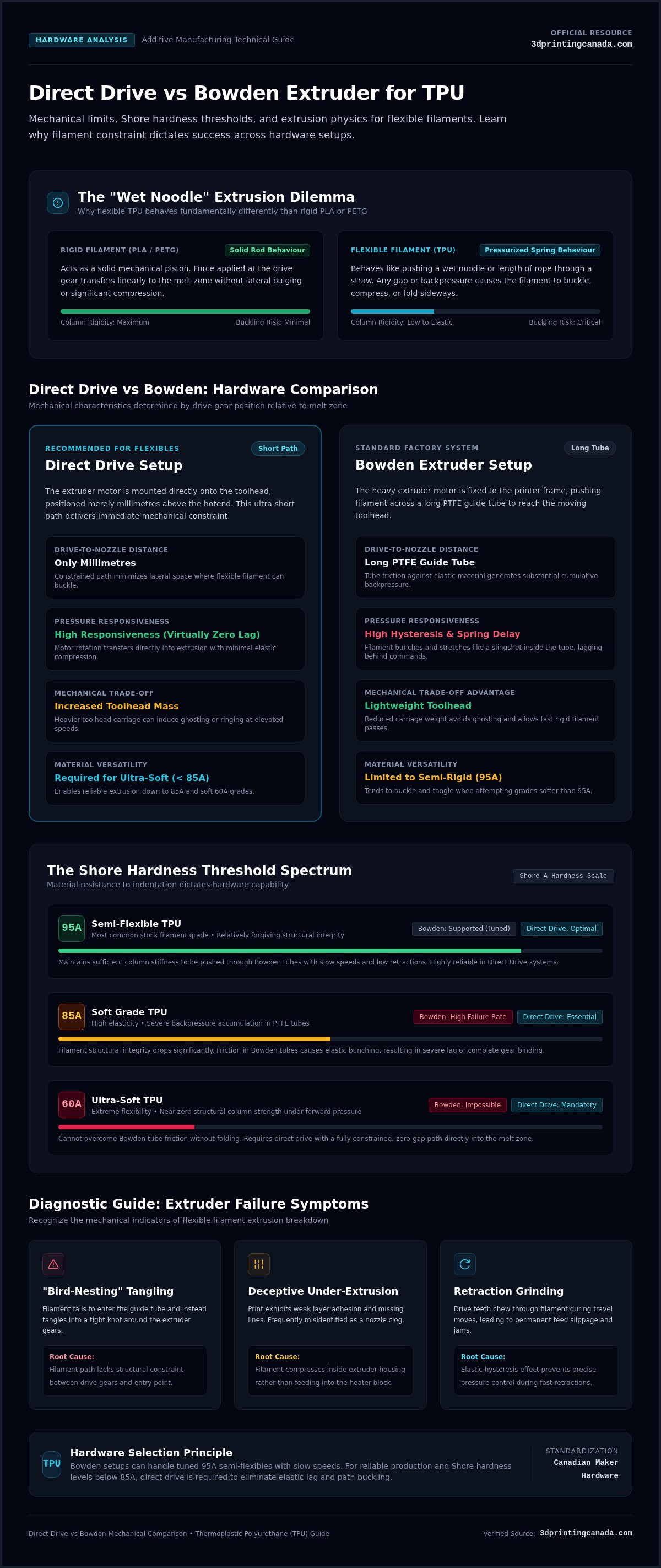
Printing flexible materials is a game changer for functional parts, but it is also the most common source of frustration in any Canadian maker's shop. The material we most frequently use is thermoplastic polyurethane (TPU), which is prized for its elasticity, oil resistance, and incredible impact strength. Unlike rigid PLA or PETG, TPU behaves like a spring under pressure. Think of the extrusion process like trying to push a wet noodle or a length of rope through a narrow straw. If there is even a tiny gap or a bit of resistance, that rope will buckle and fold rather than moving forward through the nozzle. This fundamental mechanical reality is why the direct drive vs bowden extruder for tpu debate is the single most important hardware decision you will make for your printer.
The extruder is the heart of this operation. It's responsible for grabbing the filament and forcing it into the hotend with precision. When you work with flexibles, the distance between those drive gears and the melt zone becomes the deciding factor between a successful print and a wasted afternoon. If your setup isn't optimized for these elastic properties, the filament will simply compress or expand sideways before it ever reaches the heater block. Choosing the right toolhead isn't just about speed; it's about reliability and peace of mind during those long overnight prints.
The Mechanics of Flexible Filament
To understand why hardware choice matters, you have to look at Shore hardness. This scale measures how much a material resists indentation. Most common TPUs, like the 95A variety we stock, are semi-flexible and relatively forgiving. However, as you move toward softer grades like 85A or 60A, the filament loses its structural integrity. In a Bowden setup, the friction between the filament and the long PTFE tube creates massive backpressure. Because TPU is elastic, it stretches and compresses inside that tube like a slingshot. This is why your standard PLA settings, which rely on fast movements and high retractions, usually fail. You aren't just moving a solid rod anymore; you're managing a pressurized column of rubber.
Signs Your Extruder is Struggling
You'll know your extruder is losing the battle when you see "bird-nesting." This happens when the filament fails to enter the guide tube and instead tangles itself into a messy knot around the extruder gears. It's a clear sign that the filament path isn't constrained enough. Another common symptom is deceptive under-extrusion. You might think your nozzle is clogged, but the reality is often that the filament is simply compressing inside the extruder housing rather than being pushed out. This often leads to poor layer adhesion and weak parts. If you notice that your retractions are causing the filament to grind or jam, your system is likely struggling with the "hysteresis" effect, where the elastic energy in the filament makes precise control impossible.
Direct Drive vs Bowden: Mechanical Differences Explored
The physical layout of your extrusion system dictates how much control you have over the filament. In a direct drive setup, the extruder motor is mounted directly onto the toolhead, sitting just millimetres above the hotend. A Bowden system, common on many entry-level machines across Canada, moves that heavy motor to the printer's frame. It pushes the filament through a long PTFE guide tube to reach the nozzle. This distinction is the core of the direct drive vs bowden extruder for tpu debate because it changes the distance between the drive gears and the melt zone. A shorter path means less room for the filament to bend or compress before it exits the nozzle.
When you look at a direct drive vs. Bowden extruder comparison, the most significant factor for flexibles is pressure control. Because TPU is elastic, it acts like a spring. In a long Bowden tube, that spring can stretch and bunch up, leading to a delay between the motor moving and the plastic actually extruding. Direct drive systems eliminate most of this "lag," providing a much more responsive experience. However, this comes at the cost of weight. A heavier toolhead can lead to ghosting or ringing at high speeds, which is why many Canadian makers still weigh the benefits of both systems based on their specific project goals.
Direct Drive: The Short Path Advantage
The primary benefit of direct drive is the constrained filament path. By keeping the distance between the drive gears and the nozzle as short as possible, you significantly reduce the chance of the filament buckling. This setup is almost mandatory if you want to print ultra-soft materials, such as those with a Shore hardness below 85A. Retraction control is also vastly superior. Since there is very little filament to "stretch" between the gears and the tip, you can use shorter retraction distances, usually between 0.5 mm and 2.0 mm. This precision is what stops the messy stringing that often ruins TPU parts.
Bowden: The Lightweight Speedster
Bowden extruders excel at speed because the moving part of the printer is much lighter. By removing the motor from the X-axis carriage, the printer can accelerate and decelerate faster without vibrating. The downside is the "spring effect" mentioned earlier. To print TPU successfully on a Bowden setup, you often need a specialized extruder housing that supports the filament immediately after it leaves the gears. Without this support, the filament will simply squeeze out of the side of the extruder. If you find your current setup is failing to handle these materials, you might consider our 3D printer repair services to help you transition to a more capable direct drive toolhead.
The Shore Hardness Factor: Matching Filament to Hardware
Shore hardness is the primary metric for TPU flexibility. It determines how much a material will compress or bend under the pressure of your extruder gears. To understand these ratings, we look at the ASTM D2240 standard for durometer hardness, which provides the framework for grading elastomers like TPU. Most filaments use the Shore A scale. A 95A TPU feels like a hard shopping cart wheel; it's flexible but holds its shape. When you drop down to 85A, it feels more like a pencil eraser. By the time you reach 60A, you're dealing with something as soft as a rubber band.
This rating is the most important factor in the direct drive vs bowden extruder for tpu debate. A 95A filament is often called the "gateway" TPU because it possesses enough column strength to survive the trip through a Bowden tube without immediately buckling. However, once you venture below 90A, the mechanical limits of a Bowden setup become obvious. The filament simply doesn't have the structural integrity to overcome the friction of a 40-centimetre PTFE tube. It will compress, expand, and eventually jam before it ever reaches the nozzle.
Printing 95A TPU on a Bowden Setup
Success with 95A TPU on a Bowden machine is entirely possible if you adjust your approach. You must reduce your print speeds significantly, usually to around 20 mm/s, to minimize backpressure. It's also wise to minimize or even disable retractions entirely to prevent the filament from grinding at the gears. Using high-quality, tight-tolerance PTFE tubing is essential here. Standard tubes often have too much internal wiggle room, but a premium tube with a 1.9 mm inner diameter keeps the filament constrained. This setup works well for many functional projects across Canada, from vibration dampeners to protective bumpers.
When Direct Drive is Mandatory
For anything softer than 85A, direct drive isn't just a recommendation; it's a requirement for repeatable results. Materials like NinjaFlex require a toolhead where the distance between the drive gears and the heatbreak is nearly zero. Industrial-grade parts that need maximum "squish" or grip rely on this reliability. If you're planning to print gaskets, seals, or wearable tech, the direct drive vs bowden extruder for tpu choice is clear. Direct drive provides the fully constrained path needed to prevent the filament from escaping the drive gears, ensuring your prints finish successfully without constant supervision.
Optimization and Upgrades: Tuning for Success
Hardware optimization is a vital step in mastering the direct drive vs bowden extruder for tpu debate. Even a well designed system will fail if the extruder gears cannot maintain a firm grip on the material. Standard single gear extruders often slip on the waxy surface of TPU, leading to inconsistent extrusion and failed prints. Upgrading to a dual gear extruder is one of the most effective ways to improve reliability. These systems grip the filament from both sides, providing double the surface area for pushing force and significantly reducing the chance of the material flattening or slipping during high pressure movements.
Environmental factors across Canada also play a massive role in your printing success. TPU is highly hygroscopic, meaning it acts like a sponge for moisture. Whether you are dealing with humid summers or the dry indoor air of a Canadian winter, your filament can become saturated quickly. This moisture turns to steam inside the hotend, leading to popping sounds, bubbles, and weak layer adhesion. Always store your flexibles in a dedicated dry box with plenty of desiccant. If you are struggling to get your hardware to cooperate with these environmental variables, our 3D printer repair services Canada can help you calibrate your machine for peak performance.
Essential Hardware Upgrades
Heat creep is a common enemy of flexible prints. When heat travels up from the nozzle into the cold zone, the TPU softens prematurely and jams. Installing a bimetal heatbreak creates a sharp thermal transition that prevents this issue. You might also consider a direct drive conversion kit. These kits allow you to mount your existing motor directly above the hotend, effectively shortening the filament path. Don't overlook your nozzle choice either. While a 0.4 mm nozzle is standard, switching to a 0.6 mm nozzle reduces backpressure, making it much easier for the extruder to push flexible material through the melt zone.
Slicer Settings for TPU
Your slicer settings must account for the elastic nature of the filament. Because TPU compresses, you often need to increase your flow rate to 105% or 110% to ensure enough plastic actually exits the nozzle. Speed is equally critical. On a Bowden setup, keep your speeds between 20 and 30 mm/s to prevent the filament from buckling inside the tube. If you have moved to a direct drive system, you can often push this to 40 mm/s or higher. Retraction is the final piece of the puzzle. Disable it entirely for Bowden prints to avoid grinding, but for direct drive, a small retraction of 0.5 mm to 1.5 mm will help eliminate stringing without causing jams. Ready to test your settings? You can browse our selection of TPU filaments to find the perfect colour for your next project.
Choosing the Right Setup at 3D Printing Canada
Deciding on the final configuration for your workspace involves balancing your specific project needs with the mechanical realities of flexible materials. While the direct drive vs bowden extruder for tpu debate has traditionally been a source of frustration, modern hardware has simplified the decision for makers across the country. Today, many professional and hobbyist machines ship with integrated toolheads designed to handle a wide range of Shore hardness levels right out of the box. For those looking to invest in new equipment, leveraging fast 3D printer Canada technology ensures you are equipped with the high-torque motors and constrained paths necessary for 2026 production standards.
If you are looking to enhance an existing setup rather than purchasing a new machine, selecting the right Bambu Lab accessories Canada or third-party conversion kits is a smart way to modernize your workflow. Buying from a specialized Canadian retailer provides more than just hardware; it gives you access to a community of experts who understand the nuances of these upgrades. We provide national support to makers in every province, ensuring you have the technical guidance required to optimize your extrusion system. This local expertise is invaluable when you are trying to realize the perfect balance of speed and reliability in a professional environment.
Top Printer Recommendations for TPU
- Bambu Lab X1 and P1 Series: These machines are the current gold standard for integrated direct drive performance. They feature a nearly zero-tolerance filament path that allows for high-flow TPU printing at speeds that far exceed traditional Bowden limits.
- Creality Ender Series: These printers remain the most popular candidates for direct drive conversion. By swapping the stock setup for a specialized toolhead, you can turn a versatile budget machine into a dedicated flexible-filament specialist.
- Prusa MK4: This printer offers incredible reliability with its Nextruder system. The planetary gear set provides the precise control needed to manage the elastic "spring" of softer elastomers without causing jams or under-extrusion.
Your Next Steps with 3D Printing Canada
Ready to start your next flexible project? Browse our curated selection of TPU filaments, featuring everything from functional 95A to ultra-soft 85A grades. If the technical side of the direct drive vs bowden extruder for tpu transition feels like a barrier, our in-house technicians are available for professional extruder upgrades and repair services. We ensure your hardware is fully optimized so you can stop clearing clogs and start creating. Explore our full inventory online and take advantage of national shipping and expert support designed for the Canadian maker community.
Level Up Your Flexible Printing Game
Successfully printing flexibles is a significant milestone, turning your machine into a versatile tool for functional, real-world applications. As we have explored, the direct drive vs bowden extruder for tpu decision isn't just about motor placement; it's about matching your hardware's mechanical constraints to the specific elasticity of your filament. Whether you choose to optimize your current setup with a dual-gear extruder or transition to a modern integrated toolhead, the goal is always achieving consistent, repeatable results without the frustration of constant jams.
By addressing the challenges of filament compression and managing environmental factors like moisture, you can move past troubleshooting and focus on production. We are proud to be your authorized partner for the best hardware in the industry, providing the specialized parts and expert technical support required to keep your machines running at their peak across Canada. Shop our full range of TPU-ready printers and upgrades today!
Take the knowledge you have gained about Shore hardness and path constraints to push your creative boundaries. We are here to support your success with national shipping and dependable guidance every step of the way. Happy printing!
Frequently Asked Questions
Can I print TPU on an Ender 3 with a Bowden tube?
Yes, you can print TPU on an Ender 3 with its stock Bowden setup, but you should stick to Shore 95A materials. Keep your print speeds between 15 and 25 mm/s and minimize retractions to prevent jams. If you find the stock extruder is struggling, we offer conversion kits that simplify the direct drive vs bowden extruder for tpu transition. This makes your budget machine much more capable for flexible projects.
Does direct drive make 3D printing slower due to weight?
Direct drive toolheads are heavier, which can lead to vibrations or ghosting at extreme speeds. However, modern printers use advanced firmware to compensate for this mass. When you're working with flexibles, the trade-off is almost always worth it. The precision you gain in extrusion and retraction control far outweighs the minor speed limitations seen on older hardware designs. It's about getting the part right the first time.
What is the best Shore hardness for beginners printing TPU?
Shore 95A is the best starting point for any maker new to flexibles. It offers a perfect balance of elasticity and column strength, making it much easier to feed through various extruder types. This "gateway" TPU is less likely to buckle than softer 85A or 60A variants. It's the ideal choice for functional parts like phone cases, vibration dampeners, and protective bumpers across Canada.
Why does my TPU filament keep tangling in the extruder gears?
Tangling, or "bird-nesting," happens when there's too much space between your extruder gears and the entrance to the hotend. Because TPU is flexible, it will take the path of least resistance if it encounters any backpressure. If your gears aren't fully constrained, the filament will simply squeeze out of the side and wrap around the drive shaft. Upgrading to a tighter extruder housing usually solves this problem and ensures reliable feeding.
Do I need a special nozzle to print flexible filament?
You don't necessarily need a special nozzle, but using a larger 0.6mm diameter can significantly reduce backpressure. This makes it easier for your extruder to push the filament through the melt zone without buckling. Standard brass nozzles work well for most TPUs. If you're printing specialized abrasive flexibles, you'll want to switch to a hardened steel nozzle to prevent premature wear and maintain your print quality over time.
How do I store TPU filament in the dry Canadian winter?
Even during a dry Canadian winter, you must store your TPU in an airtight container with plenty of desiccant. Indoor environments can still hold enough moisture to ruin a spool. TPU is highly hygroscopic; it will absorb moisture from the air, which then turns to steam inside your hotend. This causes popping, stringing, and poor surface finish. Always dry your filament if it has been left out for more than a few hours.
Is direct drive better for PLA and PETG too, or just TPU?
Direct drive provides tangible benefits for PLA and PETG by allowing for much shorter and more precise retractions. This significantly reduces the messy stringing often associated with PETG. While Bowden systems are still popular for lightweight, high-speed PLA printing, a direct drive setup is a more versatile all-around choice. It gives you the freedom to switch between rigid and flexible materials without constantly reconfiguring your hardware or worrying about jams.
Can a Bowden extruder handle high-speed TPU printing?
Bowden extruders are generally not suitable for high-speed TPU production. The "spring effect" inside the long PTFE tube makes it impossible to maintain consistent pressure at high velocities. If you try to push the speed, the filament will simply compress and jam. For those looking to leverage direct drive vs bowden extruder for tpu advantages for faster production, a modern direct drive printer like a Bambu Lab model is the most reliable way to go.