
L’étiquette « food safe » sur votre bobine de filament ne raconte qu’une partie de l’histoire, et s’y fier seul pourrait conduire à une catastrophe bactérienne. Vous avez probablement passé des heures à faire défiler des fils Reddit ou des sites de fabricants, pour finalement trouver des conseils contradictoires sur ce qui constitue réellement un filament pour imprimante 3D compatible avec les aliments. C’est une préoccupation courante. Personne ne veut offrir un emporte-pièce personnalisé qui libère des additifs ou héberge des colonies de bactéries dans ses lignes de couche poreuses. Nous comprenons le besoin d’une clarté absolue lorsque vous conciliez votre passion créative avec la sécurité de votre famille ou de vos clients.
Dans ce guide 2026, vous découvrirez la vérité essentielle sur l’impression 3D compatible avec les aliments dans le contexte canadien. Nous allons dépasser le jargon marketing pour vous montrer précisément comment gérer les certifications des matériaux, la contamination de la buse et un post-traitement efficace. Vous obtiendrez une liste de contrôle claire pour votre atelier, une compréhension des filaments à acheter au Canada, ainsi que les étapes techniques nécessaires pour rendre vos impressions véritablement sûres au contact des aliments. De l’entretien du matériel aux scellants de qualité alimentaire, nous vous accompagnons.
Points clés
- Distinguez les matériaux de qualité alimentaire des objets finaux compatibles avec les aliments afin de vous assurer que votre vaisselle personnalisée est réellement adaptée à son usage.
- Découvrez pourquoi choisir un filament pour imprimante 3D compatible avec les aliments de haute qualité n’est que la première étape d’un processus de sécurité complet.
- Identifiez les risques cachés de prolifération bactérienne dans les lignes de couche et de contamination au plomb provenant des buses en laiton standard.
- Maîtrisez la « règle d’or » du post-traitement en utilisant des revêtements époxy de qualité alimentaire pour créer des surfaces lisses et faciles à nettoyer.
- Comprenez comment organiser votre espace de production et vous approvisionner en fournitures fiables et certifiées auprès d’experts canadiens de confiance.
Comprendre la différence entre qualité alimentaire et compatible avec les aliments en impression 3D
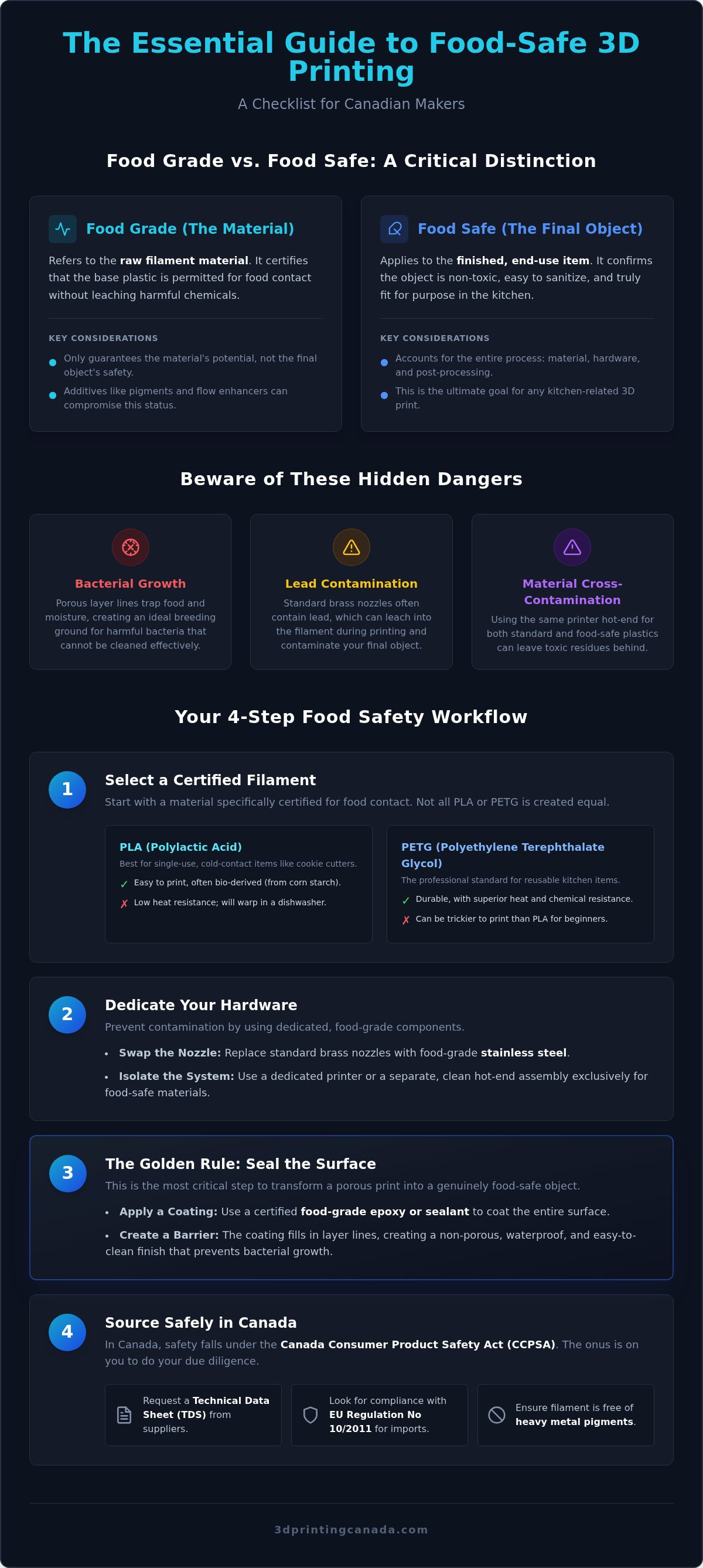
Avant d’imprimer cet emporte-pièce personnalisé, vous devez comprendre que « qualité alimentaire » et « compatible avec les aliments » ne sont pas des termes interchangeables. Dans le monde de l’impression 3D, ces étiquettes représentent deux étapes très différentes du parcours de sécurité. Lorsqu’un matériau est qualifié de qualité alimentaire, cela signifie que le plastique brut est autorisé à entrer en contact avec les aliments sans libérer de substances chimiques nocives. Cependant, un filament pour imprimante 3D compatible avec les aliments ne garantit que le potentiel du matériau; il ne tient pas compte de ce qui se passe pendant le processus d’impression lui-même.
Une désignation compatible avec les aliments s’applique à l’objet final, destiné à l’usage. Elle confirme que l’objet répond à des normes de sécurité spécifiques pour son application prévue, par exemple qu’il est non toxique et facile à désinfecter. Vous pouvez commencer avec un matériau certifié, mais si la buse de votre imprimante est sale ou si vos lignes de couche sont trop profondes, le résultat final ne sera pas sûr pour la cuisine. Comprendre cette distinction est la première étape pour vous protéger, ainsi que toute personne utilisant vos créations imprimées.
Le matériau contre le procédé
La composition chimique du granulé de résine brut n’est que le point de départ. Lors de la fabrication du filament, les entreprises ajoutent souvent des pigments, des lubrifiants ou des agents d’amélioration de l’écoulement pour améliorer l’imprimabilité. Ces additifs ne sont pas toujours documentés, et ils peuvent introduire des impuretés qui font perdre au plastique de base son statut de qualité alimentaire. C’est pourquoi l’ensemble de l’écosystème de l’impression alimentaire 3D nécessite une approche globale de la sécurité. La sécurité alimentaire est une combinaison de matériau, de matériel et de géométrie.
Normes réglementaires pour les Canadiens
Bien que vous voyiez souvent des marques de filaments citer les normes FDA 21 CFR, vous devez savoir comment cela se traduit pour les fabricants canadiens. Au Canada, la responsabilité de la sécurité des produits relève de la Loi canadienne sur la sécurité des produits de consommation (LCSPC). Santé Canada ne certifie pas actuellement les imprimantes 3D ni les filaments comme étant compatibles avec les aliments avant leur mise sur le marché. La responsabilité incombe plutôt aux fabricants et aux vendeurs de s’assurer que leurs produits sont sûrs pour le consommateur. Les normes canadiennes s’alignent généralement sur les références internationales en matière de sécurité alimentaire, mais vous devez toujours faire preuve de diligence raisonnable. Ne vous contentez pas de prendre une affirmation marketing pour argent comptant.
- Demandez une fiche technique (TDS) à votre fournisseur pour vérifier l’origine du matériau.
- Vérifiez la conformité au règlement (UE) n° 10/2011 si le produit est importé d’Europe.
- Assurez-vous que le filament est exempt de pigments à base de métaux lourds, fréquents dans les bobines bon marché sans marque.
En vous concentrant sur des données vérifiées plutôt que sur des promesses vagues, vous pouvez bâtir une base fiable pour vos projets en contact avec les aliments. Utiliser un filament pour imprimante 3D compatible avec les aliments vérifié est la meilleure façon de commencer, à condition de poursuivre avec le matériel adéquat et les bonnes étapes de post-traitement.
Matériaux de filament sûrs : PLA, PETG et conformité FDA
Choisir le bon matériau est votre première ligne de défense. Si le polymère brut ne répond pas aux normes de sécurité, aucun nettoyage ni revêtement ne rendra l’impression finale sûre pour votre cuisine. Bien que de nombreux amateurs supposent que n’importe quel PLA ou PETG convient, la réalité exige d’examiner de près la composition chimique de la bobine précise que vous achetez. Tous les plastiques ne se valent pas, surtout lorsqu’ils sont destinés à entrer en contact avec votre repas.
PLA : le choix du débutant
Le PLA est le point de départ le plus populaire pour les créateurs. Il est souvent présenté comme « sûr » parce qu’il est fabriqué à partir d’amidon végétal fermenté, comme le maïs ou la canne à sucre. Nous appelons souvent cela le mythe de l’amidon de maïs. Bien que la résine de base soit d’origine biologique, le processus de fabrication implique généralement l’ajout de stabilisants chimiques et de pigments pour obtenir des couleurs spécifiques. Le PLA naturel, non pigmenté, est généralement l’option la plus sûre, mais il présente un inconvénient majeur : la chaleur. Le PLA a une faible température de transition vitreuse, ce qui signifie qu’il se déformera et perdra sa forme dans un lave-vaisselle canadien standard. Il est idéal pour des articles peu sollicités et en contact avec le froid, comme les emporte-pièces, mais il ne résistera pas à un cycle de lavage à chaud.
PETG : la référence professionnelle
Pour les objets qui doivent être lavés et réutilisés, le PETG est le favori de l’industrie. Il offre une durabilité et une résistance chimique supérieures à celles du PLA. Il ne se dégrade pas lorsqu’il est exposé à des aliments acides comme la sauce tomate ou à des vinaigrettes grasses. Si vous cherchez le bon matériau pour votre prochain projet, notre guide sur le filament pour imprimante 3D au Canada détaille les spécifications de performance de ces polymères. Le PETG se rapproche beaucoup des plastiques utilisés dans les contenants alimentaires commerciaux, ce qui en fait un choix fiable pour des bols ou des bacs de rangement réutilisables.
Ne négligez pas le polypropylène (PP). C’est le matériau utilisé dans la plupart des emballages alimentaires professionnels, car il est extrêmement inerte et résistant à la chaleur. Il est plus difficile à imprimer que le PLA, mais pour un contact alimentaire à forts enjeux, c’est une option de premier ordre. Quel que soit le matériau, vous devez éviter les filaments « mystère ». Les bobines bon marché sans marque contiennent souvent des plastiques recyclés d’origine inconnue ou des pigments de métaux lourds comme le plomb et le cadmium. Investir dans un filament pour imprimante 3D compatible avec les aliments de haute qualité provenant d’un fabricant transparent est la seule façon de garantir que votre projet ne libérera pas de toxines dans votre repas. Si vous avez besoin d’aide pour choisir un matériau certifié, parcourez notre sélection de filaments afin de trouver exactement ce que votre projet requiert.
Les risques cachés : bactéries, buses et contamination croisée
Même si vous vous approvisionnez en filament pour imprimante 3D compatible avec les aliments de la plus haute qualité, votre imprimante elle-même peut introduire des risques inattendus. Le procédé FDM est intrinsèquement salissant à l’échelle microscopique. Il ne s’agit pas seulement du plastique, mais aussi de la machine qui lui donne forme. Vous devez aller au-delà de la bobine et considérer l’impact de votre matériel sur la sécurité finale de votre impression. Ne supposez pas qu’une pièce d’apparence propre est une pièce sûre.
Le « problème des recoins » est l’obstacle le plus important pour tout créateur. Les lignes de couche créent une série de vallées profondes et étroites à la surface de votre impression. Ces reliefs constituent un terrain idéal pour les microbes, retenant particules alimentaires et humidité dans des zones invisibles. Cet environnement est presque impossible à désinfecter manuellement. Si vous imprimez des objets destinés à être utilisés plusieurs fois, ces interstices microscopiques deviennent un foyer permanent pour les bactéries.
Les matériaux du matériel jouent également un rôle majeur dans la contamination. La plupart des imprimantes d’origine sont équipées de buses en laiton. Le laiton contient souvent de petites quantités de plomb pour améliorer l’usinabilité. À mesure que le filament frotte contre la buse, des particules microscopiques de plomb peuvent se retrouver dans votre impression. La contamination croisée est un autre risque silencieux. Si vous avez imprimé avec des matériaux abrasifs comme la fibre de carbone ou des filaments phosphorescents, ces particules peuvent rester dans votre hotend et contaminer vos objets destinés au contact alimentaire. Vous assaisonnez en quelque sorte vos impressions « sûres » avec des résidus industriels.
Le défi de la porosité
Les impressions FDM sont fondamentalement poreuses. Même si une pièce peut sembler lisse au toucher, une analyse microscopique révèle un paysage de cavités parfaites pour des colonies bactériennes. C’est pourquoi l’expression « compatible lave-vaisselle » est trompeuse et dangereuse. La chaleur élevée d’un lave-vaisselle peut ne pas déformer une pièce en PETG, mais elle n’atteindra pas non plus ces interstices microscopiques pour tuer les bactéries. L’eau chaude et le savon sont efficaces sur les surfaces planes, mais ne pénètrent pas les structures poreuses inhérentes à l’impression 3D. Considérez toute impression 3D brute comme un article à usage unique, à moins de prendre des mesures supplémentaires pour la sceller.
Mises à niveau matérielles pour la sécurité
Passer à une buse en acier inoxydable est une étape obligatoire pour tout projet lié aux aliments. L’acier inoxydable ne contient pas de plomb et résiste beaucoup mieux à l’usure, garantissant qu’aucun fragment métallique ne finira dans votre vaisselle. Vous devez également maintenir un chemin de filament impeccable. Si votre imprimante a été utilisée à des fins industrielles ou si vous avez travaillé avec des composites, une révision professionnelle peut être nécessaire. Faire appel à des services de réparation d’imprimantes 3D au Canada est un excellent moyen de vous assurer que votre extrudeur et votre hotend sont nettoyés en profondeur et exempts de risques de migration chimique. Une imprimante dédiée aux objets en contact avec les aliments est toujours le choix le plus sûr pour les créateurs sérieux.
Post-traitement pour le contact alimentaire : revêtements et scellants
Si vous souhaitez aller au-delà des objets à usage unique, sceller vos impressions est la seule voie fiable. Même lorsque vous commencez avec un filament pour imprimante 3D compatible avec les aliments de haute qualité, le procédé FDM laisse derrière lui ces vallées microscopiques évoquées plus tôt. La résine époxy de qualité alimentaire est la règle d’or de l’industrie pour une bonne raison. Elle crée une barrière lisse, non poreuse, semblable au verre, qui transforme une impression texturée en une surface lavable et homogène. Il ne s’agit pas seulement d’esthétique; il s’agit de rendre l’objet facile à désinfecter avec du savon à vaisselle classique et de l’eau.
Sceller correctement vos impressions exige une approche méthodique. Suivez ces étapes pour garantir une finition sûre :
- Ponçage : Commencez avec du papier abrasif de grain 120 et progressez jusqu’au grain 400. Cela aplanit les lignes de couche afin que la résine s’écoule uniformément.
- Nettoyage : Lavez soigneusement la pièce pour éliminer toute la poussière de plastique et les huiles de la peau. Tout débris laissé en place sera définitivement emprisonné sous le revêtement.
- Application : Mélangez votre époxy de qualité alimentaire selon les proportions exactes du fabricant. Appliquez une couche fine et uniforme à l’aide d’un pinceau propre ou par trempage.
- Durcissement : Placez l’objet dans un environnement sans poussière. Ne précipitez pas cette étape. Même si un revêtement peut sembler sec en 24 heures, il faut souvent 72 heures, voire une semaine entière, pour qu’il devienne totalement inerte et sûr pour le contact alimentaire.
Choisir une époxy compatible avec les aliments
Lors de l’approvisionnement en résine, recherchez des produits qui mentionnent explicitement la conformité à la norme FDA 21 CFR 175.300 ou à des références similaires de Santé Canada pour le contact alimentaire. Vous devez distinguer les mentions « non toxique » et « compatible avec les aliments ». Une résine non toxique est généralement sûre à manipuler une fois durcie, mais elle n’a pas nécessairement été testée pour la migration lorsqu’elle est exposée à des aliments ou liquides acides. Une fois votre objet utilisé, inspectez régulièrement le revêtement. Si vous remarquez des fissures, des éclats ou une délamination, cessez immédiatement d’utiliser l’objet pour les aliments, car les bactéries coloniseront rapidement le plastique exposé.
Méthodes alternatives de lissage
Le lissage à la vapeur avec de l’acétone pour l’ABS ou l’ASA est une méthode populaire pour obtenir une finition brillante et professionnelle. Bien que cela fasse fondre efficacement la couche externe pour éliminer les reliefs, cela ne scelle pas toujours la porosité interne de l’impression. Il existe également un risque que des solvants résiduels restent emprisonnés dans le plastique pendant des semaines. Pour obtenir les meilleurs résultats, nous recommandons un ponçage manuel suivi d’un scellant dédié. Si vous êtes prêt à commencer votre prochain projet avec les bons matériaux, parcourez notre sélection de filaments de haute qualité pour trouver la base idéale pour vos créations compatibles avec les aliments.
S’approvisionner en fournitures fiables et compatibles avec les aliments au Canada
Acheter auprès d’un spécialiste canadien vous offre bien plus qu’une simple livraison nationale rapide. Cela apporte un niveau de contrôle qualité souvent absent lors de commandes sur des marchés internationaux non vérifiés. Lorsque vous vous procurez un filament pour imprimante 3D compatible avec les aliments auprès d’un expert local, vous recevez un produit qui a été manipulé et stocké dans un environnement à température contrôlée. Cela réduit le risque de dégradation du matériau avant même qu’il n’arrive chez vous. Vous pouvez également compter sur un soutien local pour vous aider à interpréter les fiches techniques et les certifications de matériaux conformes aux attentes canadiennes.
Organiser votre atelier pour une production compatible avec les aliments nécessite un changement d’état d’esprit. Si vous prenez la sécurité au sérieux, vous ne devriez pas utiliser la même imprimante pour les objets en contact avec les aliments que pour les prototypes industriels ou les impressions décoratives. Des particules résiduelles provenant de filaments abrasifs peuvent rester longtemps dans l’ensemble de l’extrudeur. Une imprimante « propre » dédiée est la meilleure façon d’éliminer le risque de contamination croisée. De plus, tenez des registres minutieux de vos lots de filament. Si un fabricant publie une mise à jour technique ou un changement de matériau, vous saurez exactement quelles impressions sont concernées.
Créer un flux de travail compatible avec les aliments
Votre espace de travail devrait refléter les normes d’une cuisine plutôt que celles d’un atelier traditionnel. Aménagez une zone dédiée à vos projets alimentaires afin d’empêcher la poussière, les huiles ou les copeaux métalliques de se déposer sur vos impressions. Les machines rapides ont changé la donne pour les créateurs canadiens, mais elles nécessitent un entretien spécifique pour rester compatibles avec les aliments. Consultez notre guide sur les accessoires Bambu Lab Canada pour trouver les améliorations de buse en acier inoxydable nécessaires à une impression sans plomb. Garder votre filament parfaitement sec dans un contenant scellé est également essentiel. L’humidité crée des bulles internes pendant l’extrusion; celles-ci entraînent une surface plus poreuse et davantage d’endroits où les bactéries peuvent se cacher.
L’avenir de l’impression compatible avec les aliments en 2026
À mesure que nous avançons en 2026, nous voyons arriver sur le marché canadien davantage de polymères spécialisés. De nouveaux mélanges de polypropylène et de PETG résistant à la chaleur facilitent la création, pour les amateurs, d’outils de cuisine fonctionnels et durables. 3D Printing Canada reste engagé à soutenir notre communauté nationale en fournissant l’expertise technique et les matériaux de haute qualité dont vous avez besoin pour réussir.
Avant de commencer votre premier projet, utilisez cette liste de contrôle finale :
- Le filament est-il non pigmenté ou accompagné d’une TDS vérifiée ?
- Votre buse en acier inoxydable est-elle installée et soigneusement nettoyée ?
- Votre espace de travail est-il exempt de poussières industrielles et de contaminants chimiques ?
- Disposez-vous d’une époxy de qualité alimentaire prête pour le post-traitement ?
Si vous n’êtes pas sûr des exigences de votre projet spécifique, ne devinez pas. Consultez nos experts pour trouver le bon filament pour imprimante 3D compatible avec les aliments et le matériel adapté à vos besoins. Nous sommes là pour vous aider à créer quelque chose d’extraordinaire et de sûr.
Rehaussez vos créations culinaires en toute confiance
Naviguer dans les complexités de la sécurité alimentaire en impression 3D n’a pas à être accablant. Vous savez maintenant que le choix d’un filament pour imprimante 3D compatible avec les aliments n’est que le début d’un flux de travail de sécurité plus vaste et plus complet. Le véritable succès vient de l’équilibre entre la science des matériaux, une hygiène rigoureuse du matériel et un post-traitement approprié. En passant à des buses en acier inoxydable et en scellant vos lignes de couche avec une époxy de qualité alimentaire, vous protégez votre santé tout en repoussant les limites de ce que votre imprimante peut faire.
Notre équipe est prête à vous aider à bâtir un environnement de production fiable et propre. Achetez des filaments certifiés et des buses en acier inoxydable chez 3D Printing Canada pour accéder à notre vaste inventaire d’accessoires Bambu Lab et de pièces spécialisées. Nous offrons une expédition rapide partout au Canada et un soutien technique expert pour toutes vos mises à niveau matérielles afin de garantir que votre machine soit toujours prête pour la cuisine. Vous avez les connaissances et les outils; il est maintenant temps de commencer à créer en toute sérénité.
Foire aux questions
Le filament PLA est-il naturellement compatible avec les aliments ?
Le PLA n’est pas naturellement compatible avec les aliments dans sa forme commerciale standard. Bien que le polymère de base provienne d’amidon végétal fermenté, les fabricants ajoutent souvent des additifs chimiques et des pigments pour améliorer la qualité d’impression et la couleur. Ces éléments supplémentaires peuvent migrer dans les aliments avec le temps. Vous devez toujours consulter la fiche technique pour toute marque précise. Même avec du PLA naturel, la nature poreuse de l’impression exige un scellant de qualité alimentaire pour être réellement sûr.
Puis-je mettre des objets imprimés en 3D au lave-vaisselle ?
La plupart des objets imprimés en 3D ne devraient pas aller au lave-vaisselle. Le PLA a une faible température de transition vitreuse et se déformera ou fondra dans un cycle de lavage canadien standard. Le PETG supporte des températures plus élevées, mais l’eau sous pression ne peut pas atteindre les lignes de couche microscopiques pour tuer les bactéries. Cette humidité piégée conduit souvent à la formation de moisissures. Un lavage à la main avec de l’eau tiède et du savon est plus sûr, à condition que la pièce ait d’abord été correctement scellée.
Ai-je besoin d’une buse spéciale pour l’impression 3D compatible avec les aliments ?
Vous devez utiliser une buse en acier inoxydable pour toute impression destinée au contact alimentaire. Les buses en laiton standard contiennent souvent de petites quantités de plomb pour faciliter le processus de fabrication. À mesure que le filament passe à travers, des particules microscopiques de plomb peuvent être arrachées et incorporées à votre objet. L’acier inoxydable est sans plomb et beaucoup plus résistant à l’usure. C’est une mise à niveau matérielle obligatoire si vous voulez vous assurer que votre vaisselle reste non toxique.
Comment rendre mes impressions 3D résistantes aux bactéries ?
La manière la plus efficace de rendre vos impressions résistantes aux bactéries est de les sceller avec une résine époxy de qualité alimentaire. Ce revêtement remplit les lignes de couche et crée une surface lisse et non poreuse, facile à nettoyer. Sans scellant, les interstices microscopiques des impressions FDM servent de terrain fertile aux microbes. Utiliser un filament pour imprimante 3D compatible avec les aliments de haute qualité et veiller à ce que votre matériel soit propre aide également à réduire le risque de contamination initiale.
Est-il sûr d’imprimer en 3D des emporte-pièces ?
L’impression 3D d’emporte-pièces est sûre pour un contact alimentaire à court terme si vous suivez des précautions spécifiques. Utilisez un filament naturel, non pigmenté, et une buse en acier inoxydable pour éviter la migration chimique. Comme la pâte reste coincée dans les lignes de couche, ces objets sont difficiles à désinfecter correctement. Nous recommandons de considérer les impressions brutes comme des outils à usage unique ou de les revêtir d’une résine compatible avec les aliments. Cela garantit que vous ne transférez pas d’anciennes bactéries d’une série de gourmandises à une autre.
Quel est le meilleur revêtement compatible avec les aliments pour les impressions 3D ?
Une résine époxy de qualité alimentaire certifiée est le meilleur revêtement pour les impressions 3D. Recherchez des résines qui répondent explicitement aux normes FDA 21 CFR 175.300 ou à des références similaires de Santé Canada. Ces revêtements créent une finition durable, semblable au verre, qui empêche les particules alimentaires de se loger dans le plastique. Bien que le lissage à la vapeur avec de l’acétone puisse améliorer l’apparence des pièces en ABS, il n’offre pas le même niveau de protection non poreuse ni la même sécurité chimique qu’un scellant dédié.
Tous les filaments PETG sont-ils compatibles avec les aliments ?
Tous les filaments PETG ne sont pas compatibles avec les aliments. Bien que le PETG soit durable et résistant chimiquement, de nombreuses bobines contiennent des matériaux recyclés ou des pigments qui ne sont pas approuvés pour le contact alimentaire. Vous ne devriez faire confiance qu’aux produits accompagnés d’une fiche technique vérifiant leur statut de sécurité. S’approvisionner en filament pour imprimante 3D compatible avec les aliments auprès d’un spécialiste canadien réputé vous garantit des matériaux de haute qualité qui n’ont pas été compromis par des additifs inconnus ou de mauvaises conditions de stockage pendant l’expédition nationale.
Puis-je utiliser des pièces imprimées en 3D pour des liquides comme le café ou le thé ?
L’utilisation de pièces imprimées en 3D pour des liquides chauds comme le café ou le thé est généralement déconseillée. Les températures élevées peuvent amener des matériaux courants comme le PLA à se déformer ou à libérer des substances chimiques dans votre boisson. Même le PETG résistant à la chaleur peut libérer des additifs lorsqu’il est exposé à de l’eau bouillante. Si vous devez imprimer une tasse ou un mug, il faut un revêtement épais, résistant à la chaleur et de qualité alimentaire. La plupart des créateurs jugent plus sûr d’utiliser l’impression 3D pour des poignées ou des manchons plutôt que pour le contenant du liquide lui-même.