
La bobine de plastique générique la moins chère que vous avez trouvée en ligne pourrait bien être l’erreur la plus coûteuse qui se trouve dans votre atelier. Nous sommes tous passés par là : vous êtes à mi-parcours d’une impression de vingt heures lorsqu’un bouchage ou une rupture gâche tout, généralement à cause d’un diamètre irrégulier ou d’un enroulement médiocre. Quand vous recherchez du filament PLA Canada fiable, vous ne devriez pas avoir à choisir entre des frais de livraison internationaux élevés et des matériaux mystérieux qui bloquent votre buse. Vous méritez des couleurs éclatantes et des couches lisses sans le casse-tête constant du dépannage de votre matériel.
Nous sommes là pour vous aider à maîtriser votre choix de matériau afin que vous puissiez consacrer plus de temps à créer et moins de temps à déboucher. Ce guide comparatif 2026 détaille les différences fonctionnelles entre les variantes mate, soyeuse et résistante pour garantir la réussite de votre prochain projet. Nous verrons comment associer le bon PLA à vos besoins mécaniques ou esthétiques spécifiques, afin que vous obteniez les meilleurs résultats de votre imprimante. De la haute résistance aux chocs des filaments Tough à la finition spectaculaire du Silk, vous apprendrez exactement quelle bobine choisir pour votre prochaine grande idée.
Points clés
- Découvrez les différences fonctionnelles entre le PLA Standard, Silk, Matte et Tough afin d’adapter le bon matériau aux objectifs spécifiques de votre projet.
- Découvrez comment optimiser les réglages de votre imprimante pour le climat canadien, notamment la gestion de l’humidité et le réglage de la température idéale du plateau pour une adhérence constante.
- Apprenez à choisir le filament PLA Canada de la plus haute qualité tout en évitant les coûts cachés liés à l’expédition internationale et aux frais de douane.
- Maîtrisez des techniques simples de dépannage pour éliminer des problèmes courants comme le stringing et la sous-extrusion afin d’obtenir à chaque fois des résultats de qualité professionnelle.
- Comprenez pourquoi choisir des filaments premium testés est le moyen le plus efficace de prévenir les dommages matériels et de réduire le besoin de réparations futures.
Qu’est-ce que le filament PLA? Le matériau préféré du Canada
L’acide polylactique, plus connu sous le nom de PLA, est le roi incontesté des matériaux d’impression 3D. Issu de ressources renouvelables comme l’amidon de maïs ou la canne à sucre, ce thermoplastique biodégradable est aussi accessible que polyvalent. C’est le choix de référence pour toute personne recherchant du PLA filament Canada, car il élimine les barrières techniques qui freinent souvent un projet. Vous n’avez pas besoin d’une buse à haute température ni d’un caisson spécialisé; il vous faut simplement un plateau bien nivelé et une étincelle créative.
Les créateurs canadiens adorent le PLA pour son incroyable précision dimensionnelle. Si vous imprimez des engrenages emboîtables ou des pièces qui doivent s’assembler par enclenchement, le PLA reste plus fidèle à votre modèle numérique que presque n’importe quel autre plastique. Il présente une faible température d’impression, généralement comprise entre 190°C et 220°C, ce qui entraîne un gauchissement minimal. Cette stabilité signifie que vous pouvez imprimer de grands objets sans craindre que les coins se décollent du plateau. Comme il dégage une odeur douce et non toxique lorsqu’il est chauffé, c’est le matériau idéal pour les bureaux à domicile, les petits appartements et les salles de classe canadiennes où la ventilation peut être limitée.
L’avantage écologique de l’acide polylactique
Choisir le PLA est un pas vers un atelier plus durable. Contrairement aux plastiques à base de pétrole comme l’ABS, qui peuvent mettre des siècles à se dégrader, le PLA est conçu pour se décomposer beaucoup plus rapidement dans les bonnes conditions. Dans une installation de compostage industriel, le PLA peut se décomposer en eau et en dioxyde de carbone en seulement quelques mois. Il est essentiel ici de distinguer « biodégradable » et « compostable ». Même si le PLA ne disparaîtra pas dans le compost de votre jardin, il est bien moins nocif pour l’environnement que les plastiques traditionnels. L’utilisation de ce matériau vous aide à maintenir un espace de création écologique sans sacrifier la qualité d’impression.
Spécifications standard: 1,75 mm vs 2,85 mm
Lorsque vous recherchez du filament, vous remarquerez deux tailles principales: 1,75 mm et 2,85 mm. Pour la grande majorité des imprimantes FDM modernes au Canada, le 1,75 mm est devenu la norme nationale. Ce diamètre plus fin permet un contrôle plus précis du processus d’extrusion et est compatible avec la plus large gamme de machines. La constance du diamètre est le facteur le plus important pour éviter les bouchages et la sous-extrusion. Si le filament varie trop en épaisseur, il bloquera votre hotend ou glissera dans l’extrudeur. Chez 3D Printing Canada, nous ne stockons que les diamètres les plus fiables afin de garantir que votre matériel reste hors de l’atelier de réparation et sur l’établi.
La grande comparaison du PLA: Standard, Silk, Matte et Tough
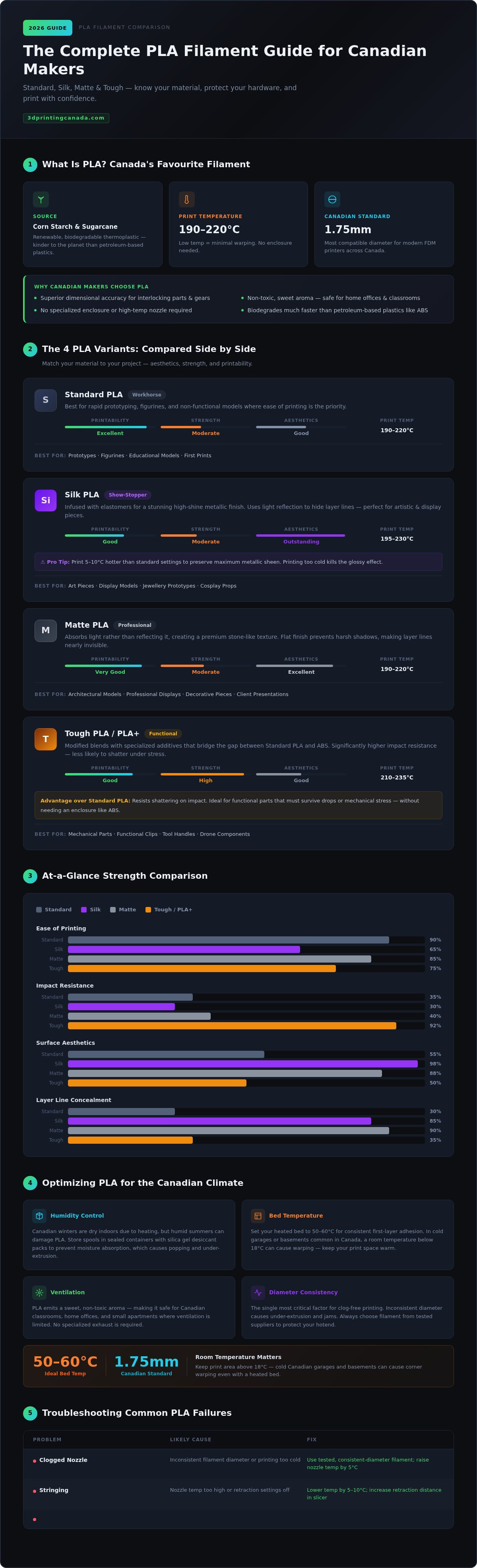
Choisir la bonne bobine implique d’équilibrer trois piliers précis: l’esthétique, la solidité et la facilité d’impression. Bien que la plupart des débutants commencent par une bobine de base, comprendre les nuances des différentes variantes vous permet d’adapter votre matériau à la tâche à accomplir. Que vous recherchiez du PLA filament Canada de confiance pour des pièces mécaniques ou une finition qui ressemble à du métal moulé, il existe une formulation spécifique conçue pour cela.
- PLA Standard: C’est votre cheval de bataille fiable. C’est le meilleur choix pour le prototypage rapide, les figurines et les modèles non fonctionnels où la facilité d’utilisation est prioritaire.
- PLA Silk: Enrichie d’élastomères, cette variante offre une finition spectaculaire et très brillante. Elle imite les surfaces métalliques et excelle à masquer les lignes de couche grâce à la réflexion de la lumière.
- PLA Matte: En absorbant la lumière plutôt qu’en la réfléchissant, le PLA Matte offre une texture haut de gamme, proche de la pierre. C’est le choix privilégié pour les maquettes architecturales et les pièces décoratives qui doivent avoir un aspect sophistiqué.
- PLA Tough (et PLA+): Ces mélanges modifiés comblent l’écart entre le PLA standard et l’ABS. Ils offrent une résistance aux chocs nettement supérieure et sont moins susceptibles de se briser sous contrainte.
Comparaison visuelle: masquer les lignes de couche
L’impression FDM laisse naturellement des « marches » ou des lignes de couche sur votre modèle. Vous pouvez les réduire grâce aux réglages logiciels, mais choisir la bonne finition est un raccourci très efficace. Le PLA Silk utilise son éclat brillant pour tromper l’œil, rendant les transitions entre les couches presque invisibles. Toutefois, le Silk nécessite généralement des températures légèrement plus élevées, souvent de 5 à 10°C au-dessus des réglages standard, pour conserver son éclat maximal. Si vous l’imprimez trop froid, il perd cette brillance métallique. Le PLA Matte adopte l’approche inverse. Sa finition mate masque les imperfections en empêchant la formation d’ombres marquées à la surface de votre impression. Utilisez le Matte pour des présentations professionnelles et le Silk pour des projets artistiques qui attirent le regard.
Comparaison fonctionnelle: résistance mécanique et tenue à la chaleur
Le PLA Standard est réputé pour sa fragilité; si vous faites tomber une pièce fine, elle peut se casser. Le PLA Tough résout ce problème en ajoutant des modificateurs spécialisés qui augmentent sa durabilité et sa flexibilité. Cela le rend adapté aux supports, poignées ou boîtiers soumis à une véritable usure. Pour ceux qui repoussent les limites de la vitesse, des variantes de PLA « High-Speed » sont apparues. Elles sont optimisées pour fondre et refroidir plus rapidement, afin de suivre les mouvements rapides des machines modernes. Si vous souhaitez maximiser le potentiel de votre imprimante, vous pourriez envisager de mettre à niveau votre matériel avec les accessoires Bambu Lab Canada que les créateurs utilisent pour obtenir ces résultats à haute vitesse. Bien que le PLA n’atteigne jamais la résistance thermique de matériaux comme l’ASA ou le nylon, ces variantes plus résistantes offrent une amélioration majeure des performances mécaniques pour les pièces fonctionnelles du quotidien.
Prêt à voir ces finitions en vrai? Vous pouvez découvrir notre gamme complète de couleurs et de textures dans notre sélection de filaments sélectionnée afin de trouver l’accord parfait pour votre prochaine réalisation.
Optimiser votre installation pour le PLA dans le climat canadien
Le succès avec le PLA filament Canada commence par la compréhension de votre environnement local. Bien que le PLA soit réputé pour sa facilité d’utilisation, nos fortes variations saisonnières peuvent introduire des paramètres inattendus. Lors d’un été humide sur la côte Est ou en Ontario, votre bobine peut absorber de l’humidité en seulement quelques jours. Cela provoque des symptômes de filament humide comme des crépitements à la buse, du stringing et un aspect de surface duveteux. Investissez dans une boîte de séchage hermétique et suffisamment de dessicant pour conserver vos matériaux dans un état optimal. Si votre filament a déjà été exposé à une forte humidité, utilisez un sécheur dédié pour restaurer ses propriétés avant de lancer une longue impression.
Les réglages matériels jouent également un rôle majeur dans vos résultats. Bien qu’il soit techniquement possible d’imprimer du PLA sur un plateau froid, nous recommandons vivement un plateau chauffant réglé entre 45°C et 60°C. Cette légère chaleur maintient la base de l’impression suffisamment souple pour empêcher les coins de se soulever. N’oubliez pas le refroidissement. Le PLA doit passer de l’état liquide à l’état solide aussi vite que possible pour conserver sa forme. Réglez vos ventilateurs de refroidissement de pièce à 100 % après la première couche afin de garantir des surplombs et des ponts nets et professionnels.
Adhérence au plateau et préparation de la surface
Votre première couche est la base de tout votre projet. Les plaques PEI texturées sont actuellement la référence pour le PLA, car elles offrent une adhérence incroyable à chaud et libèrent facilement la pièce une fois refroidies. Si vous préférez une finition miroir sur le dessous de vos impressions, une plaque de verre est une excellente alternative. Quelle que soit la surface, vous devez soigner le nivellement du plateau pour obtenir le parfait « écrasement de la première couche ». La buse doit être suffisamment proche du plateau pour aplatir légèrement le plastique, créant ainsi une base solide. Pour les impressions massives couvrant toute la zone d’impression, une fine couche de colle en bâton ou de laque peut offrir une sécurité supplémentaire contre le gauchissement.
Réglage des températures selon les saisons nationales
Les hivers canadiens créent un ensemble unique de défis pour les créateurs. Si votre imprimante se trouve au sous-sol ou près d’une fenêtre, la température ambiante de la pièce peut chuter considérablement. Cet air froid peut faire contracter le plastique trop rapidement, entraînant des fissures ou un décollement du plateau. Nous recommandons d’imprimer une tour de température pour chaque nouvelle bobine de PLA filament Canada fournie par les vendeurs. Ce test simple vous aide à trouver le « point idéal » pour cette couleur et ce lot précis. Maintenir une température de buse constante est essentiel; une variation de seulement 5 degrés peut changer la teinte ou la brillance de votre pièce finie, ruinant un modèle parfaitement conçu.
Dépannage des échecs d’impression PLA courants
Même le PLA filament Canada le plus fiable peut rencontrer des problèmes si votre matériel n’est pas correctement réglé. La plupart des soucis ne résultent pas d’une machine « cassée », mais plutôt d’un décalage entre vos réglages et la réalité physique du plastique. Le stringing et l’exsudation sont sans doute les frustrations les plus courantes. Ces fins filaments en forme de cheveux apparaissent lorsque la buse se déplace entre deux points. Pour obtenir des résultats parfaits, vous devez affiner vos réglages de rétraction. Si la distance de rétraction est trop faible, la pression reste dans la buse; si elle est trop élevée, vous risquez d’aspirer du plastique fondu dans la zone froide, provoquant un bouchage.
La sous-extrusion et les bouchages peuvent sembler similaires, mais leurs causes sont différentes. La sous-extrusion se manifeste par des espaces dans vos couches ou une texture spongieuse. Cela se produit généralement parce que votre débit est trop faible ou que votre buse est partiellement obstruée. Le gauchissement et le soulèvement des coins, bien que plus fréquents avec l’ABS, affectent toujours les grandes impressions en PLA. Cela se produit lorsque le plastique refroidit et se contracte, se détachant du plateau. Gardez votre plateau propre et assurez-vous que votre première couche est correctement écrasée pour maintenir ces coins bien à plat. Enfin, surveillez le heat creep. Si le ventilateur de refroidissement de votre hotend tombe en panne ou tourne trop lentement, la chaleur remonte le long du filament et le ramollit prématurément. Cela crée un bouchon particulièrement difficile à éliminer sans démontage complet.
Déboucher une buse obstruée
Lorsque votre extrudeur commence à cliquer, il est temps d’agir. La méthode du « Cold Pull » est la meilleure façon de sauver votre buse sans démonter toute la tête d’impression. Chauffez votre buse à 200°C, insérez un morceau de PLA, puis éteignez la chauffe. Une fois la température descendue à environ 90°C, retirez le filament d’un coup sec et ferme. Vous devriez voir à l’extrémité la forme de l’intérieur de la buse, ainsi que les débris brûlés ou la poussière qui causaient le blocage. Si vous avez fait cela trois fois et que le problème persiste, il est peut-être temps de remplacer complètement la buse. Les buses en laiton sont des consommables peu coûteux. Ne perdez pas des heures à nettoyer une pièce à cinq dollars alors qu’une neuve vous remettra immédiatement à l’impression. Pour les pannes matérielles persistantes qui vont au-delà d’un simple bouchage, notre équipe fournit des services de réparation d’imprimantes 3D Canada spécialisés auxquels les créateurs font confiance pour remettre leurs ateliers en marche.
Affinage de la rétraction et du débit
La qualité de surface est la marque d’une impression de niveau professionnel. Si vous voyez des « zits et blobs » sur vos modèles, vos réglages de rétraction ou de coasting doivent être ajustés. Ces petites imperfections apparaissent au début ou à la fin d’une ligne de couche. Vous pouvez également améliorer la cohérence en calibrant vos E-steps. Cela garantit que lorsque votre logiciel demande 100 mm de filament, l’extrudeur pousse réellement exactement 100 mm. C’est un calibrage simple qui améliore considérablement la précision dimensionnelle. N’oubliez pas que la vitesse d’impression influence aussi la finition. Faire avancer du PLA filament Canada à des vitesses extrêmes peut faire gagner du temps, mais cela peut produire une texture mate ou rugueuse si le chauffage ne suit pas. Ralentissez pour vos parois externes afin de conserver la brillance caractéristique du PLA.
Besoin d’aide pour peaufiner vos réglages? Contactez notre équipe d’assistance technique pour obtenir des conseils personnalisés sur l’optimisation de votre machine et de votre configuration matérielle spécifiques.
Pourquoi acheter votre filament PLA chez 3D Printing Canada?
Choisir une source nationale pour vos fournitures est la décision la plus intelligente que vous puissiez prendre pour votre atelier. Lorsque vous commandez du PLA filament Canada depuis notre centre basé à Hamilton, vous évitez la frustration des droits cachés aux frontières et des délais internationaux imprévisibles. Nous ne faisons pas que déplacer des boîtes; nous sélectionnons des matériaux que nous faisons confiance à utiliser pour nos propres projets. Notre équipe teste chaque variante sur les mêmes machines que celles que nous entretenons dans notre département de réparation. Cela garantit que vous recevez un produit vérifié pour la constance du diamètre et l’adhérence entre les couches avant même qu’il n’arrive chez vous.
Au-delà du plastique lui-même, vous accédez à une communauté dédiée d’experts. Si vous rencontrez une texture de surface inhabituelle ou un problème d’adhérence au plateau, vous pouvez parler à des personnes qui comprennent les défis spécifiques de l’impression dans notre climat. Nous fournissons le soutien humain et les conseils techniques que les grands détaillants internationaux ne peuvent tout simplement pas égaler. Vous n’achetez pas seulement une bobine; vous gagnez un partenaire investi dans votre réussite créative.
Soutenez un détaillant national local
S’approvisionner localement garantit que votre filament est frais et prêt à imprimer. Les matériaux qui restent des mois dans des conteneurs d’expédition en traversant l’océan arrivent souvent déjà « gorgés » d’humidité. Lorsqu’ils atteignent un entrepôt, ils peuvent déjà nécessiter un long cycle de séchage. Nous faisons tourner notre stock pour nous assurer que vous recevez des bobines en parfait état. Soutenir un détaillant national maintient également la communauté canadienne des créateurs dynamique. Cela nous permet de continuer à offrir des conseils techniques localisés, des événements communautaires et les services de réparation experts qui maintiennent votre matériel au meilleur de ses performances.
Solutions complètes d’impression 3D
Nous sommes un partenaire de service complet pour l’ensemble de votre parcours créatif. Que vous ayez besoin de scanners 3D haute résolution pour numériser une pièce ou des derniers accessoires pour accélérer votre flux de travail, nous avons le matériel pour accompagner nos matériaux. Pour les établissements d’enseignement et les entreprises à travers le pays, nous proposons des achats en volume qui permettent d’équiper à moindre coût toute une classe ou une ligne de production professionnelle. Nous fournissons les connaissances complètes et les outils nécessaires pour transformer vos conceptions numériques en réalité physique. Notre équipe est prête à vous aider à trouver le PLA filament Canada parfait sur lequel les créateurs comptent pour tout, des projets scolaires aux prototypes industriels.
Achetez dès aujourd’hui notre collection complète de filament PLA!
Commencez votre prochaine impression en toute confiance
Vous disposez désormais des connaissances nécessaires pour transformer votre flux de travail d’impression 3D, passant d’une série d’expériences frustrantes à un processus de production fiable. En associant les propriétés spécifiques des variantes Silk, Matte ou Tough aux objectifs de votre projet, vous éliminez les approximations qui entraînent du plastique gaspillé et une perte de temps. Gérer les défis uniques de notre climat canadien grâce à un stockage intelligent et à un réglage saisonnier des températures garantit que chaque bobine fonctionne à son plein potentiel. Choisir des matériaux de haute qualité est votre meilleure défense contre les bouchages matériels qui conduisent souvent à des réparations inutiles.
Trouver le PLA filament Canada parfait auquel les créateurs font confiance ne devrait pas être un pari. Notre hub de Hamilton est prêt à soutenir votre réussite créative avec une expédition nationale rapide, une assistance technique experte et une large gamme d’accessoires Bambu Lab pour maintenir votre matériel en parfait état de marche. Parcourez la meilleure sélection de filament PLA au Canada dès aujourd’hui et voyez la différence que des matériaux de qualité professionnelle apportent sur votre plateau d’impression. Votre prochaine grande création n’est qu’à une première couche réussie; nous avons hâte de voir ce que vous construirez ensuite.
Questions fréquemment posées
Le filament PLA est-il vraiment biodégradable au Canada?
Le PLA est techniquement biodégradable parce qu’il est issu de sources organiques comme l’amidon de maïs ou la canne à sucre. Cependant, il nécessite la forte chaleur et l’activité microbienne spécifique présentes dans les installations de compostage industriel pour se décomposer efficacement. Il ne se dégradera pas dans votre compost de jardin ni dans une décharge canadienne standard. Si vous souhaitez l’éliminer de manière responsable, renseignez-vous auprès de votre municipalité locale pour savoir si elle accepte le PLA dans ses flux de déchets organiques.
Quelle est la meilleure température d’impression pour le filament PLA?
La plupart des marques de PLA filament Canada utilisées par les créateurs donnent de meilleurs résultats entre 190°C et 220°C. Commencez à 200°C et ajustez en fonction des résultats d’une tour de température. Les variantes Silk ont souvent besoin de la partie haute de cette plage pour atteindre leur brillance maximale. Si vous remarquez du stringing, essayez de baisser la température de 5 degrés. Si les couches n’adhèrent pas entre elles, vous avez probablement besoin de plus de chaleur pour assurer une fusion correcte.
Le filament PLA expire-t-il ou se détériore-t-il avec le temps?
Le filament n’a pas de date de péremption stricte, mais sa qualité se dégrade s’il n’est pas stocké correctement. Le PLA est hygroscopique, ce qui signifie qu’il absorbe l’humidité de l’air au fil du temps. Cela rend le plastique cassant et provoque des bulles ou des crépitements à la buse pendant l’extrusion. Si votre bobine est restée à l’air libre pendant des mois, vous pouvez souvent la « sauver » en utilisant un sécheur de filament dédié pendant 4 à 6 heures à 45°C.
Quelle est la différence entre le PLA et le PLA+?
Le PLA+ est une version modifiée du PLA standard qui inclut des additifs spécialisés pour améliorer la résistance aux chocs et l’adhérence entre les couches. Il est généralement moins cassant et plus facile à imprimer à des vitesses plus élevées. Alors que le PLA standard est excellent pour les modèles visuels, le PLA+ est un meilleur choix pour les pièces fonctionnelles qui doivent résister à une chute ou à de faibles contraintes mécaniques. Il offre un compromis pratique entre la facilité du PLA et la robustesse de l’ABS.
Puis-je imprimer du PLA sans plateau chauffant?
Vous pouvez tout à fait imprimer du PLA sur un plateau froid, mais cela rend la première couche beaucoup plus difficile à gérer. L’utilisation d’un plateau chauffant réglé à 50°C ou 60°C améliore nettement l’adhérence et empêche les coins de l’impression de se soulever. Si vous n’avez pas de plateau chauffant, vous devrez probablement utiliser du ruban de peintre bleu ou une colle en spray spécialisée pour empêcher la pièce de glisser hors du plateau pendant l’impression.
Pourquoi mon filament PLA casse-t-il ou se brise-t-il facilement?
Un filament cassant est presque toujours le signe d’une absorption d’humidité. Lorsque le PLA devient « humide », les chaînes polymères se dégradent, faisant casser le filament comme une brindille sèche plutôt que de se plier. C’est particulièrement courant pendant les étés humides au Canada. Si votre filament se casse dans l’extrudeur, il est temps de sécher la bobine. Conserver vos bobines dans des contenants hermétiques avec des sachets dessicants empêchera ce problème de se produire dès le départ.
Comment dois-je stocker mon filament d’imprimante 3D dans un environnement humide?
Utilisez des bacs en plastique hermétiques ou des sacs sous vide pour protéger votre stock de PLA filament Canada de l’humidité. Ajoutez quelques sachets de gel de silice rechargeables dans chaque contenant pour absorber l’humidité résiduelle. Si vous imprimez souvent, une « dry box » dédiée qui alimente directement votre imprimante est un excellent investissement. Cette configuration garde le matériau parfaitement sec même lors d’impressions longues de plusieurs jours dans un sous-sol ou un atelier humide.
Le filament PLA est-il sûr pour les objets en contact avec les aliments?
Bien que la résine de base du PLA soit souvent sans danger pour les aliments, la pièce imprimée en 3D finale ne l’est pas. La plupart des filaments contiennent des colorants et des additifs qui ne sont pas certifiés pour le contact alimentaire. De plus, les minuscules stries entre les couches constituent des milieux idéaux pour la prolifération des bactéries et sont presque impossibles à nettoyer complètement. Si vous souhaitez fabriquer quelque chose pour la cuisine, utilisez l’impression comme moule pour du silicone alimentaire ou recouvrez la pièce d’une époxy alimentaire.