
Your beautiful PLA model looks great on the shelf, but it's one hot afternoon in a parked car away from turning into a warped disaster. It's a frustrating rite of passage for every Canadian maker: realizing that the ease of printing PLA doesn't always translate to durability in the real world. Deciding between pla vs petg shouldn't feel like a guessing game involving confusing technical jargon or wasted spools of plastic.
You want parts that actually last, whether they're facing the summer heat or the mechanical stress of a functional fix. This 2026 buying guide will help you master the differences between these two staples so you can choose the perfect filament for your specific application. We'll explore everything from achieving that elusive first-layer adhesion with PETG to finding the most cost-effective Canadian-made options that won't break your budget. Get ready to stop guessing and start printing with total confidence in your material choice.
Key Takeaways
- Understand the core differences of pla vs petg so you can select the right material for aesthetic detail or mechanical strength.
- Learn how to manage glass transition temperatures to prevent your parts from melting or warping in demanding environments.
- Gain practical tips for perfecting bed adhesion and extrusion settings to eliminate common printing failures like stringing.
- Realize the cost-saving benefits of choosing the right filament for the job, including high-performance Canadian-made options.
- Explore how professional calibration services and national shipping can keep your workshop running efficiently.
What are PLA and PETG? Understanding the Basics
Choosing between pla vs petg is the first major decision most makers face. It affects everything from your first-layer success to how well a part holds up in a hot Canadian summer. While both materials are staples in the 3D printing community, they serve very different purposes. Understanding these fundamentals ensures you don't waste time or filament on a project doomed to fail. It's about matching the material to the mission.
The PLA Profile: Detail and Simplicity
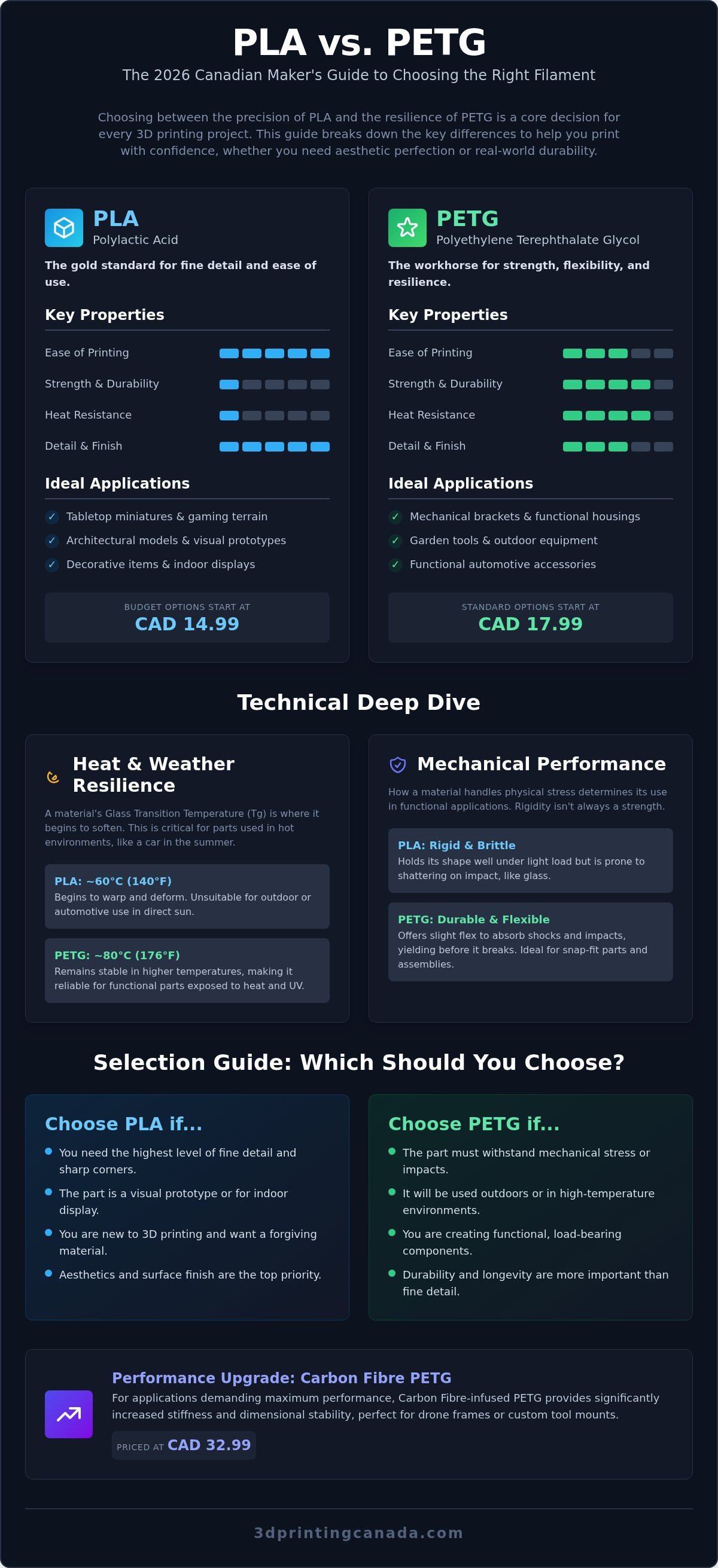
Polylactic Acid (PLA) is the undisputed gold standard for beginners and creators who prioritize fine detail. It's a thermoplastic polyester derived from renewable resources like corn starch or sugarcane. Because it prints at relatively low temperatures and has minimal thermal expansion, it rarely warps. This stability allows you to capture intricate textures and sharp corners that other materials might struggle to maintain. You can focus on the design rather than fighting with your printer settings.
Most makers reach for PLA when aesthetics matter most. It's the ideal choice for:
- Tabletop miniatures and gaming terrain
- Architectural models and visual prototypes
- Decorative items and indoor displays
If you're just starting out or running high-volume tests, our Budget PLA options start at CAD 14.99. This allows you to experiment freely while you learn your machine's quirks. It's a low-risk way to dial in your settings before moving on to more specialized or expensive materials.
The PETG Profile: Strength and Versatility
When your project needs to do more than just look good, PETG is the answer. It's a modified version of the PET plastic used in water bottles. The "G" stands for Glycol, which is added at a molecular level to make the plastic clearer and less brittle. This modification is why PETG is so popular for functional parts; it offers a level of durability and impact resistance that PLA simply cannot match. It bridges the gap between easy-to-print hobbyist materials and industrial plastics.
PETG is the workhorse of the 3D printing world. It handles mechanical stress and outdoor exposure far better than PLA. You'll find it's the preferred choice for:
- Mechanical brackets and housings
- Garden tools and outdoor equipment
- Functional automotive accessories
Our Standard PETG is priced at CAD 17.99, offering a cost-effective path to professional-grade results. While it requires slightly higher temperatures and more attention to bed adhesion, the payoff is a part that won't snap under pressure or melt in the sun. Balancing the pla vs petg debate starts with knowing whether your print needs to be pretty or tough.
Technical Comparison: PLA vs PETG Properties
Deciding between pla vs petg requires a look under the hood at how these materials actually behave when put to work. While they might look identical on the spool, their molecular makeup dictates how they handle stress, heat, and the Canadian elements. Understanding these technical nuances helps you choose a material that won't just finish the print, but will survive the application. It's the difference between a part that lasts years and one that fails on day one.
Mechanical Performance and Impact
PLA is incredibly rigid. This stiffness is excellent for models that need to hold their shape under a light load, but it makes the material brittle. If you drop a PLA print on a concrete garage floor, it's likely to shatter like glass. PETG offers a slight flexibility that absorbs impact. It yields slightly before it breaks, which is a vital trait for any part that faces regular vibrations or shocks. PETG’s superior layer adhesion makes it ideal for mechanical assemblies where components must be bolted or snapped together without cracking.
For makers who need even more performance, Carbon Fiber PETG (CAD 32.99) is a specialized option. It adds significant stiffness and dimensional stability to the standard PETG base. Whether you're building a drone frame or a custom tool mount, matching the mechanical profile to the job is key. You can explore our wide range of performance-tested filaments to find the exact mechanical match for your next project.
Heat and Weather Resilience
Temperature resistance is where the two materials diverge most sharply. PLA has a relatively low "glass transition" temperature, usually around 60°C. This is the point where the plastic starts to soften and lose its structural integrity. In a Canadian summer, the interior of a car parked in the sun can easily hit this mark. If you leave a PLA part on the dashboard, you'll likely find a warped mess when you return. PETG remains stable up to approximately 80°C, making it much more reliable for automotive interiors or engine bay brackets.
Weathering and UV resistance also favour PETG. While PLA can become brittle and discoloured when left outside, PETG handles UV radiation and moisture with ease. This makes it the primary choice for garden stakes, bird feeders, or outdoor signage. When handling these materials, always follow the University of Rochester 3D printer guidelines to ensure your printing environment remains safe and well-ventilated. Choosing the right material for the environment ensures your hard work doesn't melt or crack when the seasons change.
Printing Settings and Success Strategies
You've picked your material; now you need to make it stick. Mastering the pla vs petg workflow requires adjusting your slicer profile to match the physical needs of each plastic. While your printer might handle both, the way you manage heat and cooling will determine whether you end up with a functional part or a bird's nest of tangled plastic. Success starts with understanding that these materials have very different "personalities" on the build plate.
Mastering the First Layer
The first layer is the foundation of every print. For PLA, a bed temperature of 60°C is usually the sweet spot. It's a forgiving material that sticks well to almost any surface, from PEI sheets to glass. PETG is more demanding, requiring a bed temperature between 70°C and 80°C. Be careful with PETG on bare glass or smooth PEI, as it can bond too well and actually rip chunks out of your build surface when you try to remove it. Use a glue stick or hairspray as a release agent to create a protective barrier.
Stringing is another common hurdle when moving to PETG. Because PETG is stickier and more "oozy" than PLA, you'll need to fine-tune your retraction settings. Increase your retraction distance slightly and slow down the retraction speed to help pull the filament back cleanly. If you're seeing wispy hairs across your print, it's often a sign that your nozzle is a few degrees too hot or your filament has absorbed moisture.
Essential Hardware Upgrades
Standard 3D printers often come with components designed primarily for PLA's lower melting points. When you step up to PETG, your hardware faces more heat stress. Consider these upgrades to keep your machine running smoothly:
- Capricorn Premium PTFE Bowden Tubing (CAD 16.95): This tubing handles higher temperatures better than standard white PTFE. It also has tighter internal tolerances, which improves filament travel and reduces clogs.
- All Metal Hotend Kit (CAD 85.95): Standard hotends use a PTFE liner that can off-gas or degrade at the 240°C+ temperatures required for PETG. An all-metal version allows for safe, consistent high-temp printing.
Don't overlook the importance of cooling. PLA loves a 100% fan speed after the first few layers to lock in fine details. PETG needs a much gentler touch. Set your cooling fan to 0-30% to ensure the layers have enough time to fuse properly. Too much cooling on a PETG print will lead to poor layer adhesion, causing the part to split under pressure. Finally, always keep your PETG in a dry box. It's a hygroscopic material, meaning it sucks moisture out of the air, which leads to bubbles and popping sounds during extrusion.
Selection Guide: Which One Should You Buy?
Stop guessing and start evaluating your project requirements with a structured approach. Choosing between pla vs petg comes down to four specific factors: what the part needs to do, where it will live, what your hardware can handle, and how much you want to spend. If you're mass-producing decorative items, your needs differ wildly from someone building a custom bracket for a roof rack. Evaluate the mechanical stress your print will face. If it's purely for display, stick with the ease of PLA. If it's a tool that needs to survive a drop, PETG is your better partner.
Best PLA Options for Your Shop
PLA remains the undisputed king of the workshop for a reason. It's reliable, accessible, and produces stunning visual results with minimal effort. Consider these options based on your specific goals:
- Standard PLA (CAD 22.99): This is your consistent workhorse. It's perfect for educators and designers who need repeatable results without the fuss of constant calibration.
- Budget PLA (CAD 14.99): Use this for your draft prints. It's the most cost-effective way to check fit and form before committing to a more expensive final material.
- Canadian-made PLA+ (CAD 26.99): When you need a bit more "oomph" than standard PLA, this version is engineered for improved impact resistance. It's a great way to support local manufacturing while upgrading your part's durability.
Top PETG Picks for Functional Parts
If your part needs to survive the real world, reach for PETG. It offers the chemical and temperature resistance that PLA lacks, ensuring your hard work doesn't warp or degrade. Pick the right variant for your application:
- Standard PETG (CAD 17.99): This is your everyday functional material. It's tough enough for workshop organizers, household fixes, and mechanical prototypes.
- Transparent PETG (CAD 20.99): PETG is naturally clearer than PLA. Use this for light-diffusing covers, vases, or containers that need to be watertight and UV-stable.
- Carbon Fiber PETG (CAD 32.99): This is the professional's choice. The added carbon fiber reduces warping and significantly increases stiffness, making it perfect for high-performance mechanical parts like drone frames.
Your printer's capability is the final gatekeeper in this decision. Ensure your machine is calibrated for the higher temperatures PETG requires before loading a spool. If you're looking to scale up production, balancing the cost-per-kg with your project's performance needs will keep your shop profitable. If you're ready to stock up for your next big build, buy PLA and PETG filaments today to ensure you always have the right material on hand for any project.
Why Source Your Filament from 3D Printing Canada?
Buying filament is about more than just picking a spool off a shelf; it's about finding a reliable partner for your creative journey. In the ongoing debate of pla vs petg, having access to over 2600 products in these categories ensures you never have to settle for a material that is "close enough." Our team lives and breathes 3D printing right here in Canada. We understand the specific challenges you face, from the dry winter air affecting your PETG to finding the right high-speed PLA for a tight deadline. We're here to make sure your printer stays running and your projects stay on track.
Local Expertise and Technical Support
Success in 3D printing often requires more than just the right plastic. Sometimes, your hardware needs a professional touch to achieve those perfect, repeatable layers. Our 3D printer repair services Canada team is ready to help you calibrate your machine for peak performance. If you're struggling with complex print failures that slicer settings alone can't fix, our expert Technical Services are available at CAD 175/hr. Because we perform professional repairs daily, we know exactly how different filaments interact with various hotends and extruders. We don't just sell boxes. We provide the human support and specialized knowledge required to help you realize your most ambitious designs.
Bulk Savings and National Reach
Whether you're in a major urban hub or a remote rural town, our national shipping network ensures your workshop stays stocked. We prioritize speed and reliability so you don't have to pause your production while waiting for a delivery. For high-value orders, we offer shipping insurance for just CAD 2.25. This small addition provides massive peace of mind, ensuring your investment is protected from the moment it leaves our warehouse until it reaches your door. We've built our logistics to support the needs of professional shops and hobbyists alike.
Our massive selection includes everything from budget-friendly spools to specialized Canadian-made PLA+ that supports our local economy. By choosing a domestic supplier, you avoid the headache of international duties and unpredictable customs delays. You get the tools you need and the local expertise to use them effectively. Stop searching and start creating with a team that is as invested in your success as you are. Browse the full PLA vs PETG collection here and find the perfect match for your next project.
Elevate Your Next 3D Printing Project
You've seen how the choice between pla vs petg dictates the success of your project, from fine-detailed miniatures to rugged outdoor fixtures. PLA offers the simplicity and precision every maker loves for visual models. PETG provides the mechanical strength and temperature resistance required for parts that actually go to work. By matching your material to your project's environment and stress levels, you'll eliminate wasted filament and failed prints. It's about working smarter to realize your creative vision.
We're here to support that journey with over 2600 products in stock and national Canadian shipping that keeps your workshop running from coast to coast. If you hit a technical snag, our expert technical repair services are always ready to help you dial in your machine for any material. Having a local partner means you don't have to navigate technical hurdles alone. Shop our full range of PLA and PETG filaments today and start building something that lasts. Your next great creation is just one successful first layer away. Happy printing!
Frequently Asked Questions
Is PETG stronger than PLA?
PETG is generally considered tougher, while PLA is more rigid. If you need a part to survive a drop or absorb impact, PETG is the superior choice because it is much less brittle. PLA has a higher tensile strength, meaning it can hold more weight before stretching, but it will shatter under sudden stress. Choosing between pla vs petg for strength depends on whether your project needs to be stiff or impact resistant.
Can I print PETG on a standard Ender 3?
You can print PETG on a standard Ender 3, but you'll need to make a few adjustments. Ensure your bed can reach 80°C and your nozzle is set to roughly 240°C. Be cautious with the stock PTFE tube, as it can release fumes if pushed too hot for long periods. Upgrading to a Capricorn tube or an all-metal hotend is a smart move for consistent results when printing this material over the long term.
Is PLA or PETG better for outdoor use in Canada?
PETG is the clear winner for the Canadian climate. It offers excellent UV resistance and handles the shift from freezing winters to hot summers without losing its structural integrity. PLA tends to become brittle in the cold and can soften or warp if left in direct sunlight or a warm vehicle. For any project that lives on your patio or in your garden, PETG is the only reliable option for year round durability.
Does PETG require a special nozzle?
A standard brass nozzle is perfectly fine for printing basic PETG. You don't need hardened steel unless you're using composite filaments like our Carbon Fiber PETG. One thing to watch is the material's tendency to stick to the nozzle. Keep your nozzle clean and consider a silicone sock to prevent burnt plastic from globbing onto your heater block. This simple step saves you from ruined prints and messy cleanups during longer print jobs.
Is PLA filament food safe?
PLA is often marketed as bio-friendly, but it isn't truly food safe once it has been printed. The gaps between layers are perfect breeding grounds for bacteria that you can't easily wash away. Many filaments also contain chemical pigments and additives that aren't rated for food contact. Unless you're using a specific food grade material and coating the final print in a food safe epoxy, it's best to avoid using it for kitchenware or containers.
Why is my PETG print stringing so much?
Stringing is usually caused by the material's high viscosity and its tendency to absorb moisture. PETG is very hygroscopic, so if it's been sitting out, it will pop and ooze during the print. Try drying your spool in a dedicated dryer for a few hours. You should also calibrate your retraction settings. Increasing the retraction distance and speed slightly can help pull the filament back cleanly before the nozzle moves to a new location.
How should I store my filament to prevent moisture?
Store your spools in airtight bins or vacuum sealed bags with plenty of fresh desiccant. This is especially important for PETG, which pulls moisture from the air much faster than PLA. If you live in a humid part of Canada, consider a dedicated filament dryer box that feeds directly into your printer. Keeping the material dry is the easiest way to prevent clogs and ensure your layers bond properly every single time you hit print.
What is the best temperature for printing PLA+?
The ideal temperature for PLA+ usually falls between 210°C and 225°C. This is slightly higher than standard PLA because of the additives used to increase the material's toughness and layer adhesion. It's always best to print a temperature tower when starting a new roll. This helps you find the specific sweet spot for your machine and ensures you get the best balance between a smooth surface finish and maximum structural strength for your parts.