
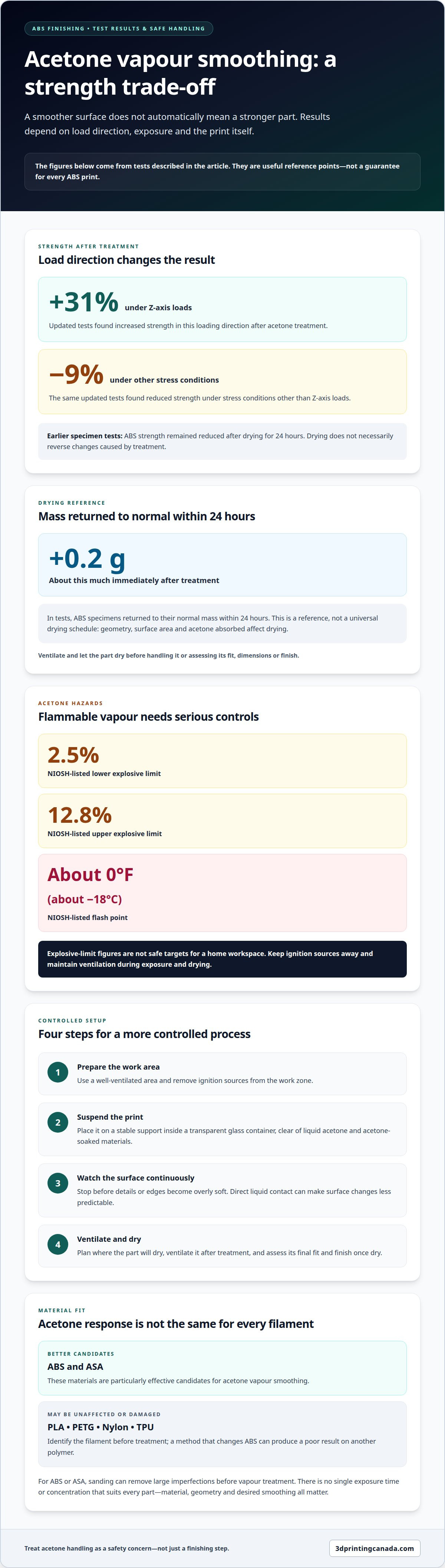
A smoother ABS print isn’t automatically a stronger one. Updated tests found acetone treatment increased strength by 31% under Z-axis loads but reduced it by 9% under other stress conditions. A safe vapor-smoothing protocol for ABS parts using acetone also means controlling fire and exposure hazards, ventilating the part and letting it dry.
The appeal is easy to understand: acetone can soften the outer surface of ABS and ASA, helping layer lines look less pronounced. But the finish and the part’s performance both depend on how the treatment affects the print, not just how smooth it looks.
This guide explains what acetone vapour smoothing can do to ABS and ASA, why strength results vary with load direction, and how long tested ABS specimens took to return to their normal mass. It also covers practical ways to reduce fire and vapour exposure risks, helping you decide whether to treat a part.
Key Takeaways
- Keep the part suspended above acetone and acetone-soaked materials to avoid unpredictable contact and surface changes.
- Plan for ventilation and drying after treatment; the part’s shape and exposure affect how the finish develops.
- ABS and ASA are better candidates for acetone vapour smoothing than materials such as PLA, PETG, nylon, and TPU.
- Reduce fire and vapour exposure risks by treating acetone handling as a serious safety concern, not just a finishing step.
- There isn’t a single concentration or exposure time that suits every ABS part; the finish depends on the material, geometry, and degree of smoothing sought.
Acetone vapor polishing methods and drawbacks
Acetone vapour smoothing can soften an ABS print’s outer surface, but it can also change dimensions and strength. The method matters: controlled vapour exposure is different from direct contact with liquid acetone.
Manual and Automated Smoothing
Manual smoothing uses a closed container with the part suspended inside; automated systems control exposure in a dedicated chamber. Both methods aim to soften surface layers, but the setup affects how evenly vapour reaches the print. A steam bath is described as the most effective method, while submerging a part in acetone is less recommended because the results can be unpredictable.
In a manual setup, suspend the part so it touches neither liquid acetone nor acetone-soaked material. Automated controls can make exposure more repeatable, but they don’t remove the need to monitor the part continuously. Overexposure can soften details and edges, so judge the finish as it develops rather than relying on a fixed visual expectation.
Material-Specific Smoothing Methods
Choose a finishing method that suits the filament’s response to acetone. ABS and ASA are particularly effective candidates for vapour smoothing; PLA, PETG, nylon, and TPU may be unaffected or damaged. Identify the filament before using acetone, since a method that changes ABS can produce a poor result on another polymer.
For ABS or ASA, sanding can remove large imperfections before vapour treatment. This helps separate prominent defects from layer lines the vapour may soften. Acetone smoothing is used primarily on FDM prints, whose surfaces show stacked deposition layers. A glass container is preferred because it is transparent and non-reactive.
Safety Equipment for Vapor Smoothing
Use a glass container, a stable support to suspend the print, protective gear, and a well-ventilated work area. This setup keeps the part away from liquid acetone while addressing exposure and flammability hazards. Keep it away from ignition sources, and use a container that lets you see the part during treatment.
Choose equipment that lets you observe the surface without opening the container during exposure. The support should hold the print securely and keep it clear of acetone-soaked materials. A transparent glass vessel makes it easier to spot softening or lost detail, while ventilation helps reduce vapour accumulation around the work area.
Safe Setup and Process Steps
Keep acetone handling, the suspended print, ventilation, and post-treatment drying in a controlled sequence. For storage and disposal in Canada, follow the acetone container’s label and applicable municipal hazardous-waste instructions.
- Prepare a well-ventilated area and remove ignition sources from the work zone.
- Place the print on a stable support inside a transparent glass container, clear of liquid and soaked materials.
- Apply vapour exposure while watching the part continuously; stop before details or edges become overly soft.
- Ventilate the part after treatment and leave it to dry before handling or assessing the finish.
Keep the part suspended throughout exposure. Direct acetone contact can produce less predictable smoothing, and the surface may change dimensions slightly. Strength can also shift: updated tests found a 9% reduction under stress conditions other than Z-axis loads. In initial ABS specimen tests, strength remained reduced after drying for 24 hours.
Drying time after acetone exposure
Drying continues after a smoothed ABS part leaves the acetone vapour. Ventilate the part and let it dry before handling it or judging its final surface. Appearance alone cannot establish a fixed drying time: geometry, surface area, and how much acetone the surface absorbed all affect how quickly it releases vapour.
What the drying results show
In tests, ABS specimens gained about 0.2 grams immediately after acetone treatment, then returned to their normal mass within 24 hours. That result gives a useful reference, not a universal schedule for every print. A thin bracket and a thick, enclosed housing differ in surface area and geometry, so they may not release absorbed acetone at the same pace.
Drying does not reverse the surface changes caused by treatment. Outer layers may remain softened or reshaped after excess acetone evaporates. Let the part ventilate and dry before checking its fit, dimensions, or finish. For a component with a tight mating surface, assess that area after drying instead of assuming its dimensions are unchanged.
PPE and exposure assessment
Acetone vapour presents exposure and flammability risks, so use appropriate protective gear and work in a well-ventilated area. Before starting, consider where vapour could collect, who might enter the workspace, and how you will move the part to ventilate. These checks help identify exposure pathways beyond the container itself.
Keep handling brief and deliberate. Plan where the treated print will dry before opening the setup, so you don’t carry it through an occupied area. Protective gear supports safer handling, but it doesn’t replace ventilation or workspace planning. If ventilation changes during the process, pause and address the work area before continuing.
Monitoring vapour exposure
Monitor the part’s surface and the area around the container continuously. Visual checks can help prevent over-smoothing, but they don’t measure airborne acetone. A smooth-looking surface does not mean the surrounding air is safe; maintain ventilation throughout exposure and drying.
NIOSH lists acetone’s lower explosive limit as about 2.5% and its upper explosive limit as about 12.8%. These figures describe explosive limits, not a safe target for a home workspace. NIOSH also lists acetone’s flash point as about 0°F (about −18°C), reinforcing why ignition sources must stay away from acetone handling.
Keep the work area ventilated while the part dries, and avoid placing it near ignition sources. The test result of normal mass within 24 hours offers context for ABS specimens, while the part’s shape and exposure determine its own drying behaviour. For print-quality issues that should be addressed before finishing, explore 3D printer repair services.
Acetone vapor smoothing for ABS and ASA
ABS and ASA are particularly effective candidates for acetone vapour smoothing. The treatment softens the printed surface, reducing visible layer lines on FDM parts. Because FDM builds parts layer by layer, their surfaces can retain ridges even when the print is otherwise well formed. Acetone changes the outer surface; it is not a general-purpose finish for every filament.
Why ABS and ASA respond
Acetone vapour acts on the outside of ABS and ASA prints, where it can soften surface material and blend visible layer boundaries. This can make a part look more continuous, but it changes the surface itself. Treat dimension-critical features, such as clips or close-fitting openings, as functional surfaces to assess after finishing.
ASA is also suitable for acetone vapour smoothing, while PLA, PETG, nylon, and TPU may be unaffected or damaged. This distinction matters when finishing a project made from multiple materials: the same exposure can produce different outcomes across polymers. Identify the filament first, then decide whether acetone suits the specific part.
Surface finish and print details
Before smoothing an ABS or ASA print, sanding can remove large imperfections that vapour alone may not address. For example, you can level a prominent ridge or rough seam mechanically before surface treatment. This separates correcting a major defect from softening finer layer texture and can help preserve small details.
Watch the part continuously during exposure. A softened edge, shallow lettering, or narrow wall can lose definition if treatment continues too long. Acetone may slightly alter surface dimensions, including minor reductions, so don’t assume the finished exterior will match the as-printed measurements. Consider this before treating parts with mating faces or precise openings.
Strength and orientation
Surface appearance is only one result to consider. Acetone vapour treatment can create additional bonds between FDM layers along the Z-axis, potentially making a print more isotropic. In practical terms, treatment may change how strength is distributed across print directions rather than making every direction stronger.
Updated ABS tests found increased strength under Z-axis loads alongside reduced strength in the strong axis. The interiors of the tested parts remained unchanged; treatment affected only their outermost layers. These findings apply to the ABS FDM parts tested, not every geometry, filament, or print orientation. For a load-bearing ABS component, consider its expected force direction and surface requirements before choosing a finish.
Use acetone smoothing when the material and desired finish suit the process. For an ABS or ASA print with large surface flaws, address them first. If dimensions or directional strength matter, weigh the surface changes against the part’s intended function.
Acetone vapour hazards and fire risk
Acetone vapour smoothing has two central hazards: flammability and exposure. Keep the work area well ventilated, use appropriate protective gear, and keep ignition sources away from acetone. These controls matter during setup, treatment, and drying, since vapour can escape when you open the container or move a treated part.
NIOSH lists acetone’s flash point as about 0°F (about −18°C). It also lists a lower explosive limit of about 2.5% and an upper explosive limit of about 12.8%. These values describe fire and explosion hazards, not safe operating targets. Don’t use them to judge whether a room is safe by smell or appearance.
Indoor use in Canada must be assessed against applicable provincial or territorial workplace-safety requirements and local fire-code requirements. The specific provisions depend on the jurisdiction and work setup, so don’t assume one rule applies identically across Canada. For workplace use, assess the location, ventilation, acetone handling, and ignition risks under the applicable requirements.
Ventilation is a core safety control, not an optional finishing detail. Choose a work area with free airflow, and prevent people from lingering near the process. A closed container can limit direct contact with liquid, but it doesn’t remove the need to ventilate the work area. Opening the container and transferring the print can release vapour.
- Before treatment: Clear ignition sources from the work area and plan where the part will dry.
- During exposure: Keep the area ventilated and use appropriate protective gear.
- After exposure: Move the part carefully to its planned drying area, maintaining ventilation.
Protective gear supports safer handling, but it does not replace ventilation or ignition control. Set up the process so you can observe the part and stop before surface details soften excessively. Keep the equipment focused on what the print needs, and don’t introduce heat or other ignition sources near acetone.
Plan the full route from the container to the drying location before starting. Moving a treated print through an occupied room, for example, can carry vapour beyond the smoothing area. Choose a ventilated drying location close to the work area, and keep the print away from ignition sources as it dries. If ventilation changes or vapour escapes unexpectedly, stop and reassess the setup.
What acetone concentration and exposure time are used for vapor smoothing ABS?
No single acetone concentration or exposure time suits every ABS print. The finish depends on the part’s geometry, exposed surface, and desired degree of smoothing. A thin decorative panel and a thick bracket present different surfaces to the vapour, so the same exposure can produce different results. A practical safety protocol for smoothing ABS parts with acetone vapour accounts for these variables and the workspace.
Concentration and time work together: vapour conditions affect how quickly the ABS surface softens, while exposure determines how far that change progresses. Increasing either can smooth the surface further, but can also blur edges, soften lettering, or alter dimensions. On a part with shallow text, for example, preserving detail may matter more than removing every visible layer line.
Use continuous observation as a practical control. Suspend the print, keep it clear of liquid acetone, and watch the surface during treatment. Stop when it reaches the finish you need instead of relying on a universal duration. A single set time could over-smooth a small, detailed part or leave a larger exposed surface uneven.
Part design affects the result. Recesses, holes, narrow walls, and sheltered faces may respond differently from broad outer surfaces. Consider a housing with a flat front and recessed lettering: the open face may smooth differently from the details. Print quality matters too, since sanding can remove large imperfections before vapour treatment.
Include the intended use in your decision. A display piece may prioritize consistent appearance, while a fitted component may need its openings and mating faces preserved. Acetone can slightly alter surface dimensions, so judge the finish against those functional areas. Treatment can also affect strength differently by load direction, making a smooth exterior an incomplete measure of success.
For a controlled trial, use a non-critical ABS sample printed with comparable settings and surface features. Observe it continuously, then ventilate and dry it before judging its appearance and dimensions. In later trials, change one process condition at a time. This safety protocol for smoothing ABS parts with acetone vapour also helps identify whether vapour conditions, exposure, or geometry changed the result.
- Before exposure: Identify functional details and large surface defects.
- During exposure: Watch the print and stop at the desired surface change.
- After exposure: Let the part ventilate and dry before assessing fit or finish.
A visible finish is only one result to assess. Check whether the part still suits its intended dimensions, detail, and loading direction. For practical help with 3D printing, explore 3D printing support.
3D Printing Canada
3D Printing Canada can help you address printer issues that affect print quality before you consider finishing an ABS or ASA part. If inconsistent extrusion, layer defects, or other equipment problems are showing up in prints, its 3D Printer Repair Services are a practical next step. Better-formed prints can make it easier to assess whether surface finishing is needed at all.
If finishing results raise questions about your printer, filament, or print quality, use the guidance in this article to identify what you’re seeing and what matters for the part’s intended use. Acetone smoothing still calls for careful attention to material compatibility, ventilation, and dimensions.
Contact 3D Printing Canada to discuss a 3D printing or equipment concern.
Choose the finish that fits your next print
Before treating a finished part, define what success means for its intended job. A display model may prioritize consistent appearance, while a fitted component must retain useful dimensions and details. This helps you decide whether acetone finishing belongs in the workflow or whether the as-printed surface better suits the part.
Build a safety protocol for vapour smoothing ABS parts with acetone around the specific print and workspace, not an assumed standard exposure time. For a project with tight tolerances or functional loads, consider the finishing decision in light of the part’s intended use. A careful plan keeps surface appearance from becoming the only measure of a successful print.
If you’re working through a print-quality or equipment question before choosing your next step, talk with 3D Printing Canada. Keep experimenting thoughtfully, and let the part’s purpose guide the finish.
Frequently Asked Questions
Does smoothing make a 3D print stronger?
Not in every direction. Updated tests found acetone-treated ABS FDM parts were 31% stronger under Z-axis loads, but 9% weaker under other stress conditions. The treatment made the tested parts more isotropic, shifting strength between axes rather than increasing it uniformly. For a functional part, the direction of its expected load matters as much as the smoother finish. Appearance alone doesn’t show whether the part suits its intended job.
How does acetone vapor smoothing work on ABS parts?
Acetone vapour softens an ABS print’s outer surface, allowing layer lines to blend as the surface changes. In the tested treatment, only the outermost layers were affected; the interior remained unchanged. A broad exterior face may look smoother, for example, while shallow lettering or sharp corners can lose definition if the surface softens too much. Keep the print suspended above liquid acetone, then assess the result after ventilation and drying.
What PPE is recommended when handling acetone for ABS vapor smoothing?
Use appropriate protective gear when handling acetone, and work in a well-ventilated area. The right gear depends on the task and product directions, so follow the acetone container label and safety data sheet. PPE is only one risk control; it doesn’t replace ventilation, careful handling, or keeping ignition sources away. Plan where the treated part will dry before opening the smoothing container.
What are acetone's flammability limits, ignition risks, and safe ventilation requirements?
NIOSH lists acetone’s flash point as about 0°F (about −18°C), its lower explosive limit as about 2.5%, and its upper explosive limit as about 12.8%. These figures describe flammability hazards, not safe room targets. Keep ignition sources away and maintain good ventilation during handling, exposure, and drying. Indoor workplace requirements in Canada can depend on the province or territory and local fire codes, so the applicable rules vary by location and setup.
What are the health risks of inhaling or contacting acetone, and what first aid is recommended?
Acetone presents toxicity and exposure risks through vapour and liquid contact. If exposure occurs, stop the task and follow the first-aid instructions on the product label or safety data sheet. Don’t guess at treatment or continue working where vapour has accumulated. For serious symptoms, seek urgent medical help and provide the product information. Keep the label accessible before starting so it is available if an incident occurs.
How does acetone vapor smoothing compare with sanding, polishing, or other ABS finishing methods?
Acetone vapour softens the outer surface to reduce visible layer lines; sanding helps remove larger imperfections before treatment. These methods address different surface problems: a rough seam may need sanding before vapour smoothing refines the surrounding texture. Directly submerging ABS in acetone is less recommended because results can be unpredictable. Choose a method based on the defect and the details you need to preserve, such as a sharp edge or shallow lettering.