
Imagine you're nineteen hours into a complex multi-colour print when the filament spool finally runs dry. Without an automated system, that project is likely headed for the scrap bin; however, with the right setup, your printer simply swaps to a backup spool and keeps moving without missing a beat. You've likely realized that 3D printing should feel like a creative outlet rather than a constant battle with mechanical jams or unexpected downtime. Most Canadian makers are tired of waiting weeks for replacement parts to cross the border only to get hit with surprise import duties.
This guide shows you how the Bambu Lab AMS Canada ecosystem transforms your workshop into a hands-off production powerhouse. We will dive into the latest 2026 hardware like the high-speed AMS 2 Pro and the moisture-fighting AMS HT. You'll discover how to achieve seamless multi-material results while leveraging local Canadian technical support to keep your shop running at peak efficiency. From automatic filament backups to advanced drying presets, we're covering everything you need to master the next generation of multi-colour printing.
Key Takeaways
- Discover how to automate your printing workflow with the Bambu Lab AMS Canada ecosystem, enabling seamless multi-colour transitions and automatic filament run-out protection.
- Identify the right hardware for your shop by comparing the mechanical features and compatibility of the standard AMS, AMS lite, and the high-performance AMS HT.
- Save on overall costs and minimize downtime by sourcing your unit locally, avoiding unexpected import duties while securing access to expert Canadian technical support.
- Optimize your results with professional tips on filament selection and maintenance strategies designed to keep your feeding system clear and efficient.
- Learn how professional repair services and a comprehensive selection of upgrade parts act as a reliable safety net for your multi-material production.
What is the Bambu Lab AMS and Why Does it Matter?
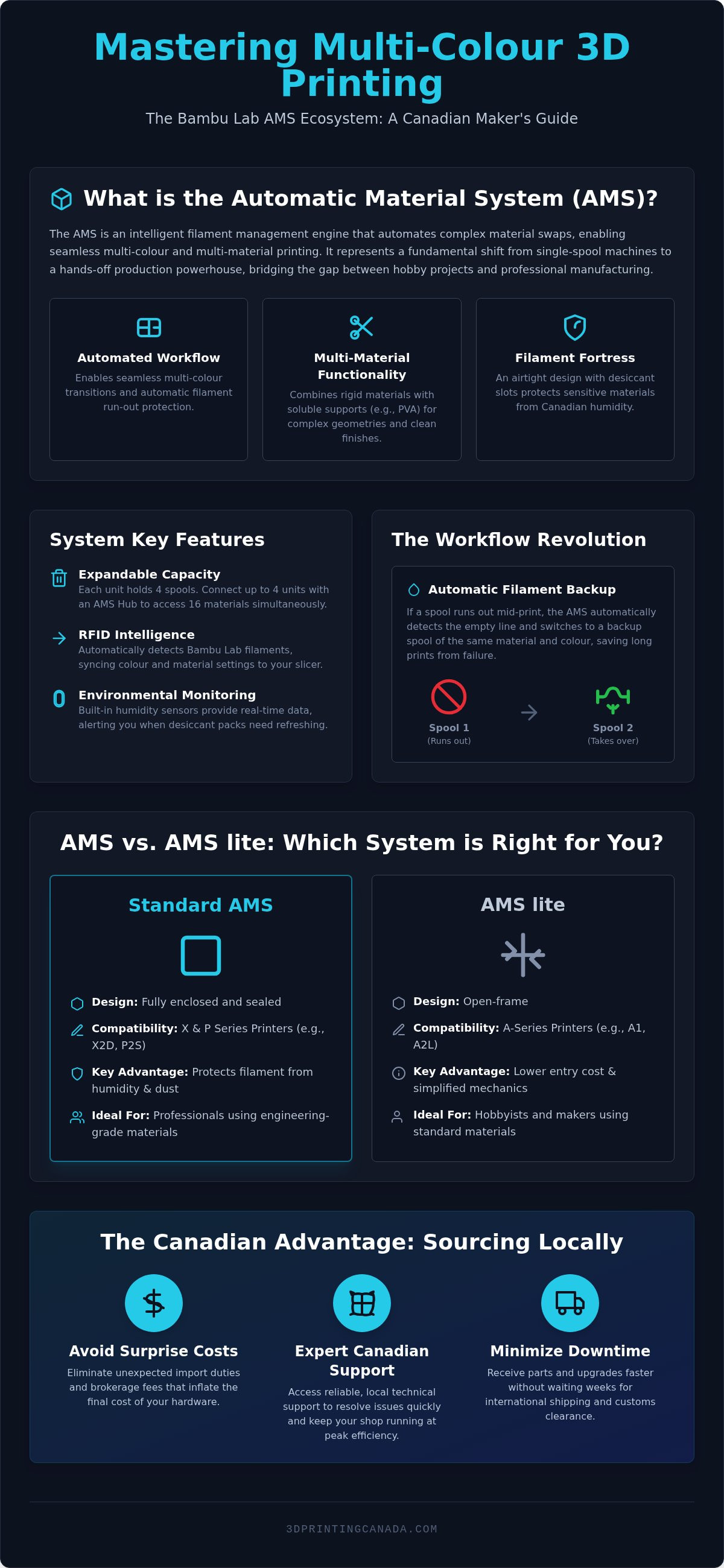
The Bambu Lab AMS Canada experience is about more than just adding a splash of red to a white model; it represents a fundamental shift in how we approach multi-material 3D printing. The Automatic Material System (AMS) is an intelligent filament management engine that sits atop or beside your printer, orchestrating complex material swaps without you needing to lift a finger. By 2026, the industry has moved past the limitations of single-spool machines. This technology is now the standard for anyone looking to bridge the gap between hobbyist projects and professional-grade manufacturing.
While multi-colour aesthetics are the most visible benefit, the real value lies in functional applications. You can load your AMS with dedicated support materials like PVA or specialized interface filaments that snap away cleanly, leaving a factory-smooth finish on overhanging surfaces. This capability allows you to print geometries that were previously impossible or required hours of tedious post-processing. When you invest in a Bambu Lab AMS Canada setup, you're gaining the ability to combine rigid materials with different properties in a single, cohesive part.
The system also acts as a fortress for your filament. Canadian weather is notoriously unpredictable; high humidity in the summer can ruin a spool of PETG or Nylon in a matter of hours. The AMS features an airtight design with integrated gaskets and desiccant slots that maintain a low-moisture environment. It's a proactive solution that ensures your materials stay "fresh" and ready to print, regardless of the humidity fluctuations outside your shop.
Key Features of the AMS System
- Expandable Capacity: Each unit holds four spools, but you can daisy-chain up to four units together to access 16 different materials simultaneously.
- RFID Intelligence: The system automatically detects Bambu Lab filaments, instantly syncing colour and material settings to your slicer.
- Environmental Monitoring: Built-in humidity sensors provide real-time data, letting you know exactly when it's time to swap out your desiccant packs.
The Workflow Revolution: Auto-Refill and Multi-Colour
One of the most practical features is "Auto-Refill." If you're halfway through a massive 24-hour print and your primary spool runs out, the AMS automatically detects the empty line and switches to a backup spool of the same material. It's a massive relief for long-distance prints where you can't be physically present to swap filament. This automation significantly reduces the learning curve for complex designs. You don't need to be a CAD expert to manage material changes; the software and hardware handle the heavy lifting, allowing you to focus on the creative side of your project.
AMS vs. AMS Lite: Choosing the Right System for Your Printer
Selecting the right hardware for your Bambu Lab AMS Canada setup depends entirely on the machine sitting on your workbench. For the 2026 flagship models like the X2D and P2S, the standard enclosed AMS remains the gold standard. In contrast, the A-series, including the A1 and A2L, utilizes the open-frame AMS Lite. While both systems manage four spools, their mechanical DNA is vastly different. The standard unit is a sealed environment, which is vital for materials like PETG that absorb moisture quickly in Canadian workshops. Researching the future of multi-material printing reveals a trend toward complex polymer-metal composites, making robust feeding systems more important than ever.
The choice between these two systems often comes down to a cost-to-performance analysis. Professionals who require consistent results with engineering-grade materials will find the enclosed system indispensable. Hobbyists, however, might prefer the lower entry price and simplified mechanics of the Lite version. Both systems represent a massive leap forward in accessibility, but they cater to different styles of making.
The Standard AMS: Built for the X and P Series
The standard AMS is a sophisticated piece of engineering. It uses an internal hub and buffer system to pull filament from the spools and push it through the PTFE tubes to the toolhead. This design allows for a compact footprint, as the unit can sit directly on top of your X2D or P2S. Professional users often prefer this model because it protects expensive engineering filaments from dust and debris. If you're looking to expand your capabilities, you can easily browse our selection of Bambu Lab accessories to find the necessary hubs for daisy-chaining multiple units together.
The AMS Lite: Simplified Multi-Material for A-Series
If you're using an A-series printer, the AMS Lite offers a different set of advantages. Its open-frame, top-loading design makes material swaps incredibly fast. You don't have to open a lid or navigate internal rollers; you just slide the spool on and go. This simplicity makes maintenance and cleaning much easier compared to the standard unit. However, this design isn't meant for flexible materials like TPU or highly abrasive carbon-fibre blends. For makers focused on PLA and decorative prints, the Lite version provides a cost-effective entry point into multi-colour work without the complexity of an internal buffer.
The Canadian Advantage: Sourcing Your AMS Locally
Many makers are tempted by international listings, only to get caught in the "Duty Trap." When you order hardware from outside the country, you often face unpredictable customs fees and brokerage charges that can add a significant amount to your final bill. Choosing a Bambu Lab AMS Canada supplier ensures that your investment stays within a predictable budget. Beyond the financial aspect, sourcing locally means you're directly contributing to the Canadian 3D printing ecosystem. This support allows local experts to maintain a steady stock of essential components like PTFE tubes and internal hubs, which are often the first parts to wear out during high-volume production. It's about building a sustainable resource for every maker in the country.
Fast Nationwide Shipping Across Canada
Getting your hardware quickly is essential for minimizing downtime. Local warehousing significantly reduces transit times and the risk of shipping damage associated with long-haul international routes. Whether you're in a major urban centre or a more remote region, you can rely on consistent delivery speeds without the headache of international courier surcharges. We provide real-time inventory tracking for all Bambu Lab accessories, ensuring you know exactly when your upgrade will arrive. This reliability is a major factor highlighted in this Make: Magazine review of the Bambu X1 Carbon with AMS, which emphasizes how the system's complexity benefits from a dependable supply chain.
Local Technical Support and Professional Repairs
The AMS is a sophisticated piece of equipment with multiple moving parts, sensors, and motors. If a complex jam occurs or a motor fails, shipping the unit back across an international border for service is both slow and expensive. Having access to Canadian-based technical support provides a vital safety net. Our experienced technicians understand the specific challenges of the Canadian market and offer professional 3D printer repair services to keep your setup running. Instead of waiting weeks for a response from an overseas help desk, you can speak with someone who can provide proactive solutions and expert maintenance. This local expertise ensures that your multi-material workflow remains a productivity tool rather than a source of frustration. We don't just sell you the hardware; we provide the human support required to use it effectively.
Optimizing Your AMS: Filament Compatibility and Maintenance
Getting the most out of your Bambu Lab AMS Canada setup requires more than just plugging it in; you need to be selective about what you feed it. While you can find high-quality 3D printer filament Canada wide, not every spool is a perfect match for the internal rollers. The "Cardboard Spool Debate" is a prime example. Many sustainable brands use cardboard, but these spools can shed dust that clogs your internal drive gears or causes slippage on the rollers. To fix this, you should use snap-on plastic rings or respool the material onto a plastic core to ensure consistent friction and a cleaner internal environment.
Maintenance is your best defence against mid-print failures. You should regularly inspect your PTFE paths for signs of internal scoring, especially if you've been running many colour changes. Use a small brush or compressed air to clean the drive gears every few months to remove accumulated filament debris. Certain materials require special handling; for instance, flexible filaments like TPU are too soft for the system to push through the long tubes, while glow-in-the-dark materials are highly abrasive and will wear down your components faster than standard PLA.
Spool Compatibility and Troubleshooting
Standardizing your spool sizes is the easiest way to prevent retraction errors. If a spool is too light, it might jump during a fast rewind, leading to a tangle. You can solve this by adding a printed weight to the centre of the spool. To achieve 99% uptime, ensure your spools are between 50 and 68 millimetres wide to prevent them from binding against the unit's internal walls. If you're using non-Bambu brands, consider using a hub adapter to maintain a steady grip on the rollers.
Advanced Material Handling
The real magic happens when you start using soluble supports for complex geometries. This allows you to print intricate parts that would be impossible to clean manually. However, you must manage moisture carefully; during a humid Canadian summer, even an enclosed AMS needs fresh desiccant to keep these sensitive materials dry. You should also take the time to calibrate your "flush" settings. By optimizing these values in your slicer, you can significantly reduce filament waste, commonly known as the "poop" factor, without risking colour bleed in your final model. Stock up on the right materials by visiting our collection of high-quality filaments today.
Why 3D Printing Canada is Your Ultimate AMS Partner
Choosing the right hardware for your shop is only half the battle; the other half is ensuring you have a reliable partner to keep that equipment running at peak performance. When you invest in a Bambu Lab AMS Canada setup, you aren't just buying a plastic box with motors. You're entering a high-performance ecosystem that requires specialized knowledge and a steady supply of compatible materials. We've positioned ourselves as more than just a retailer. We act as a sophisticated hub of expertise, providing the comprehensive knowledge and human support required to help you succeed with multi-material printing.
Our commitment to the Canadian 3D printing community goes beyond simple transactions. We rigorously test our entire inventory of filaments specifically for AMS compatibility, ensuring that every spool you buy from us will feed and retract reliably. By focusing on performance and utility, we help you avoid the frustration of failed prints and wasted material. Whether you're a casual hobbyist or a professional running a production floor, we provide the proactive solutions you need to stay creative.
Expert Repair Services for Bambu Lab Hardware
The complexity of the AMS system means that mechanical issues can occasionally arise, from stubborn filament jams to sensor calibration errors. While some manufacturers expect you to handle these problems alone, we offer professional 3D printer repair services Canada wide. Our experienced technicians use specialized tools and genuine parts to diagnose and fix hardware issues locally. This service acts as a vital safety net for small businesses and prosumers who cannot afford weeks of downtime. By handling maintenance and repairs within the country, we ensure your multi-material workflow remains consistent and profitable.
Your One-Stop Shop for Upgrades
Finding the right parts for the latest 2026 models, such as the X2D or P2S, should be a straightforward process. We maintain a deep inventory of Bambu Lab parts Canada wide, ranging from replacement PTFE tubes to complete internal hub assemblies. If you're looking to expand your capabilities, we offer bundle opportunities that include AMS units, specialized filaments, and essential spares. For a deeper dive into how to enhance your machine, check out our Bambu Lab accessories Canada guide for the latest on upgrades and parts.
We believe that sophisticated technology should be approachable. Our team is always ready to provide the guidance you need, whether you're troubleshooting a specific material or planning a major shop upgrade. By sourcing your equipment and expertise from a local Canadian resource, you gain the confidence to push the boundaries of what your 3D printer can achieve. Let us handle the technical hurdles so you can focus on what matters most: your next great project.
Level Up Your Multi-Material Production
The shift toward multi-material 3D printing is more than just a trend; it's a significant upgrade to your creative and professional capabilities. By integrating the Bambu Lab AMS Canada system into your workshop, you're choosing a future of automated filament backups and complex, multi-colour designs that require minimal manual intervention. You've learned that sourcing your gear locally isn't just about speed; it's about securing a reliable safety net through expert technical support and avoiding the duty trap of international shipping.
As an authorized retailer for the world's leading brands, we are here to support your journey with over 800 filament options in stock and expert 3D printer repair services available nationwide. Whether you're troubleshooting a new material or expanding your production capacity, you don't have to navigate the technical hurdles alone. Our team is ready to help you realize your most ambitious projects with confidence and precision.
Upgrade Your Workflow with the Bambu Lab AMS Today and start building something extraordinary. Your next masterpiece is just a few clicks away.
Frequently Asked Questions
Is the Bambu Lab AMS compatible with third-party filaments in Canada?
Yes, the Bambu Lab AMS Canada ecosystem is compatible with most third-party filaments, provided the spool dimensions fit within the unit's internal rollers. You should ensure spools are between 50 and 68 millimetres wide for the best results. While many Canadian-made filaments work perfectly, avoid cardboard spools unless you use plastic adapter rings or respool them. This prevents cardboard dust from contaminating the internal drive gears and causing long-term feeding issues.
How do I connect multiple AMS units to my Bambu Lab printer?
You can connect up to four AMS units in parallel to achieve 16-colour printing by using the official AMS Hub. This hub replaces the single-filament buffer on the back of your X or P-series printer. Once the hardware is connected, the printer's firmware automatically recognizes the additional slots. This setup is ideal for complex professional projects that require a diverse palette of materials or dedicated backup spools for high-volume production runs.
Can the AMS handle flexible materials like TPU?
No, the standard AMS and AMS Lite are not designed to handle flexible materials like TPU or TPE. These filaments are too soft to be pushed through the long PTFE tubes and often tangle within the internal hub's drive gears. If you need to print flexible parts, you should load the spool directly onto the printer's external spool holder and bypass the automated system entirely to avoid mechanical jams and frustrating downtime.
What should I do if my AMS has a filament jam?
If you encounter a jam, start by identifying where the filament is stuck using the printer's interface. Often, the issue is a broken piece of filament within the PTFE tubing or the internal hub. You can usually clear these by disconnecting the tubes at the push-to-connect fittings. If the jam is deeper within the drive gears, you might need to partially disassemble the unit to remove the debris and restore smooth operation.
Does 3D Printing Canada offer repair services for the Bambu Lab AMS?
Yes, 3D Printing Canada provides professional 3D printer repair services for the entire Bambu Lab ecosystem, including the AMS units. Our experienced technicians use specialized tools and genuine parts to resolve complex hardware failures that are difficult to fix at home. This local service provides a reliable safety net for Canadian makers, ensuring your equipment returns to production quickly without the costs and delays of international shipping or unpredictable customs fees.
How does the AMS protect filament from humidity?
The standard AMS features an airtight enclosure equipped with silicone gaskets and dedicated desiccant slots to keep your materials dry. It also includes integrated humidity sensors that provide real-time data to your printer's dashboard. This setup is particularly useful in Canada, where summer humidity can quickly degrade sensitive materials like PETG or Nylon. Replacing your desiccant packs regularly ensures the internal environment remains optimal for high-quality, bubble-free printing results.
Is the AMS Lite better for beginners than the standard AMS?
The AMS Lite is often considered more beginner-friendly because of its open-frame design and simplified loading process. It allows you to see the entire filament path, making it easier to troubleshoot and maintain. However, your choice depends on your printer model; the Lite version is only compatible with the A-series machines. If you value ease of access and mostly print with PLA, the Lite system is an excellent starting point for multi-material work.
How much filament waste does the AMS produce during colour changes?
The amount of waste depends on your slicer's flush settings and the contrast between the colours you are swapping. Moving from a dark colour to a light one requires more purging to prevent colour bleed. You can significantly reduce this waste by optimizing your flushing volumes or using the "flush into object" or "flush into infill" features. These settings help you maintain a clean transition while maximizing your filament's utility and reducing overall costs.