
A UL 94 V-0 rating on filament doesn’t automatically certify a 3D-printed part. In the vertical burn test, a V-0 specimen must self-extinguish within 10 seconds and produce no flaming drips. This flame-retardant filament UL 94 V-0 certification guide starts with that distinction: the rating applies to a tested material specimen, not automatically to every part printed from it.
It’s easy to see a V-0 label and assume a finished component will meet the same standard. But specimen thickness matters, and print orientation, infill and wall design can affect how a part responds to flame. A rating at one thickness doesn’t establish the same rating at another.
Here, you’ll learn what UL 94 V-0 does and doesn’t tell you, why thickness is central to interpreting a result, and how flame-retardant PLA, PETG, ABS and PC compare. That gives you a clearer basis for matching a material to your print and its intended use.
Key Takeaways
- A UL 94 V-0 result applies to a tested specimen, not automatically to every part printed from that material.
- Match the tested specimen thickness to your design; a rating at one thickness doesn’t establish the same performance at another.
- Understand how V-0 differs from other UL 94 classifications before choosing a material for your application.
- Compare flame-retardant PLA, PETG, ABS and PC by considering both their heat behaviour and the needs of your print.
- Account for the print’s design and manufacturing process, since both can affect how flame-retardant additives perform.
UL 94 flammability classifications
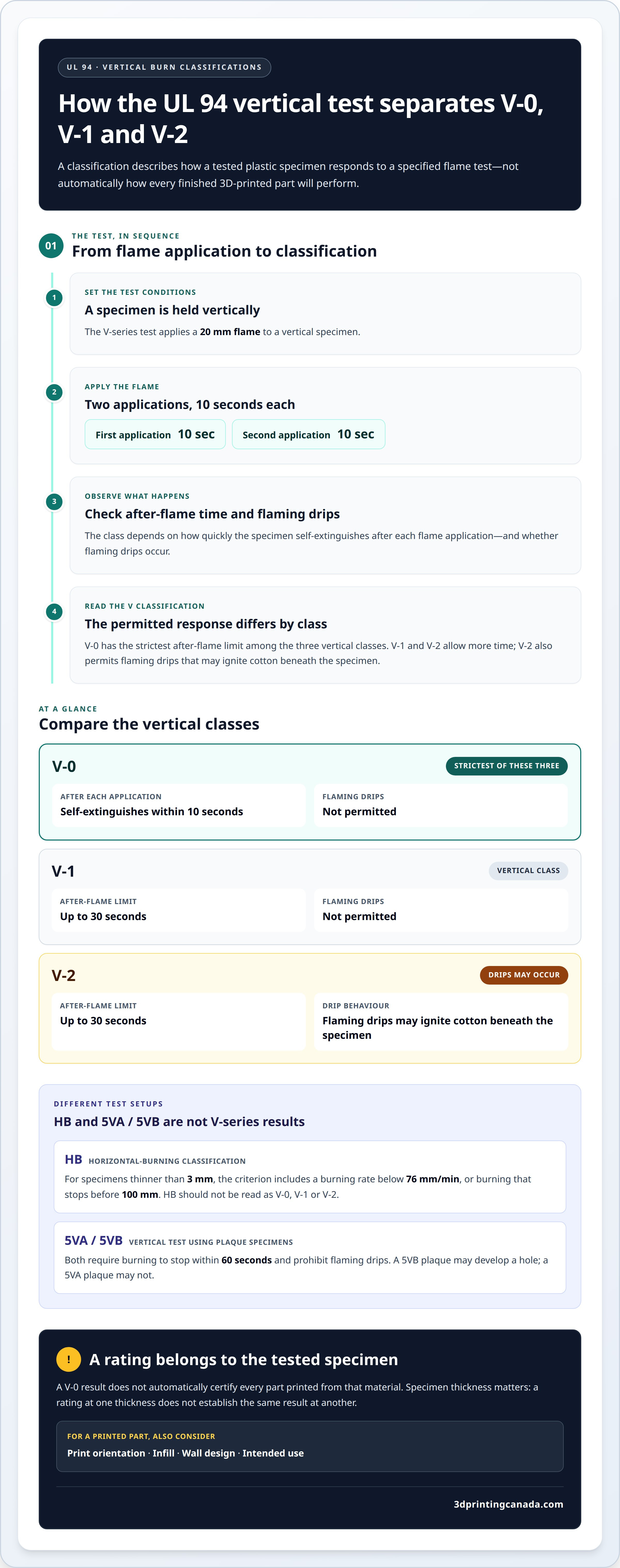
UL 94 is a plastics flammability standard developed by Underwriters Laboratories. It classifies how a small specimen responds to a specified flame test, not whether an entire 3D-printed assembly is fireproof. For a V-0 result, the specimen must self-extinguish within 10 seconds after each flame application and produce no flaming drips. That distinction matters when a design uses printed housings near a heat source.
UL 94 vertical flammability classifications are V-0, V-1 and V-2. In the V-series test, a 20 mm flame is applied to a vertical specimen twice, for 10 seconds each time. V-0 has the strictest after-flame limit of these three classes: each application must be followed by self-extinguishing within 10 seconds. V-1 allows up to 30 seconds, but flaming drips aren’t permitted. V-2 allows up to 30 seconds, and flaming drips may ignite cotton beneath the specimen.
Those differences can change a material decision. For a 3D-printed bracket where burning droplets could reach nearby components, V-0’s no-flaming-drips requirement is relevant. A V-2 classification permits that behaviour, even though the specimen still has a defined self-extinguishing limit. UL 94 V-0 describes the tested material’s flame response; it doesn’t establish that a finished part is safe at every temperature or in every use.
UL 94 also includes HB, a horizontal-burning classification that measures burn rate. For specimens thinner than 3 mm, the HB criterion includes a burning rate below 76 mm/min, or burning that stops before 100 mm. HB is distinct from the vertical V ratings, so an HB result shouldn’t be read as V-0, V-1 or V-2. The test setup and orientation help explain why those classifications aren’t interchangeable.
Other UL 94 classifications include 5VA and 5VB, which use a vertical burn test and assess plaque specimens. Both require burning to stop within 60 seconds and prohibit flaming drips. A 5VB plaque may develop a hole; a 5VA plaque may not. These results describe different test criteria, not a general ranking for every part or application.
During printing, the hot end and heated bed can cause burns, and a flame-retardant label doesn’t remove those handling hazards. UL 94 measures a specimen’s response to a controlled flame; it doesn’t certify the printer, print area or finished assembly for fire safety.
UL 94 is a small-scale standard for plastics used in parts of devices and appliances. It isn’t a building-construction, finish or contents rating. For automotive housings or other critical parts, the useful classification depends on the specified test, specimen thickness and part design, not the material name alone.
Flame-retardant versus flame-resistant materials
Flame-retardant materials are formulated to slow ignition or flame spread; flame-resistant describes performance under specified exposure. For a printed part, the material, geometry and intended use all matter when choosing a filament.
Material Properties and Rating Factors
Material properties are the mechanical and thermal behaviours that affect how a part performs, including stiffness, impact strength and heat resistance. They matter because a flame-retardant rating doesn’t tell you whether a bracket will bend, crack or soften in service.
Flame-retardant PLA has a typical heat-resistance range of 55-60°C, while flame-retardant PETG is typically 70-80°C. Flame-retardant ABS has a typical heat-deflection range of 90-100°C, and flame-retardant PC typically reaches 105-115°C. These ranges help compare thermal behaviour, but don’t establish the strength of a finished part.
Thickness changes the outcome, too. A polymer may achieve V-0 at 3.0 millimetres but only V-2 or HB at 1.0 millimetre. A V-0 result at 3.2 mm doesn’t establish V-0 at 1.6 mm. Wall thickness, print orientation and infill also shape how a printed part responds to flame.
For example, a rigid housing may need to retain its shape under heat, while a clip may need impact strength. Match those needs to the operating temperature and the tested thickness, rather than choosing by resin name alone.
Selection and Compliance Considerations
Selection and compliance considerations connect a material’s test results to the part’s end use. A small-scale material rating doesn’t replace every fire classification a product or project may require.
In Canada, UL 94 is a small-scale plastics test, not a building-construction or whole-product fire approval. Model codes don’t recognize small-scale UL 94 ratings as substitutes for other fire ratings they specify. The relevant criteria depend on the application, such as an appliance component versus a building finish.
Testing starts by defining the required classification and specimen thickness, then preparing specimens that represent the production material and process. For printed parts, data for injection-moulded versions of the same resin may not represent the printed structure. A specimen’s print orientation, infill and wall design can affect its flame behaviour.
Testing costs depend on the test scope, specimen preparation and laboratory services involved; there isn’t one universal fee for every material and part. Keep the intended application, dimensions and production method together when planning the test. For material options suited to different printing needs, explore 3D printing filaments.
Why are flame-retardant materials important?
Flame-retardant additives change how a polymer responds to ignition and burning. In electronics, for example, a housing may place plastic near heat-generating components. The additive is intended to influence flame behaviour, not make the part non-combustible. Its effect depends on the polymer, additive package and part design. A filament label alone doesn’t show how every finished shape will respond.
Some additives act in the gas phase, interrupting chemical reactions that sustain a flame. Others act within the polymer, promoting a protective char layer or reducing the fuel released as the material decomposes. These mechanisms explain why formulations based on the same plastic can perform differently. Additive choice is a material-design decision, not simply a colour or finish option.
Halogenated systems use elements such as bromine or chlorine in flame-retardant chemistry. Non-halogenated approaches can use phosphorus-based or mineral additives, among other formulations. Those categories describe chemistry, not a guaranteed test result. A halogen-containing formulation doesn’t automatically achieve a particular UL 94 classification, and a non-halogenated label doesn’t establish performance on its own. The tested grade and specimen are what matter for a rating.
PFAS refers to a broad family of per- and polyfluoroalkyl substances. The term doesn’t mean “flame retardant,” nor is it a shortcut for identifying every halogenated additive. A formulation’s ingredients and intended performance are separate questions. For a specific filament, consult the manufacturer’s technical and material documentation for its stated composition and test claims.
Printed geometry adds another layer of complexity. A formulation tested at one wall thickness may behave differently in a thinner section, while a thicker wall can change how heat and flame move through the part. Additives can also affect processing, so print settings and material formulation need to work together. This matters for small electronics enclosures as well as industrial components.
Work backwards from the application: identify the relevant fire-performance requirement, then consider the polymer’s mechanical and thermal needs. Compare formulations using data for the same material grade and relevant specimen thickness. Don’t assume that “halogen-free,” “flame-retardant” or a resin family name proves a finished part’s performance. The complete printed design, including wall thickness, remains part of the assessment.
Test specimen dimensions and thickness
UL 94 results apply to specimens with defined dimensions and thickness, not automatically to every printed enclosure. For a V-0 test, a vertical specimen receives a 20 mm flame twice, for 10 seconds each time. It must self-extinguish within 10 seconds after each application, with no flaming drips. The test measures material behaviour under a controlled exposure, not the full fire safety of a finished product.
Thickness is part of the rating. A polymer that achieves V-0 at 3.0 millimetres may receive only V-2 or HB at 1.0 millimetre. A result at 3.2 mm doesn’t establish V-0 performance at 1.6 mm. The thinner specimen has less material through which heat must travel, which can change how quickly it ignites or burns. A rating therefore needs to match the specimen thickness being assessed.
The UL 94 V-0 pass criteria consider more than one flame application. The total flaming time for five specimens is typically limited to 50 seconds, while afterglow is typically limited to 30 seconds. These criteria describe the test set; they don’t mean a printed part will behave identically. Material grade, print process and final wall design all affect the part’s response.
For the procedure described by the University of Texas Fire Research Group, ten specimens measure 125mm x 13mm x 3.175mm, with one set conditioned at 23 C and 50% RH for 48 hours. Specimen preparation and conditioning matter because consistent dimensions and exposure conditions help make test results comparable. A filament sample and a production part may not share the same structure or thermal behaviour.
In 3D printing, wall thickness and geometry can vary across one component. A housing might have a thick mounting boss, thin side walls and narrow ribs, each responding differently to flame. Print orientation changes the direction of deposited layers, while infill density changes the internal structure. Those features can affect how heat moves and how the part holds together during burning.
That’s why injection-moulded data for a resin shouldn’t stand in automatically for a printed part. A 0.75 mm, 1.5 mm or 3.0 mm specimen represents a specific thickness, not every possible design. For a part intended for production, specimens should reflect its production wall thickness and print process. The result then speaks more directly to the mechanical and thermal features of the actual design.
Flame-retardant PLA, PETG, ABS and PC filaments
Choosing among flame-retardant PLA, PETG, ABS and PC means balancing heat response, print needs and the tested rating. These plastics aren’t interchangeable just because a filament is described as flame-retardant. A grade’s UL 94 result applies to its tested specimen thickness, while the finished part’s geometry and print process affect its behaviour. This guide to flame-retardant filament and UL 94 V-0 certification helps frame those choices around the application.
Flame-retardant PLA typically has a heat-resistance range of 55-60°C; PETG’s typical range is 70-80°C. These ranges can help frame choices for parts with modest thermal demands, but neither establishes flammability performance. Check which specimen thickness achieved the stated rating and whether it reflects the intended part. PLA and PETG may suit different design goals, but a V-0 claim still needs thickness-specific context.
Flame-retardant ABS has a typical heat-deflection range of 90-100°C, while flame-retardant PC typically reaches 105-115°C. Those ranges can make ABS or PC worth evaluating for applications with greater thermal demands. They don’t guarantee that a printed component will achieve V-0. In manufacturing, the filament grade, wall thickness, print orientation and final geometry all contribute to the part’s flame response.
Thickness can narrow the choices. Flame-retardant ABS and PLA filaments can achieve V-0 at thicknesses of 3 mm or more, while typical FDM walls of 0.8-2 mm may not reach V-0. A common V-0 thickness listed for FR ABS is 1.6 mm. Treat each stated thickness as part of the rating, not a detail that automatically carries over to another design. For a flame-retardant filament UL 94 V-0 certification guide, keep the intended wall thickness central to the comparison.
Print preparation matters, too. Most flame-retardant materials should be dried before use; one example moisture-mitigation recommendation is 60-80°C for 4-6 hours. Abrasive additives can wear a nozzle, so a hardened metal or ruby nozzle is recommended for those formulations. Minimizing air incorporated into the print also helps the filament melt properly. Follow the material’s printing requirements and assess the finished design at its production wall thickness.
For aerospace, a UL 94 result may not address every project requirement; FAR 25.853 is identified as a standard aerospace projects may require. Compare PLA, PETG, ABS and PC by application, printability, heat needs and thickness-specific evidence. Explore flame-retardant filament options to help narrow your material choice.
3D Printing Canada: Filaments
3D Printing Canada offers filaments to support your next print, whether you’re comparing materials for a prototype or planning a functional part. Use the distinctions in this guide to think through the polymer, intended application and specimen thickness relevant to your design. A filament’s rating alone doesn’t certify a finished print, so match material information to the part you’re making.
If your printer needs attention before a materials change, 3D printer repair services can help address equipment issues. Bambu Lab accessories are another option for supporting compatible printing setups. Choose the next step based on your project: material selection, printer support or accessories.
For help with your filament needs, contact 3D Printing Canada.
Make your next material choice with confidence
Turn what you’ve learned into a design decision: define the part’s job, identify its performance needs, and choose a filament whose documentation fits that application. A guide to flame-retardant filament UL 94 V-0 certification is most useful when it informs the complete print plan, not just the material label. Keep the intended geometry and manufacturing process in view as your project moves from idea to finished part.
If you’re ready to explore filament options, 3D Printing Canada can help you take the next step. The team also offers Bambu Lab accessories, 3D printer repair services and 3D Printeda. Choose the support that fits your printing plans, whether you’re selecting materials or addressing a printer issue.
Contact 3D Printing Canada to discuss your next project. Make a thoughtful material choice, then keep building.
Frequently Asked Questions
Does 3D printing a UL 94 V-0 material automatically make the part certified?
No. A material’s test result doesn’t automatically certify a part printed from it. The printed design may differ from the tested specimen in wall geometry, layer orientation, infill and manufacturing conditions. A thin clip and a thick enclosure made from the same filament, for example, aren’t identical test specimens. If a project requires evidence for the finished component, testing should represent its production material, design and print process.
Is “fire resistant” the same as “flame retardant”?
No. “Flame retardant” generally describes a material formulated to slow ignition or flame spread, while “fire resistant” can imply performance under broader exposure or use conditions. Neither phrase alone identifies a particular test result. For a printed switch cover, look for the named classification, material grade and tested thickness in its supporting documentation. A descriptive label isn’t a substitute for application-specific fire-performance evidence.
What does UL 94 V-0 mean?
UL 94 V-0 means a tested plastic specimen met the standard’s V-0 vertical-burning criteria. In the test, the specimen must extinguish within 10 seconds after each flame application, and flaming drips aren’t permitted. The classification describes the specimen under those test conditions. It doesn’t mean a component can’t burn, nor does it establish performance for a different thickness, printed design or complete product.
What else should you know?
Processing and geometry can change how a printed part behaves, even when its filament has a flammability rating. Moisture, layer bonding, wall design and material changes between batches may affect production consistency. Keep the filament grade and print parameters consistent when making parts intended to match tested samples. A rating also doesn’t cover every hazard, such as electrical faults or heat exposure in actual use, so assess the whole design.
What is UL 94?
UL 94 is a plastics flammability standard developed by Underwriters Laboratories. It uses small-scale tests to classify how plastic specimens respond to flame. Its classifications include horizontal-burning HB and vertical ratings V-0, V-1 and V-2, alongside other test categories. The standard can help compare material behaviour for device and appliance parts, but it isn’t a building-construction or whole-product fire approval.
What is the UL Yellow Card and where do I find it?
A UL Yellow Card records a plastic material’s UL recognition and associated ratings. It can help identify the listed material grade and the thickness linked to a flammability classification. Look for the card or corresponding material record in UL’s certification information, then compare its grade details with the filament documentation. A similar-sounding polymer name alone doesn’t establish that the record applies.
What is the best 3D printing material for fire-rated electronic enclosures?
There isn’t one best material for every enclosure. Start with the enclosure’s operating temperature, mechanical demands, wall design and required fire-performance criteria. Flame-retardant PC has a typical heat-resistance range of 105-115°C, while flame-retardant ABS has a typical heat-deflection range of 90-100°C. Those ranges can inform a shortlist, but the relevant tested grade and thickness matter more than the polymer name alone.
Which flame-retardant plastic is best for consumer electronics enclosures?
The right fit depends on the enclosure’s heat exposure, impact needs, shape and required material rating. For example, compare flame-retardant ABS and PC against the product’s temperature demands and design constraints, then consider the rating at the intended wall thickness. Don’t choose by resin family alone: a filament result at a different thickness may not represent the finished enclosure. The product’s full compliance requirements also guide material selection.