
Could a spool of specialty filament turn a dependable brass nozzle into the cause of rough, inconsistent prints? If you’re weighing hardened steel nozzle vs brass for abrasive filament, start by checking the filament’s composition and how often you plan to print it. Carbon-fibre and glass-fibre blends, glow-in-the-dark materials, and some wood- or metal-filled filaments can wear brass faster than standard PLA, PETG, or ABS.
It’s reasonable to hesitate before switching. Hardened steel resists wear, but transfers heat less efficiently than brass, which can affect melting and flow. You don’t need to overhaul your print profile blindly. The right choice balances nozzle life with the thermal behaviour of your hot end, filament, and printer.
This guide explains which filaments may warrant a harder nozzle, what changes when you switch from brass to hardened steel, and when brass remains practical. It also covers compatibility and manufacturer guidance to review before changing a nozzle or adjusting print settings.
Key Takeaways
- Use filament composition and printing frequency to decide whether a more wear-resistant nozzle makes sense.
- Compare hardened steel nozzle vs brass for abrasive filament by weighing nozzle durability against heat transfer.
- Before changing nozzles, check your printer documentation for compatible geometry and hot-end requirements.
- After installation, run a test print and adjust settings in line with your printer and filament manufacturer guidance.
- Keep a brass setup for suitable everyday materials, and switch when your abrasive-filament use calls for it.
Why abrasive filament changes the brass-versus-hardened-steel nozzle decision
With ordinary, unfilled filament, a brass nozzle can remain a practical choice. Hard particles or fibres in some filaments can gradually wear the nozzle’s internal surface as the material passes through during printing.
That doesn’t mean every specialty spool calls for a nozzle change. The decision behind hardened steel nozzle vs brass for abrasive filament depends on the specific filament formulation, how much you plan to print, and which nozzles your printer’s hot end supports. A few small test prints create a different wear burden from regularly producing larger parts with an abrasive blend. Nozzle fit and geometry matter too.
Which filament additives can be abrasive?
Carbon-fibre-filled and glass-fibre-filled filaments are familiar examples because their reinforcing fibres can wear a softer nozzle over repeated prints. Other additives may also be abrasive, but a material’s name alone doesn’t tell you exactly how it will behave. Glow-in-the-dark or mineral-filled filament, for example, can vary by manufacturer and formulation. Check the filament maker’s guidance for the specific material rather than treating every product in a category as identical.
Abrasiveness comes from the additive’s properties and concentration, not just the base polymer. Two filaments made from the same base plastic can place different demands on a nozzle if one includes hard particles or fibres and the other does not. Read the material details and printing recommendations before deciding whether your usual nozzle is suitable.
Why brass wear matters for print consistency
Abrasive particles can gradually wear the nozzle opening. As its shape changes or the opening grows, the printer may no longer extrude material as expected. You might notice inconsistent line width, excess material, or dimensions that drift from the intended measurements. Wear can be gradual, so an acceptable first print doesn’t show how the nozzle will perform after continued use.
Wear and a clog are different problems. A worn nozzle has an opening altered by material passing through it; a clog restricts or interrupts filament flow. Clogs can have other causes, including debris in the filament path or temperature and feeding issues. If extrusion becomes uneven, don’t assume the nozzle is worn based on that symptom alone. Consider the material you’ve printed, how much has passed through the nozzle, and whether another part of the setup could explain the change.
There isn’t a dependable lifespan that applies to every brass nozzle and abrasive-filament combination. Wear varies with the filament formulation, the total amount printed, and the printer setup. For occasional experiments, monitor print consistency to help decide whether a change is worthwhile. If abrasive materials are a regular part of your workflow, prioritizing wear resistance becomes more relevant.
How brass and hardened steel behave differently in an abrasive-filament setup
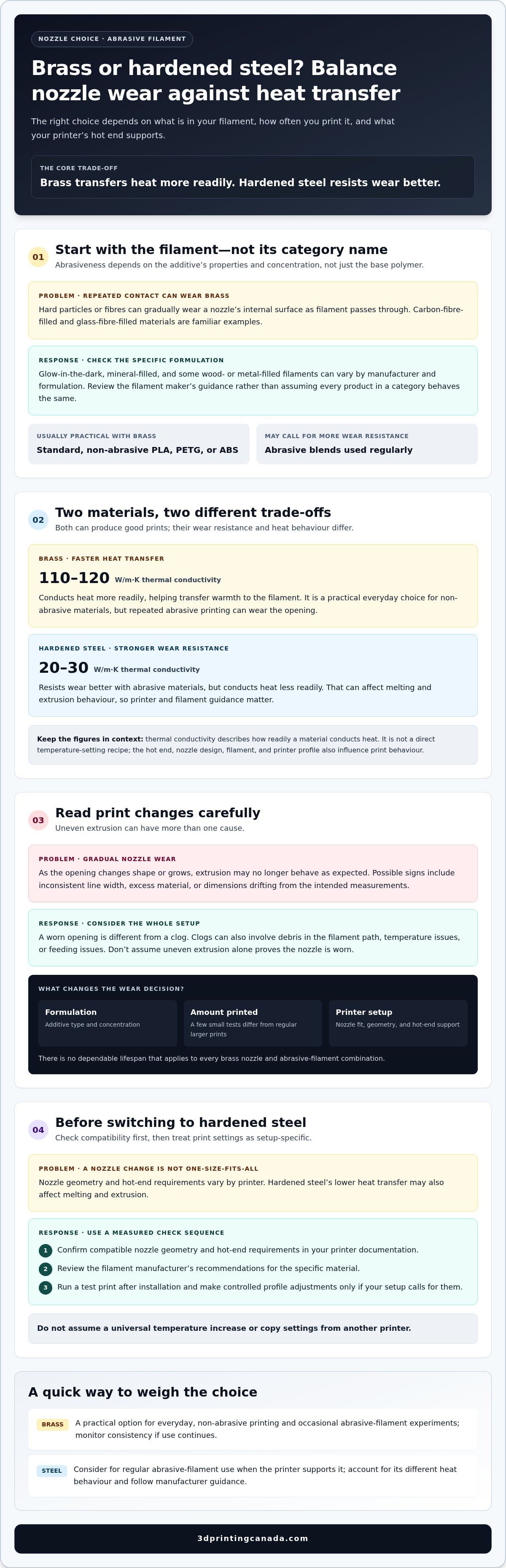
Both nozzle materials can produce good prints, but they respond differently to heat and repeated contact with abrasive material. Brass conducts heat more readily, helping transfer warmth to the filament efficiently. Hardened steel is more resistant to wear, making it a practical option for regular abrasive-filament use. The core trade-off is simple: brass transfers heat more readily, while hardened steel resists wear better, so neither material is best for every print setup.
The difference in heat transfer is substantial: brass typically measures around 110-120 W/m·K in thermal conductivity, compared with about 20-30 W/m·K for hardened steel. These figures describe how readily the materials conduct heat; they aren’t a direct temperature-setting recipe. Your hot end, nozzle design, filament, and printer profile all influence how the material behaves during a print.
| Factor | Brass | Hardened steel |
|---|---|---|
| Wear resistance | Suitable for non-abrasive use, but the opening can wear with repeated abrasive-filament printing. | More resistant to wear from abrasive materials. |
| Heat transfer | Conducts heat more readily, helping transfer heat to the filament. | Conducts heat less readily, which may affect melting and extrusion behaviour. |
| Common use | A practical choice for everyday, non-abrasive filaments. | Often considered for regular use with abrasive blends. |
| Setup considerations | Use settings suited to the filament and printer. | Check printer and filament guidance; the profile may need adjustment. |
Brass nozzles: responsive for general-purpose printing
Brass is a common choice for standard, non-abrasive filaments because it transfers heat efficiently. Heat moves readily through the nozzle to the filament passing through it, supporting predictable melting with a suitable printer profile. If abrasive filament is only an occasional experiment, brass may still suit most of your regular printing. Frequent abrasive use makes gradual wear a greater consideration.
Hardened steel nozzles: more wear resistance, different heat behaviour
Hardened steel offers a durability advantage when abrasive material is part of your routine, since it’s less prone to wear than brass. Its lower thermal conductivity can change how heat reaches the filament, which may affect extrusion. Don’t apply a universal temperature increase or copy settings from another printer. Check your printer documentation and filament manufacturer’s recommendations, then make controlled adjustments if your setup calls for them.
That’s the practical distinction in the hardened steel nozzle vs brass for abrasive filament decision: weigh how often you use abrasive material against the thermal behaviour your setup needs. If you’re comparing materials for upcoming prints, browse 3D printing filaments and check the additives and manufacturer guidance for the specific material.
When hardened steel is worth choosing over brass for abrasive filament
Ask how often you use abrasive filament, how much material passes through the nozzle, and whether your printer supports a suitable hardened steel option. These factors help distinguish a change that supports your regular workflow from one that adds setup work for a rare test print.
Choose hardened steel for recurring abrasive-filament jobs
If carbon-fibre- or glass-fibre-filled filament is part of your regular printing schedule, prioritizing wear resistance can make sense. The case is stronger when you’re producing larger parts, repeating the same job, or printing enough abrasive material that nozzle wear could affect consistency over time. A more wear-resistant nozzle can suit that workload, though you still need settings appropriate to the nozzle and filament.
Keep the decision focused. A nozzle change addresses the surface where filament exits the hot end; it doesn’t automatically upgrade other printer components or make every material easier to print. Treat the nozzle as one part of the system, alongside the printer’s hot end, material profile, and print requirements.
Keep brass for occasional or non-abrasive printing when appropriate
If most of your work uses standard PLA or PETG and abrasive filament is limited to an occasional small project, you may have little reason to change an otherwise suitable brass setup. Weigh that limited use against the work of changing nozzles and tuning your profile. Occasional use still exposes brass to wear, so follow the filament maker’s guidance and monitor print consistency as you use the material.
For a mixed workflow, a dedicated nozzle for abrasive jobs may be more convenient than repeatedly changing materials on one setup, provided your printer supports that nozzle design. Whether this is practical depends on your printer and how you organize your prints.
Material choice only helps if the nozzle fits. Nozzles aren’t universally interchangeable. The thread, length, shape, and other geometry must match the hot end and printer design. A hardened steel nozzle that doesn’t fit correctly isn’t a workable solution. Check your printer documentation for compatible nozzle types and any profile requirements for different materials.
In practice, the hardened steel nozzle vs brass for abrasive filament decision comes down to recurring wear versus the need to match and tune a different nozzle. Choose hardened steel when abrasive printing is a regular, meaningful part of your workload and your setup supports a compatible option. Keep brass where it suits your everyday materials and occasional use. To compare materials for planned prints, explore 3D printing filament options and review each manufacturer’s recommendations.
A practical checklist for changing to a hardened steel nozzle
A nozzle swap involves more than choosing a harder material. The replacement must suit your printer’s hot end, and your print profile may need reassessment after installation. Work through compatibility, installation, and testing in that order. If anything conflicts with the printer manufacturer’s instructions, pause rather than forcing a part or improvising a procedure.
Check compatibility before removing the existing nozzle
Use your printer documentation to identify the nozzle dimensions, mounting style, and hot-end compatibility required for your model. Nozzles aren’t universal, even if they look similar or share a material. Follow the manufacturer’s safe replacement procedure, including its instructions for heating, tools, and tightening. A nozzle fitting another printer doesn’t prove it’s suitable for yours.
- Confirm the match. Check the replacement nozzle’s geometry and mounting requirements against your printer and hot-end documentation. Verify that the nozzle material suits your intended filament and that the printer supports that type.
- Install according to the printer’s procedure. Follow the manufacturer’s instructions from removal through tightening. Replacement methods vary, so use the specified procedure rather than assuming a cold or heated change is appropriate for every machine. Avoid overtightening or leaving the nozzle improperly seated, as installation errors can cause hardware problems.
- Run a controlled test print. Before starting a long or important job, choose a small test model using the filament you intend to print. Review the filament manufacturer’s guidance and your printer’s recommendations for temperature, flow, and extrusion settings. Change settings only where the guidance or test results indicate a need.
Calibrate and assess the first test print
Look for steady extrusion and consistent lines, then check the model for gaps, excess material, or other changes in print quality. If you need to tune the profile, change one setting at a time and test again. This makes it easier to identify which adjustment affected the result. Don’t carry settings over from another printer or filament without checking that they suit your hardware and material.
Record the nozzle and filament used, along with any profile adjustments. This gives you a useful reference if you switch back to brass or print the same material again. If extrusion remains inconsistent after you’ve checked the fit, installation, filament guidance, and settings, repeated adjustments may not resolve a hardware issue. 3D Printing Canada provides expert 3D printer repair services for persistent printer problems.
Keep the hardened steel nozzle vs brass for abrasive filament decision grounded in how your printer performs, not a one-size-fits-all temperature change. Confirm the fit, follow the manufacturer’s installation procedure, and validate the setup with a small print before relying on it for a longer job.
Match your nozzle choice to the filament and supplies you use
Choose a nozzle based on the materials you print regularly, how much abrasive filament passes through it, and what your printer can use. Brass may remain a sensible fit for everyday non-abrasive materials, while recurring abrasive jobs can make hardened steel worth considering. If you print a mix of materials, focus on the ones that place the greatest wear demands on your routine rather than treating one nozzle as ideal for every spool.
A quick decision guide for common printing patterns
- Mostly standard filament: If your usual prints use non-abrasive materials such as standard PLA or PETG, a compatible brass setup may continue to meet your needs.
- Frequent abrasive blends: If abrasive filament is a regular part of your projects, consider whether hardened steel’s added wear resistance suits your print volume and workflow.
- A mix of materials: Base your main setup on the wear-intensive materials you print often. If your printer supports it, a separate compatible nozzle for abrasive jobs may help keep settings and material use organized.
Occasional abrasive printing still deserves attention. Wear depends on the specific filament and how much you print, so check the material manufacturer’s advice rather than assuming every filled filament behaves the same way. For a small one-off project, you may decide to keep your existing setup; for repeated jobs, the trade-off may be different.
Keep material choice connected to print goals
Nozzle material is one part of the setup, not a guarantee of print quality. Your result also depends on the filament, printer, hot end, nozzle geometry, and profile settings. Follow the filament maker’s guidance and your printer documentation, especially if a material calls for different temperature or flow settings.
Compatibility matters for printer-specific accessories too. If you use a Bambu Lab printer, consult the relevant Bambu Lab accessories guidance alongside your printer documentation before selecting a replacement nozzle. Don’t assume a nozzle designed for one hot end will fit another, even if both are made from hardened steel.
The practical answer to hardened steel nozzle vs brass for abrasive filament is to match the nozzle to your regular materials, print frequency, and printer compatibility. Keep brass if it suits your ordinary filament use; consider a compatible hardened steel option when abrasive printing becomes a recurring part of your workflow. Explore 3D Printing Canada’s filament and printer-support resources to plan supplies around your materials and projects.
Plan your next abrasive-filament print with confidence
Let your next project guide the decision. Before loading a new material, consider what you want the finished part to do, how often you’ll print with that filament, and what your printer documentation recommends. This gives you a practical starting point without treating a nozzle change as a guarantee of better results.
The question of hardened steel nozzle vs brass for abrasive filament is also a chance to make material choices more intentional. Keep notes on how your filament and printer perform, then use those observations to refine your setup for future projects.
3D Printing Canada offers filaments and printer accessories, along with professional 3D printer repair services. Explore 3D printing supplies and support as you plan your next print or address a persistent hardware issue.
Choose thoughtfully, test your setup, and keep creating with confidence.
Frequently Asked Questions
Can you print abrasive filament with a brass nozzle?
Yes, a brass nozzle can print some abrasive blends, but repeated use may wear its opening. For the hardened steel nozzle vs brass for abrasive filament decision, treat a one-off small part differently from a batch of functional components. Keep track of the filament and amount printed, and look for changes in extrusion over time. A successful first print doesn’t prove the nozzle will remain unaffected during continued use.
Can a hardened steel nozzle print regular PLA?
Yes, in many compatible printer setups, hardened steel can print standard PLA. If a familiar PLA profile produces uneven lines after a nozzle change, don’t assume the filament is faulty; the nozzle’s different heat behaviour may affect extrusion. Check the printer and filament guidance, then test a small model. Record the profile and results so you can compare them with your previous setup.
Do you need to change the nozzle diameter for abrasive filament?
No, abrasive filament doesn’t automatically require a different nozzle diameter. Diameter changes the size of the opening and can affect detail, flow, and print time, while nozzle material relates to wear resistance. For example, switching from a smaller opening to a larger one may alter several print characteristics at once. Check the filament maker’s recommendations and printer limits, and test diameter and material changes separately where possible.
How can you tell if a nozzle is worn out?
Possible clues include changed line widths, inconsistent extrusion, or dimensions that differ from earlier prints made with the same settings. Those signs aren’t proof of wear. A partial clog, feed problem, or filament condition can cause similar symptoms. Compare a small print using a familiar material and inspect the nozzle only as described in your printer’s maintenance instructions. Avoid forcing tools into the opening.
Does hardened steel require a higher printing temperature than brass?
Not in every setup. Hardened steel transfers heat differently from brass, so the temperature that gives steady extrusion can depend on the nozzle, hot end, printer, and filament. Start with the manufacturers’ recommended settings rather than applying a fixed increase. If the first test shows under-extrusion or poor layer bonding, adjust one setting at a time within the recommended range and check the result with another small print.
Can abrasive filament clog a nozzle?
Yes, a clog can happen, but it’s distinct from abrasive wear. A clog restricts filament flow and may relate to debris, material handling, temperature, or feeding conditions; wear gradually changes the nozzle opening. If flow stops or becomes erratic, pause the print and follow the printer maker’s troubleshooting steps before replacing parts. For hardware problems that persist after basic checks, professional 3D printer repair services can help diagnose the issue.