
Choosing low odor filaments for classroom use can make printing more comfortable, but a faint smell or no smell you notice doesn’t tell you everything about what may be released during a print. PLA is generally considered low-odour, but the material is only one part of the decision.
When planning classroom projects, consider printer compatibility, the room and school procedures alongside the filament. Materials can differ in noticeable odour and printing requirements, and a low-odour label isn’t a safety plan.
This guide compares PLA, PETG, ABS and ASA, with practical criteria for matching materials to projects and printers. It also explains what odour can and can’t tell you, and how product documentation, ventilation and classroom routines fit into a considered setup.
Key Takeaways
- Compare PLA, PETG, ABS and ASA by project needs and printer requirements rather than assuming one material suits every classroom.
- Use manufacturer documentation to understand material-specific odour guidance and printing requirements. A material name alone doesn’t describe every formulation.
- Choose low odor filaments for classroom use as part of a broader setup decision, not as a substitute for considering room conditions and school procedures.
- Use a practical selection process, then run a small, supervised test print to assess print quality and perceived odour in context.
- Compare filament categories with your printer and project requirements. 3D Printing Canada sells filaments, 3D printers and related equipment, and provides technical support and repair services.
What makes a low-odour filament suitable for classroom use?
“Low odour” is a comparison, not a universal technical guarantee. It describes how noticeable a filament’s smell may seem during printing relative to other materials or formulations. It doesn’t mean odour-free, emission-free or automatically suitable for every room. For educators considering low odor filaments for classroom use, comfort is one factor, not a complete assessment of the printing setup.
This guide focuses on filament for fused deposition modelling (FDM), where a heated nozzle melts plastic and deposits it layer by layer. Resin printing uses different materials and processes, so it isn’t covered here. Low odour is not a classroom safety certification. Consider it alongside the project, printer and room.
What does low odour mean when filament is printing?
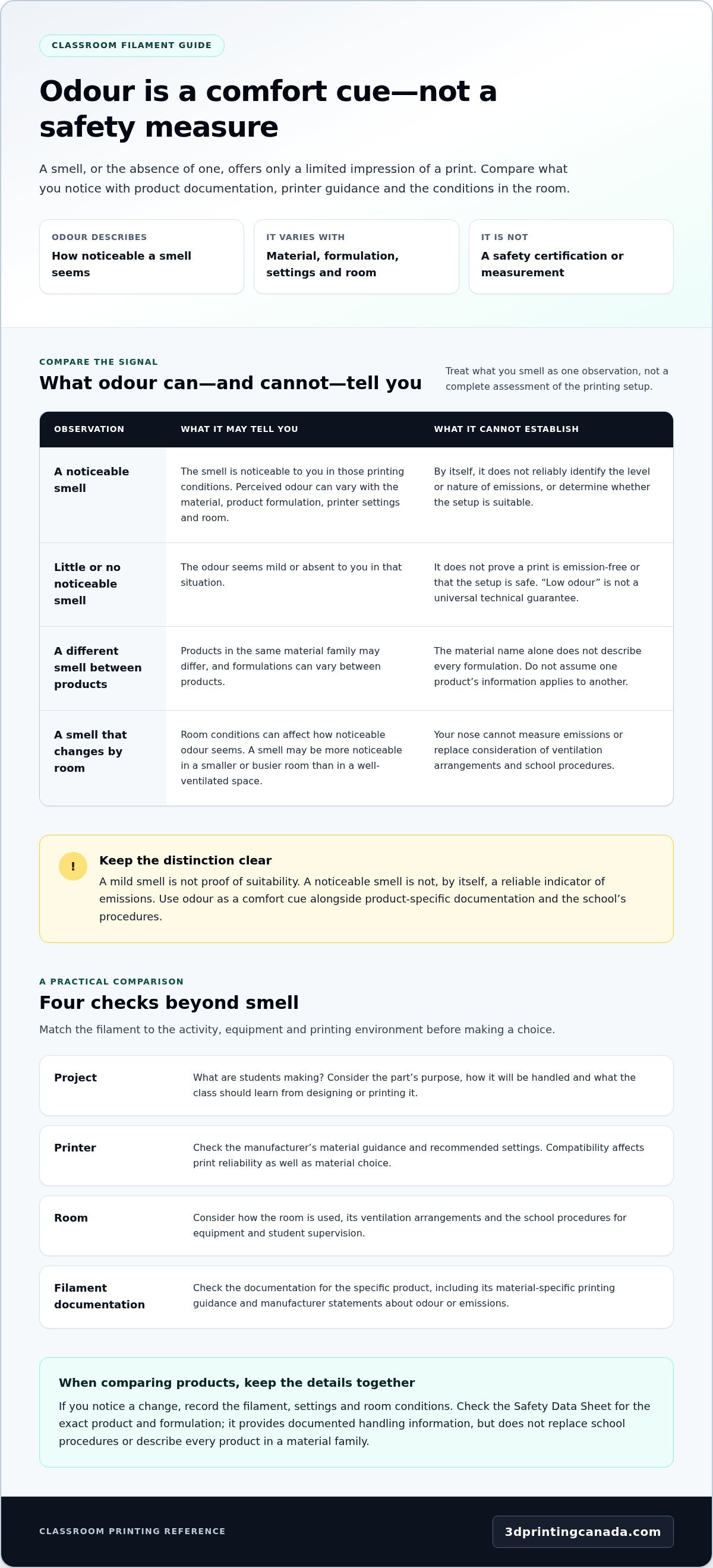
Perceived odour can change with the material, its particular formulation, printer settings and room conditions. A smell that seems mild in a well-ventilated space may be more noticeable in a smaller or busier room. Manufacturer descriptions can help you compare products, but check the documentation for the specific filament. Products within the same material family may differ.
Use your nose as a comfort cue, not a measuring instrument. A noticeable smell doesn’t, by itself, reliably indicate the level or nature of emissions. Little or no noticeable smell doesn’t establish that a setup is safe either. Odour is only one part of the decision.
What should educators prioritize before choosing filament?
Start with the learning activity. A model used to explain geometry has different demands from a fixture students will handle repeatedly. Then check the printer’s material guidance and consider the room where printing will take place. A suitable option meets the project’s needs, works with the equipment and fits the school’s procedures and ventilation arrangements.
Use these questions to frame the comparison:
- What are students making? Note the part’s purpose, how it will be handled and what the class should learn from designing or printing it.
- What does the printer support? Check the manufacturer’s material guidance and recommended settings before selecting a spool. Compatibility affects print reliability as well as material choice.
- Where will printing happen? Consider how the room is used, its ventilation arrangements and the school procedures that apply to equipment and student supervision.
- What does the filament documentation say? Look for material-specific printing guidance and manufacturer statements about odour or emissions. Treat broad labels as a starting point, not a complete assessment.
This helps you avoid choosing by smell alone. A filament that seems comfortable during a brief print may still be a poor fit if it doesn’t meet the printer’s requirements or the project’s demands. A technically suitable material also needs to be considered in the context of the room and school practices. Compare all three: project, printer and printing environment.
Why filament material and printing conditions affect odour
A spool’s material name is a useful starting point, not a complete description of how it will smell in a classroom. PLA, PETG, ABS and ASA each refer to a broad material family, and formulations can differ between products. Printer temperature, settings and room conditions also matter, so prints using the same material family may not have the same perceived odour.
Low odour alone cannot establish material safety. Smell is a subjective impression, not a measurement of what a print releases or how much. Use it as one observation, and rely on product-specific documentation and school procedures when deciding on handling and printing conditions.
How printer settings and the room can change the experience
Follow the manufacturer’s recommended settings for the specific filament. Temperature can influence how printing smells, so don’t raise it beyond the guidance just to force a print to work. If a print is unreliable, review the material and printer instructions rather than making unsupported setting changes.
Room conditions matter, too. A printer beside a frequently used desk may be more noticeable than one in a separate, ventilated area. Room size, printer placement and several machines running at once can affect how odour is perceived. Plan ventilation when deciding where and when to print, and follow applicable school procedures. Don’t assume that an open window or an enclosed printer automatically addresses every room concern.
What a Safety Data Sheet can, and cannot, tell you
Look for the Safety Data Sheet (SDS) for the exact filament product and formulation. It provides documented handling information, but it isn’t a universal assessment of every material in that family or a substitute for school procedures. An SDS for one brand shouldn’t be used to make claims about another.
Keep documented information separate from assumptions. A noticeable smell alone doesn’t identify a filament’s composition or establish a level of safety. If you notice a change between products, record the filament, settings and room conditions so you can make a useful comparison. Refer to the product documentation and follow your school’s process if questions arise.
This evidence-first approach helps you compare low odor filaments for classroom use without treating a mild smell as proof of suitability. Browse filament options by material and compare product information with your printer and project needs. Keep the documentation for each product with your classroom printing procedures.
PLA, PETG, ABS, and ASA: comparing classroom filament options
No material is a classroom winner in every situation. Use the comparison below to narrow your options, then check the manufacturer’s documentation for the exact filament. Material-family descriptions are broad: formulations, odour claims and print requirements can vary by product.
| Material | Potential classroom fit | Odour and requirements to check |
|---|---|---|
| PLA | Consider it for educational models, prototypes and other projects where the required properties match the product specifications. | PLA is generally considered low-odour, but don’t assume every formulation smells the same. Confirm the manufacturer’s odour statements and recommended printer settings. |
| PETG | May suit functional projects where a balance of strength and temperature resistance is useful. Compare the specific product’s documented properties with the part’s intended use. | Odour can vary by formulation. Check the product documentation rather than relying on the material name or another brand’s description. |
| ABS | Consider only if the project requires properties supported by the specific product’s documentation and the printer and room arrangements are suitable. | ABS is associated with higher VOC emissions, including styrene, than lower-emission options. Review manufacturer guidance and school procedures before use. |
| ASA | Assess it against the project’s documented performance needs and the printer’s capabilities. Don’t choose it on a general material comparison alone. | Like ABS, ASA is associated with higher VOC emissions, including styrene. Verify claims for the exact formulation and consider the room and ventilation arrangements. |
These odour notes are general tendencies, not manufacturer-specific guarantees. Verify material-specific odour or emissions claims against the relevant product documentation. A manufacturer statement about one formulation shouldn’t be applied to every spool in that material family.
When PLA may fit everyday classroom projects
For a geometry model, a labelled prototype or a component students will examine during a lesson, PLA may be a practical option if it meets the project’s needs and the printer manufacturer supports it. Start with the part’s purpose, then compare the specific filament’s properties and odour information. A familiar material name doesn’t replace product documentation or school procedures.
When PETG, ABS, or ASA may better fit the project
PETG may be worth comparing for functional parts where documented strength and temperature resistance matter. ABS or ASA may be considered when the project’s requirements justify them and the printer, room conditions and school procedures support their use. Check each product’s specifications and print guidance. Don’t select ABS or ASA for a classroom based on a generic material comparison or a low-odour label.
Use low odor filaments for classroom use as a search starting point, not a final filter. Match the material to the learning goal, check its documentation and confirm printer requirements before deciding which option suits the classroom project.
How to choose and use classroom filament with fewer surprises
A repeatable process makes filament choices easier to explain, compare and revisit. Start with what students need to make, then check printer compatibility and product guidance before introducing a material. A small, supervised test print can help you assess print quality and perceived odour in your actual setup. It can’t replace manufacturer instructions or school safety procedures.
Checklist: Match the material to the project, confirm printer compatibility, review product documentation, and account for room use and school procedures.
A classroom filament selection checklist
Work through these steps in order. Keep the product name and its documentation together so the decision is based on the exact filament, not assumptions about its material family.
- Define the learning activity. Note what students are making, how the part will be used and what they should learn. A display model and a frequently handled classroom tool may need different print characteristics.
- Set the project requirements. Consider the desired detail, strength and intended use. Compare the filament manufacturer’s specifications with the part’s requirements.
- Check printer compatibility. Review the printer manufacturer’s material guidance and follow its recommended settings for the specific filament. Don’t assume a material will work simply because it worked on another printer.
- Read the product documentation. Review applicable printing and handling instructions, odour statements and storage guidance. Keep claims tied to the particular product.
- Account for school requirements. Include purchasing procedures, the planned print location, ventilation arrangements, supervision and student access in the decision.
Plan printing, storage and student access
Before using a material for a class project, run a small test print under supervision and follow the manufacturer’s settings. Observe whether the print completes as expected and how noticeable the odour seems in that room. Record the product, settings and conditions to make comparisons useful. Treat these observations as practical feedback, not proof of safety or a substitute for documentation and school procedures.
Plan printing for periods when appropriate supervision is available, and follow school rules for who can operate or approach the equipment. Make sure students understand that printer components can be hot or moving, and follow the equipment manufacturer’s instructions about safe access. Store the filament as directed on its packaging or in its product documentation to help maintain its condition.
For a class using low odor filaments for classroom use, consistency matters. Keep a simple record of the chosen product, its settings, storage instructions and observations from supervised test prints. This gives educators a practical reference when repeating a project or evaluating a different formulation, while keeping decisions grounded in product guidance and school procedures.
When comparing materials for a classroom project, review filament options and 3D printing equipment alongside your printer requirements and project plan.
Find classroom filament options and compare them with confidence
A practical decision starts with the lesson, not a “low-odour” label. Identify what students will make and how the finished part should perform. Then check that the printer supports the material and can use it according to the manufacturer’s guidance. Keep product documentation, room conditions and school procedures in view. This sequence helps you compare low odor filaments for classroom use without expecting one material to suit every project or printing space.
Match your classroom project to a filament category
Consider the part and its role in the lesson. A model used to explain a concept may not need the same characteristics as a component students will handle or use repeatedly. Compare the project’s requirements with the documented properties of each filament, and avoid choosing by broad material-family name alone. Formulations can differ, so product-level guidance matters.
A general filament buying guide can explain material-selection fundamentals, such as how to consider intended use and printer compatibility. For a classroom decision, also compare manufacturer odour information, room arrangements and school procedures. Keep those factors distinct from a material’s performance claims: a filament that suits the part still needs to fit the classroom setup.
As you compare filament categories and equipment, keep the project requirements and printer guidance handy. 3D Printing Canada is a specialist retailer of 3D printing filaments and equipment, with technical support to help you understand printer and printing needs.
Explore filament options for your printer
Browse by material category, then review the documentation for the specific filament you’re considering. Check the printer manufacturer’s compatibility guidance and the filament maker’s instructions before choosing a product. Look for documented odour statements rather than assuming that all products made from PLA, PETG, ABS or ASA will smell alike. Assess each product on its own documentation.
Make a short comparison for your classroom: intended project, printer compatibility, product guidance, room use and relevant school procedures. This keeps odour in perspective. It can inform comfort and planning, but it doesn’t establish that a filament or setup is safe on its own. A supervised test print may help you assess print quality and perceived odour in context, while manufacturer instructions and school procedures remain the basis for decisions.
Choose with evidence, not a promise of odour-free printing. Compare 3D printing filaments with your classroom project, printer and room conditions in mind.
Make your next classroom print a confident one
Turn your next lesson idea into a simple material-selection plan. Note what students will create, what the finished part needs to do and which printer will make it. Then use product documentation and your school’s procedures to guide the choice. This gives you a practical starting point for comparing low odor filaments for classroom use without expecting a material label to answer every question about the printing environment.
3D Printing Canada sells a wide variety of 3D printing filaments and equipment. Its technical support and professional 3D printer repair services can also help educators address equipment and printing needs as classroom projects develop.
Explore 3D printing filaments and compare product information with your project and printer requirements. A thoughtful choice won’t promise odour-free printing, but it can help you plan a more considered classroom setup.
Frequently Asked Questions
Which 3D printing filament has the least odour for classroom use?
PLA is generally considered low-odour, making it a common starting point for comparing low odor filaments for classroom use. There isn’t a reliable universal ranking: brand, formulation, settings and room conditions can change the experience. Compare manufacturer statements for the exact product, and treat “low odour” as a relative description rather than a promise that you won’t notice a smell during a print.
Is low-odour filament automatically safe to use in a classroom?
No. A mild smell doesn’t establish what a filament releases during printing or whether a particular setup is appropriate. Filament printing can release volatile organic compounds and ultrafine particles, so use product documentation and school procedures to guide decisions. A spool labelled low-odour shouldn’t override a school’s requirements for where a printer may run or how printing is supervised.
Can you use PLA filament in a classroom 3D printer?
Yes, PLA can be used if the printer manufacturer supports the specific filament and the school’s procedures allow the setup. Before a class activity, check that the spool matches the printer’s recommended settings, then print a small sample under supervision. This can show whether the selected model prints as expected before students depend on it for a lesson or group project.
Does PETG smell less than ABS when 3D printing?
PETG is generally a lower-emission option than ABS, which is associated with higher VOC emissions, including styrene. That doesn’t guarantee PETG will smell less in every comparison: formulations, settings and room conditions matter. Check the documentation for both specific products. If odour is a concern, don’t use a general material comparison as a substitute for considering ventilation and school procedures.
How can I reduce noticeable filament odour in a classroom?
Follow the filament maker’s recommended settings, and avoid printing hotter than the instructions call for. Plan printer placement and ventilation with the room’s use in mind, and consider whether prints can run when the space is less occupied while still properly supervised. If the odour changes, note the filament, printer settings and room conditions. Don’t treat a reduced smell as proof that emissions have been eliminated.
What should I check before buying filament for a school 3D printer?
Check the printer’s supported materials, the spool’s product specifications, manufacturer print settings and the product-specific Safety Data Sheet. Also review school purchasing requirements, including any documentation needed for approval. If a project calls for a flexible or functional part, confirm that the product details support that use rather than choosing by material name or colour alone.
Does a filament spool’s smell tell me what it will be like during printing?
Not reliably. A spool’s smell before use doesn’t establish how noticeable odour will be once the material is heated, and a faint smell on the spool doesn’t rule out odour during printing. The printer, settings and room can affect what you notice. Use the manufacturer’s product information as your reference, and assess a new filament with a small, supervised print before planning a larger classroom activity.