
PLA is one of the easiest 3D-printing materials to work with, but its heat limits make it a poor fit for some parts. Short for polylactic acid, PLA is a thermoplastic commonly used as 3D-printing filament. Its melting point is 150 to 160 °C, though the temperature used to print it depends on the filament and printer. Understanding PLA specs helps you judge whether it suits your project, not just whether it’s easy to print.
PLA is a popular starting point because it can produce detailed prints without the demanding setup some other materials require. But a part that feels sturdy on the print bed may soften in a hot car or under prolonged heat, and “biodegradable” does not mean it will break down quickly in ordinary conditions.
This guide covers PLA’s material properties, printing characteristics, common uses and environmental limits. You’ll learn where PLA works well, when its trade-offs matter, and how to choose filament for your project.
Key Takeaways
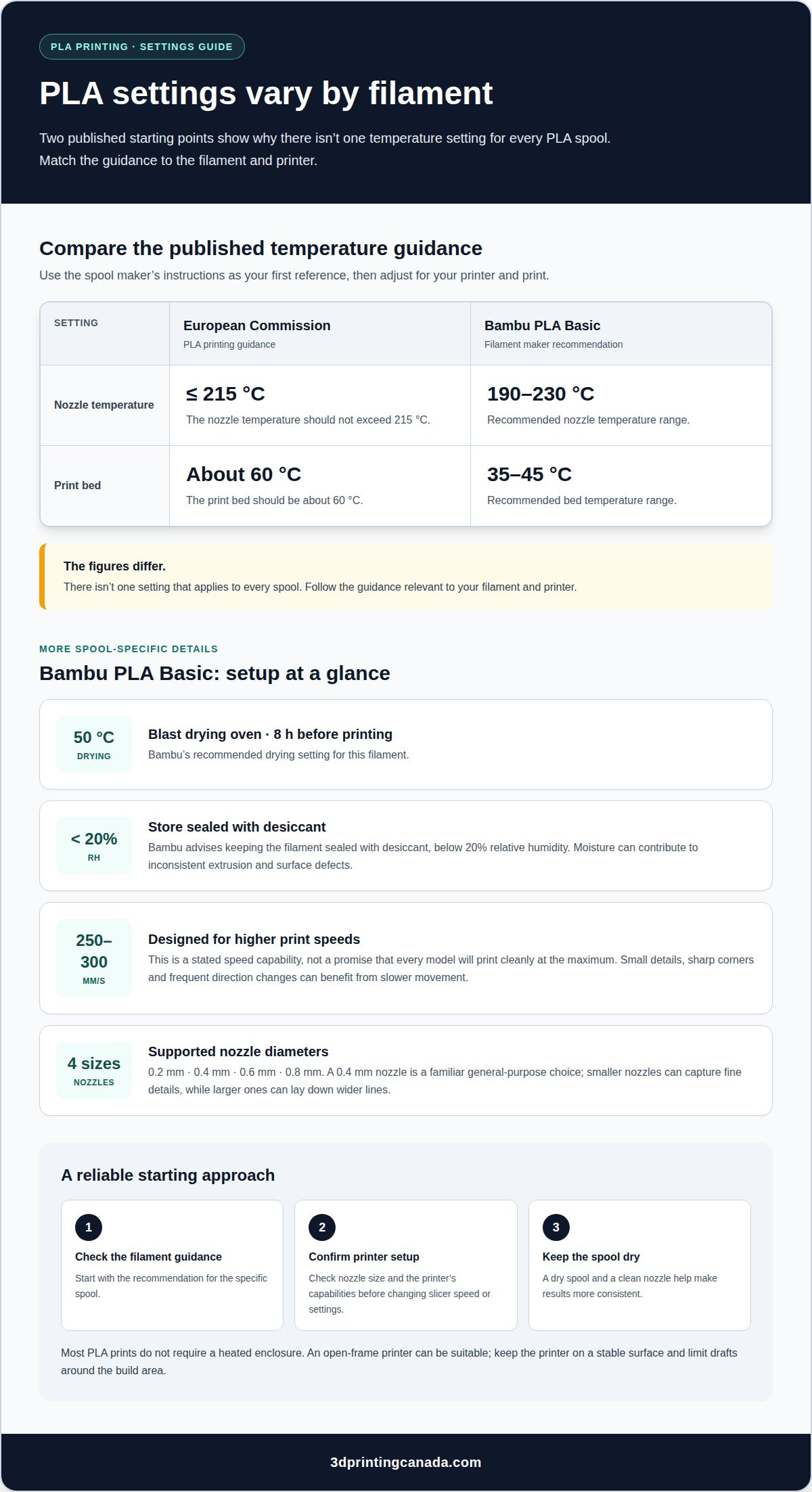
- PLA is straightforward to print, but the right settings depend on the filament and printer. For PLA printing, the European Commission says the nozzle temperature should not exceed 215ºC and the print bed should be about 60ºC.
- Use PLA’s heat-related properties to decide whether a part will suit its environment, especially if it may face warmth or sustained loads.
- Distinguish data for molded PLA from filament specifications: processing and print structure can affect the properties of a finished part.
- PLA’s compostability depends on specific conditions; outside them, decomposition can take far longer than the word “biodegradable” might suggest.
- Match the material to the job before printing. PLA is a practical choice for some parts, but its limitations matter for others.
Applications and ease of printing
PLA suits prototypes, display models, classroom projects and decorative parts where detail matters more than heat resistance. It’s widely used in desktop 3D printing because it generally prints without the demanding temperature control associated with some other materials. For example, a small desk organizer or scale model is a sensible PLA project, while a part left in a hot vehicle may not be.
Choose filament for the part’s job, not just its colour or ease of printing. Standard PLA suits appearance-focused models and fit checks. Flexible filament is a better match for flexible parts, while parts exposed to more heat or impact may need a material designed for those demands. PLA specs are a starting point, not a substitute for matching material performance to the finished part’s conditions.
Compared with ABS, PLA is generally easier to print and often used for detailed prototypes; ABS suits applications where greater toughness or heat tolerance matters. PETG can be a good middle ground when a part needs more impact resistance than typical PLA, while TPU suits flexible parts. Each material has different printing requirements, so choose based on the part’s function, your printer setup and its intended conditions.
Some PLA formulations have medical applications, including absorbable sutures and temporary fixation devices. Their composition and performance are selected for specific uses. This does not make ordinary desktop filament suitable for medical use: hobby filament and purpose-made medical materials are not interchangeable.
Packaging is another significant application. In 2022, flexible packaging accounted for approximately 35% of total PLA production, while rigid packaging accounted for 30%. Some Sun Chips bags made with PLA were used from 2008 through 2010; handling them produced noise around 95 dB. These examples show PLA’s packaging potential, as well as the practical design details that affect how a product feels in use. For broader commercial applications, specialists like Packaging For Industry (PFI) focus on developing custom packaging solutions that balance material performance with end-use demands.
PLA is not automatically food-safe simply because it is made from PLA. In Canada, food-contact suitability depends on the finished item and its materials, so a filament label alone does not establish that it meets applicable requirements.
For everyday printing, start with the application: a display model, packaging prototype and functional component each have different priorities. Consider the part’s exposure to heat, impact, repeated handling and food contact. This helps you avoid choosing filament based on printability alone.
Bambu PLA Basic filament has a diameter of 1.75 mm and is supplied as 1 kg of net filament. A 0.5 kg spool of MG Chemicals PLA filament with a 1.75 mm diameter contains approximately 167 m of filament.
PLA printability and 3D printing
PLA is a practical filament for many desktop printers because it melts and flows at relatively low temperatures. For a starting point, Bambu PLA Basic recommends a nozzle temperature of 190-230 °C and a bed temperature of 35-45 °C. Settings vary by filament, so treat the spool’s guidance as the first reference, then adjust for the printer and print.
For PLA printing, the European Commission says the nozzle temperature should not exceed 215ºC and the print bed should be about 60ºC. This differs from Bambu PLA Basic’s recommended range, so there isn’t one setting that applies to every spool. Follow the material maker’s directions and use the guidance relevant to the filament and printer.
For Bambu PLA Basic, the recommended drying setting in a blast drying oven is 50 °C for 8 h before printing. Bambu also advises storing it sealed with desiccant, below 20% RH. Moisture can contribute to inconsistent extrusion and surface defects, so storage matters alongside slicer settings. A dry spool and a clean nozzle help make results more consistent.
Most PLA prints do not require a heated enclosure. An open-frame printer can be suitable because PLA generally does not need the enclosure conditions used for materials more prone to warping. Keep the printer on a stable surface and limit drafts around the build area. If corners lift or layers separate, review bed adhesion, cooling, first-layer height and the filament’s temperature guidance.
Fast-printing PLA is designed to support higher speeds, but the printer must feed and melt filament quickly enough to keep up. Bambu PLA Basic is designed for speeds up to 250-300 mm/s. That ceiling isn’t a promise that every model will print cleanly at maximum speed; small details, sharp corners and frequent direction changes can benefit from slower movement. Check the printer’s capabilities before increasing slicer speed.
Bambu PLA Basic supports nozzle sizes of 0.2, 0.4, 0.6 and 0.8 mm. A 0.4 mm nozzle is a familiar general-purpose choice; smaller nozzles can capture fine details, while larger ones can lay down wider lines. Pair the nozzle with compatible slicer settings, and don’t assume that changing nozzle size leaves layer height and flow settings unchanged.
For a reliable first print, use the filament’s recommended temperatures, confirm the selected nozzle size, and print a simple calibration model. If you’re choosing material for a new project, browse the PLA filament options with the part’s purpose and printer setup in mind.
Molded PLA material properties
PLA’s performance is best understood through measured properties, not a single “strength” rating. Typical molded specimens have a tensile strength of 38-47.8 MPa and a tensile modulus of approximately 4,200 MPa. Tensile strength describes stress before failure; tensile modulus indicates stiffness under load. These values characterize molded samples, not every filament or finished 3D-printed part.
Elongation results add important context. Elongation at yield and elongation at break describe different points in a material’s deformation, so they should not be treated as interchangeable. Yield marks the point where deformation becomes permanent, while break describes stretching before fracture. A part can therefore bend permanently well before it reaches the elongation reported at break.
Flexural testing measures bending behaviour. Typical molded PLA specimens have a flexural strength of approximately 85 MPa and a flexural modulus of approximately 3,280 MPa. Strength indicates the stress a sample withstands during bending; modulus reflects its resistance to bending. For a bracket or flat panel, these figures offer useful context, but geometry and print orientation also affect the finished part.
Heat-related values answer different questions. A material’s glass transition temperature marks a shift towards a softer state. Its heat deflection temperature is approximately 80 °C at 1.8 MPa, a measure of deformation under a specified load. Don’t treat either result as a universal safe-use temperature for every PLA object.
Density and hardness also need context. Density and hardness are useful material properties to consider, but they do not by themselves determine how a finished part will feel or perform. Density relates mass to volume, while Shore D describes resistance to indentation. A solid component and a hollow printed model can feel very different, even when they use the same polymer.
Published values can vary with specimen preparation and test method. For example, Bambu PLA Basic lists a glass transition temperature of 60 °C, measured by DSC at 10 °C/min, while typical molded specimens are reported at approximately 53 °C. Bambu PLA Basic’s heat deflection temperature is 54 °C at 1.8 MPa under ISO 75 testing. Those distinctions matter: a test result belongs to its material and method, not automatically to every PLA grade.
Use molded data to understand the polymer, then assess the finished part separately. A 3D-printed component’s shape, layer direction and print conditions affect how it handles tension, bending and heat. For design decisions, compare the property that matches the real load, such as tensile strength for pulling or flexural strength for bending, rather than relying on one headline number.
PLA disadvantages and environmental concerns
PLA’s plant-based origins can make it sound impact-free, but the material still has practical limits. Its SPI resin identification code is 7, a category that does not by itself tell you how a local waste program handles an item. A printed part, packaging film and rigid container can also differ in composition and form. Consider the disposal route before choosing PLA for a product intended to be discarded.
PLA’s reputation as an easier-printing filament does not remove the need to consider room ventilation. Exposure depends on the formulation, printing temperature, airflow and time spent near the printer. Print in a ventilated space, and avoid staying close to the nozzle during extrusion.
“Biodegradable” also needs context. PLA can decompose in three months under specific composting conditions, but outside those conditions it may take 100-1,000 years. A home compost pile or ordinary outdoor setting should not be assumed to provide the controlled conditions needed for that faster breakdown. The intended disposal environment matters as much as the polymer name.
Water behaviour is another point to interpret carefully. Polylactic acid has a reported water solubility of 0 mg/ml, but insolubility doesn’t mean a printed part will rapidly disappear in water or soil. If a PLA model breaks into smaller pieces, that physical damage is different from biological decomposition. Keep durability in use and end-of-life handling as separate questions.
Material waste can begin before disposal. A large prototype that requires repeated redesigns may use more filament than a small test part, so print only enough detail to assess each design decision. For example, test a connector’s fit with a short section before printing the full assembly. This can reduce avoidable failed prints, without implying that leftover scraps are compostable.
PLA’s environmental impact depends on its entire use cycle: feedstock, product design, printer waste and disposal conditions. A disposable packaging item and a long-lasting display model have different needs. Match the material to the intended service life, plan for the actual disposal route, and do not treat “biodegradable” as a complete end-of-life instruction.
PLA composition and biodegradability
PLA stands for polylactic acid, a polymer made from repeating lactic acid units. These units form long chains, creating a solid thermoplastic that can be made into filament, packaging and other products. The name describes the chemistry, not a guaranteed end-of-life outcome. A PLA print and a PLA packaging film can behave differently because their shapes, thicknesses and formulations differ.
Feedstock and disposal are separate parts of PLA’s environmental impact. PLA can be made from plant-derived sugars, but that does not mean a finished item will break down wherever it is discarded. A plant-derived PLA cup left outdoors, for example, does not automatically experience the controlled conditions used for composting.
Biodegradation involves changes to the polymer, not simply the object becoming smaller. Under suitable composting conditions, PLA can decompose in three months. Outside specific composting conditions, it may take 100-1,000 years. Those different timelines show why the disposal environment matters; “compostable” or “biodegradable” wording alone doesn’t describe what happens in every setting.
A PLA prototype and a disposable food container involve different waste decisions. A durable prototype may stay in use, while a container is discarded after its intended use. In both cases, composition, additives and local collection options affect what happens next. Do not assume that items labelled PLA belong in the same disposal stream.
For a practical decision, first identify the item’s intended lifespan. A reusable model, short-lived package and one-off fit check each have different design needs. Then consider whether the item can be reused, whether it contains other materials, and which disposal route is available. These steps help distinguish PLA’s renewable origin from the conditions needed for it to break down.
PLA’s chemistry makes it useful as a mouldable thermoplastic, but its environmental benefit depends on more than its feedstock. Product design, use period and end-of-life conditions all matter. If you’re selecting material for a project, browse the available PLA filament options and match the material to the part’s purpose.
3D Printing Canada
3D Printing Canada helps turn material research into practical choices for your next print. Use the properties discussed here to match PLA filament to the part’s purpose, printer and expected conditions. If print quality is affected by a hardware issue, 3D Printer Repair Services can address printer problems; if you’re comparing materials, explore the available filaments.
PLA suits many detailed models and prototypes, but heat, load and disposal conditions can affect whether it works for a particular project. Include these requirements in your material choice instead of choosing by colour alone.
Have a question about choosing PLA for your project? Contact 3D Printing Canada.
Make your next print a deliberate choice
Let the part’s purpose guide your material choice. A prototype for checking shape and fit has different requirements from a component designed for repeated use. For future projects, note what the part must do, the conditions it will face and what happens at the end of its useful life. This brief makes the relevant PLA specs easier to apply without treating one filament as right for every print.
When you’re ready to put that decision into practice, 3D Printing Canada offers Bambu Lab Accessories and 3D Printing Canada, alongside its other 3D printing offerings. Browse the PLA filament options and choose a material with your project’s requirements in mind.
Start with a clear purpose, choose your material, and keep creating.
Frequently Asked Questions
What is PLA?
PLA, or polylactic acid, is a thermoplastic polymer used in filament and manufactured goods. “Thermoplastic” means it softens when heated and solidifies as it cools, so it can be shaped. In a printed part, the polymer’s properties work together with the design and print process to determine performance. A spool’s material data is a useful starting point, not a complete prediction of how every finished object will behave.
What is PLA plastic and what is it used for?
PLA plastic is a mouldable form of polylactic acid used in products such as 3D-printing filament, packaging and prototypes. A designer might use printed PLA to check whether two components fit before making a final part. PLA is also found in flexible and rigid packaging. The application matters: a material that works for a display model may not suit a component exposed to repeated force or heat.
What are the typical mechanical properties of PLA, including tensile strength and stiffness?
Typical molded PLA specimens have tensile strength of 38-47.8 MPa and tensile modulus of approximately 4,200 MPa. Strength describes how much tensile stress a sample withstands, while modulus indicates stiffness. These figures describe molded specimens, not a guarantee for a printed part. For example, a printed bracket’s layer arrangement and shape affect how it handles a pulling force, so match the property to the load.
What is PLA's melting temperature and glass transition temperature?
PLA’s melting point is 150 to 160 °C. Its glass transition temperature depends on the material: typical molded specimens are reported at approximately 53 °C, while Bambu PLA Basic lists 60 °C when measured by DSC at 10 °C/min. Melting and glass transition describe different changes. A part can begin softening around its glass transition without reaching its melting point, so don’t use melting temperature alone to assess heat exposure.
What are the heat resistance and temperature limits of PLA?
PLA’s heat resistance depends on the specific grade and test. Typical molded specimens have a heat deflection temperature of approximately 80 °C at 1.8 MPa, while Bambu PLA Basic lists 54 °C at the same pressure under ISO 75 testing. Heat deflection temperature measures deformation under a defined load; it isn’t a universal operating limit. A sun-warmed enclosure or loaded part can therefore need a more heat-resistant material.
What are the density, shrinkage, and dimensional accuracy of PLA?
Typical molded PLA specimens have a density of 1.08-1.12 g/cc; Bambu PLA Basic lists 1.24 g/cm³ when measured using ISO 1183. Shrinkage and dimensional accuracy depend on the filament, part geometry, cooling and printer calibration, so one value won’t predict every print. For a tight-fitting enclosure, print a small test feature first, then adjust the design or slicer settings based on the measured fit.