
What if your first 3D print didn't end in a tangled mess of plastic and frustration? Many Canadians hesitate to start this hobby because they fear wasting money on a "lemon" or getting overwhelmed by technical jargon. It's easy to feel stuck between choosing FDM or Resin technologies while worrying about where to find replacement parts if something goes wrong. We understand those hurdles because we've helped thousands of creators realize their projects without the headache.
Finding a 3D printer for beginners Canada shouldn't feel like a gamble. In this 2026 buying guide, you'll discover how to choose your first machine with total confidence. We'll show you how to achieve a "plug and play" experience with minimal tinkering, navigating the best brands like Bambu Lab and Creality. You will learn the true cost of entry and why having a reliable Canadian supplier for filament and repair services is your biggest advantage. We are diving into the top-rated models that offer 500mm/s speeds and AI error detection, ensuring your creative journey starts with a win rather than a repair bill.
Key Takeaways
- Identify the practical differences between FDM and Resin technologies to ensure you select the best machine for your specific hobby or professional goals.
- Discover the top 3D printer for beginners Canada options in 2026, focusing on user-friendly models from Bambu Lab and Creality that offer high-speed performance.
- Learn how to manage the impact of the Canadian climate on your materials by using dry boxes and selecting reliable filaments like PLA and PETG.
- Recognize why local access to replacement parts and expert repair services is the most effective way to avoid project downtime.
- Realize how the evolution of 3D printing has transformed complex DIY kits into accessible appliances that allow you to focus on creating rather than tinkering.
Why Start Your 3D Printing Journey in 2026?
There has never been a more empowering time to join the maker community. Just a few years ago, getting started required a deep understanding of what is 3D printing and the patience to assemble complex DIY kits from scratch. Today, the industry has shifted. Machines have evolved from experimental projects into user-friendly appliances that arrive nearly ready to run. For anyone looking for a 3D printer for beginners Canada offers a mature market where high-speed performance and reliability are now the standard rather than the exception.
Entering this hobby means adopting a "Maker Mindset." In your first month, you will move past the initial excitement and start to realize the practical utility of having a factory on your desk. You will learn how to download models, experiment with different materials, and perhaps even design your own solutions for around the house. While the learning curve exists, the modern ecosystem provides a safety net. Accessing a local Canadian support network for hardware and supplies ensures that if you hit a snag, you aren't waiting weeks for an international shipment or struggling with a language barrier for technical help.
The Creative Potential of Desktop 3D Printing
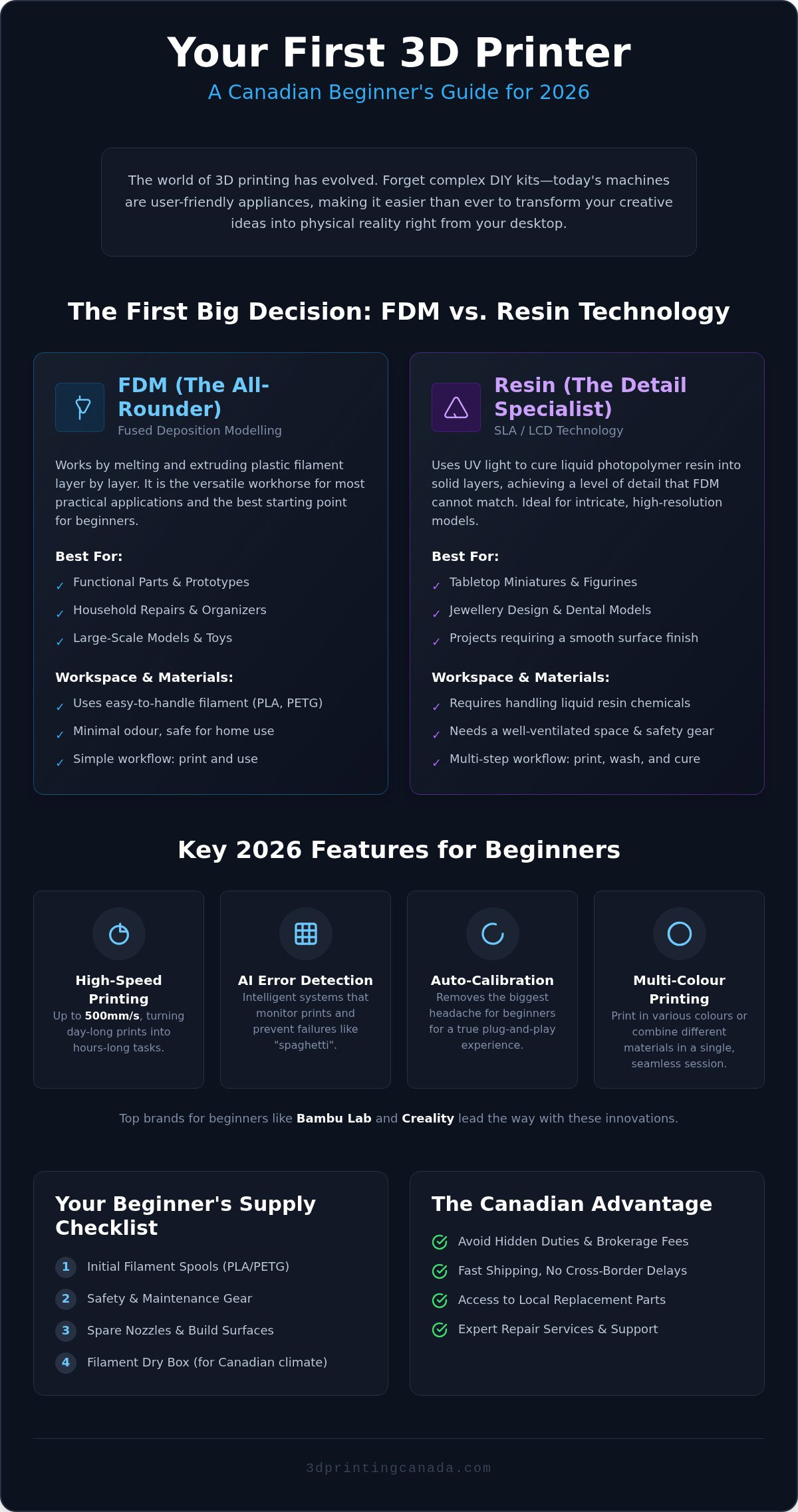
The jump in technology for 2026 is staggering. Features like auto-calibration and AI-assisted error detection have removed the most common barriers to success. You can now produce intricate tabletop miniatures or functional household repairs with incredible precision. High-speed printing has surged to benchmarks of 500mm/s, meaning projects that used to take a full day now finish in just a few hours. Multi-material options also allow you to print in various colours or combine different filament types in a single session, opening doors for complex designs that were previously impossible for beginners.
Total Cost of Ownership for Beginners
When you start budgeting, look beyond the price tag of the machine itself. A successful setup requires a few essentials to keep you running smoothly:
- Initial Filament: Start with a few spools of PLA or PETG to practice your first prints.
- Safety and Maintenance Gear: Basic tools for removing prints and cleaning the build plate.
- Spare Parts: Having extra nozzles or build surfaces on hand prevents downtime.
Choosing a 3D printer for beginners Canada-wide also means considering the logistics. Buying from a domestic retailer helps you avoid hidden duties, brokerage fees, and the high cost of cross-border shipping. It also ensures you have access to expert 3D printer repair services if you ever face a hardware issue you can't solve on your own. Investing in a machine with a robust local supply chain for parts is the smartest way to protect your investment and keep your creative momentum going.
Choosing Your Technology: FDM vs. Resin Printers
The most critical decision you'll make when looking for a 3D printer for beginners Canada is choosing between FDM and Resin technology. These two methods produce very different results and require distinct setups. FDM (Fused Deposition Modelling) is the workhorse of the industry, while Resin (SLA/LCD) is the specialist for fine detail. Understanding which one fits your creative goals will save you from buying a machine that doesn't meet your needs or requires a workspace you don't have.
FDM Printing: The Versatile All-Rounder
FDM printers work by melting plastic filament and extruding it through a nozzle layer by layer. This technology is the go-to for functional parts, household repairs, and large-scale prototypes. If you want to print a sturdy bracket for a shelf, a custom tool organizer, or a toy for your kids, FDM is the answer. It's widely considered the best starting point for beginners because the materials are easy to handle and the post-processing is minimal. You can simply take your print off the bed and start using it immediately.
Resin Printing: For the Detail-Oriented
Resin printing uses a liquid vat of photopolymer that is cured into solid layers by a UV light source. This process achieves a level of detail that FDM simply cannot match, making it the primary choice for jewellery designers, dental professionals, and tabletop miniature enthusiasts. However, it comes with a more complex workflow. Every print must be washed in isopropyl alcohol and then cured under extra UV light. This requires a dedicated workspace and a commitment to handling chemicals safely, including wearing gloves and eye protection at all times.
Safety and environment are major factors in your workspace setup. FDM printers generally use PLA filament, which is relatively odourless and safe for home use. In contrast, liquid resin produces fumes that require a well-ventilated room or an active filtration system. If you have a dedicated workshop or garage, resin is a great option. If you are printing in a home office or bedroom, FDM is typically the safer and more approachable choice. To see which technology fits your space, you can browse the latest models at 3D Printing Canada and compare the physical footprints and safety requirements of each machine type.
Best 3D Printers for Beginners in Canada
Choosing a 3D printer for beginners Canada makers can trust involves balancing ease of use with future-proof features. In 2026, the market has split into two main philosophies: the "just works" appliance and the "customizable" workhorse. Both paths lead to success, but your choice depends on whether you want to spend your time designing models or fine-tuning the machine itself. Leading brands like Bambu Lab, Creality, and Prusa Research have all stepped up to make the entry point smoother than ever.
Bambu Lab: The "Apple" of 3D Printing
Bambu Lab has fundamentally changed what we expect from a first printer. Their A1 and P1S models are current favourites across Canada because they eliminate the tedious setup steps that used to frustrate newcomers. These machines arrive nearly fully assembled. They feature sophisticated sensors that handle bed levelling and vibration compensation automatically, allowing you to go from unboxing to printing in under thirty minutes.
One of the biggest draws for the Bambu ecosystem is the Automatic Material System (AMS). This accessory allows you to print in multiple colours without stopping the machine to swap filament manually. It is a game-changer for creative projects and complex prototypes. To keep these high-performance machines running at their peak, you can easily source Bambu Lab accessories Canada wide, ensuring you have the right nozzles and build plates for any material you choose to explore.
Creality: Affordable and Highly Customizable
If you enjoy understanding how your tools work, the Creality Ender 3 V3 and K1 series remain excellent entry points. These printers offer a fantastic balance of speed and price. While they require a bit more hands-on interaction than a Bambu Lab machine, they benefit from the largest user community in the world. If you want to add a mod or need help troubleshooting a specific print, a solution is usually just a quick search away. Creality has also embraced high-speed printing, with the K1 series reaching benchmarks of 600mm/s, making it a competitive choice for those who value efficiency.
Creality machines are built with standard, accessible parts. This makes them incredibly easy to repair or upgrade using locally available components. For a 3D printer for beginners Canada based support is vital. Knowing you can grab a replacement belt or a new hotend without waiting for an overseas shipment provides the peace of mind needed to experiment freely. For those who want the ultimate reliability, Prusa Research remains the gold standard for long-term use and open-source repairability, though they often come at a higher initial price point.
Features That Guarantee Success
Regardless of the brand you choose, ensure your 2026 starter machine includes these three non-negotiable features for a frustration-free experience:
- Auto-Bed Levelling: This uses sensors to ensure the first layer sticks perfectly every time, removing the need for manual knob-turning.
- Filament Runout Sensors: These pause your print if the spool ends, saving your progress and preventing wasted material.
- PEI Spring Steel Sheets: These flexible build plates make removing finished prints effortless once they cool down; you just flex the plate and the part pops off.
Essential Supplies and the Canadian Environment
Owning a 3D printer for beginners Canada makers is an exciting step, but your machine is only as good as the supplies you feed it. Success depends on understanding your materials and how the Canadian climate affects them. From the humid summers in the Maritimes to the dry winters on the Prairies, your environment plays a massive role in print quality. You'll need more than just the printer to keep your projects running smoothly.
Managing humidity is the secret to consistent results. Many 3D printing filaments are hygroscopic, meaning they absorb moisture from the air. When wet filament hits the hot nozzle, the water turns to steam, causing bubbles, stringing, and weak parts. Investing in a dry box or a dedicated filament dryer is essential, especially if you live in a high-humidity region. Keeping your spools sealed with desiccant packs when not in use will save you hours of troubleshooting and wasted material.
Your basic toolkit should include a few non-negotiable items:
- Flush Cutters: For removing supports and trimming filament cleanly.
- Digital Calipers: Essential for measuring parts and ensuring your designs fit together.
- Scrapers and Spatulas: To help release stubborn prints from the build plate.
- Isopropyl Alcohol: To keep your build surface free of oils and dust.
Selecting the Right Filament for Your Project
Start with PLA (Polylactic Acid). It is the most forgiving material, requires lower temperatures, and doesn't warp easily. For projects that need more durability or heat resistance, PETG is the logical next step. It offers a balance between the ease of PLA and the strength of industrial plastics. Buying high-quality filament from a domestic source prevents common issues like diameter inconsistency, which often leads to frustrating nozzle clogs. To get started with reliable materials, you can browse our full selection of high-quality filaments designed for the Canadian market.
Workshop Setup and Maintenance
Organize your workspace to maintain a stable environment. 3D printers are sensitive to temperature swings and drafts, which can cause prints to peel off the bed. Place your machine away from windows or air vents. Maintenance is equally vital. Get into the habit of checking your belt tension and cleaning your nozzle every few weeks. These small routines prevent the hardware failures that often discourage new users. If you follow these steps, your 3D printer for beginners Canada based setup will remain a reliable tool for years to come.
Success Beyond the Box: Support and Repairs
Modern machines are designed to be user-friendly, but even the best 3D printer for beginners Canada has to offer is still a mechanical tool. At some point, you will face a challenge that isn't covered in the quick-start guide. Whether it is a stubborn nozzle clog or a software setting that won't behave, knowing where to turn for help is what separates a successful maker from someone with a dusty machine in the corner. You don't have to solve every problem alone.
The reality of 3D printing is that "plug-and-play" doesn't mean "maintenance-free." While brands like Bambu Lab have automated many processes, you still need a plan for when things go wrong. Choosing a machine with local support means you aren't stuck waiting weeks for a replacement part to clear customs or struggling with a support ticket in a different time zone. Having a Canadian partner for your journey provides a safety net that makes the learning curve feel much smaller.
Expert Repair Services in Canada
Sometimes a DIY fix isn't enough. Beginners often run into complex issues like damaged heat breaks or fried stepper drivers while they are still learning the ropes. When a jam becomes too stubborn or a component fails, utilizing professional 3D printer repair services Canada based experts provide is the most efficient solution. These technicians can diagnose hardware faults quickly, saving you from the frustration of "parts-cannon" troubleshooting where you buy expensive components you might not actually need.
Regular professional maintenance can also extend the life of your hardware. A technician can calibrate your gantry, check for belt wear, and update firmware more thoroughly than most beginners. This proactive approach ensures your 3D printer for beginners Canada setup remains as precise as the day you unboxed it. Think of it like a car tune-up; a little expert attention now prevents a total breakdown later.
Where to Go for Help and Inspiration
Beyond hardware support, your success depends on the software you use and the community you join. Slicing software like Bambu Studio, OrcaSlicer, or Cura acts as the bridge between your 3D model and the printer. Take the time to explore these tools, as they offer the settings that improve print quality. For inspiration, sites like Printables and MakerWorld offer millions of free models designed by creators across the globe.
Don't overlook the value of localized advice. Joining Canadian 3D printing groups on social media or community forums connects you with people who understand your specific challenges. They can recommend the best local filaments or share tips on managing shop temperatures during a Canadian winter. This peer-to-peer energy is the heart of the maker movement. It turns a solitary hobby into a collaborative experience where everyone helps each other realize their creative goals.
Start Your Creative Journey Today
Choosing your first machine is the beginning of a rewarding adventure in making. You now have the knowledge to decide between versatile FDM systems and high-detail resin printers while understanding how to manage the Canadian climate to keep your filaments dry. Finding the right 3D printer for beginners Canada offers isn't just about picking a brand; it's about the community and support system you join. Success comes when you have the right tools and a reliable team behind you.
We are here to act as your mentor and partner throughout this process. As an authorized dealer for Bambu Lab and Creality, we offer the peace of mind that comes with expert in-house repair services and reliable nationwide shipping across Canada. Whether you want to fix household items or design intricate miniatures, we have the supplies and expertise to keep your machine running at its peak. Browse our curated collection of beginner-friendly 3D printers and start making today! We can't wait to see what you realize with your new setup.
Frequently Asked Questions
What is the best 3D printer for a beginner in 2026?
The Bambu Lab A1 series is currently the top recommendation for anyone seeking a 3D printer for beginners Canada wide. These machines offer a true "appliance" experience with automatic bed levelling and vibration compensation already built in. They remove the technical barriers that used to stop people from starting. You can focus on your designs rather than spending hours turning knobs or troubleshooting the first-layer adhesion issues that plagued older models.
How much does it cost to start 3D printing in Canada?
Starting this hobby requires budgeting for the machine, a few spools of filament, and basic safety gear. Entry-level printers are more affordable than ever, but you should also set aside funds for extra nozzles and cleaning supplies. Buying from a domestic retailer helps you avoid unexpected customs duties and high shipping fees on these initial items. This ensures your total cost of entry remains predictable while giving you access to local support from day one.
Is 3D printing difficult to learn for someone with no technical background?
Modern technology has made 3D printing highly accessible for people without a technical background. Slicing software now includes "one-click" presets that take the guesswork out of complex print settings. While there is a learning curve to understanding how different materials behave, the community provides endless tutorials. You can start by downloading free models and simply hitting print; you will naturally pick up the technical skills as you explore more advanced projects over time.
Do I need a special room or ventilation for a 3D printer?
If you are printing with PLA or PETG on an FDM machine, a standard home office or hobby room is usually sufficient. However, if you choose a resin printer or want to work with advanced materials like ASA or Nylon, active ventilation is a requirement. These processes release fumes that need to be filtered or vented outside for safety. Always check the safety guidelines for the specific material you plan to use in your workspace setup.
Where can I buy 3D printer filament and parts in Canada?
You should source your filament and replacement parts from a dedicated Canadian supplier to ensure fast shipping and reliable quality. We are an authorized dealer for major brands like Bambu Lab and Creality, providing a vast selection of PLA and specialty filaments. Buying locally ensures that the standard 1.75mm diameter is consistent across your spools and that you have access to expert advice if a specific material is giving you trouble.
What happens if my 3D printer breaks and I can’t fix it?
When a hardware issue becomes too complex for a DIY fix, you can rely on expert 3D printer repair services to get back up and running. Many beginners worry about "lemons," but having access to a professional technician acts as a safety net for your investment. We provide in-house repairs for hardware faults, ensuring your 3D printer for beginners Canada setup isn't out of commission for long. This local support is much faster than international shipping.
Can I make money with a beginner 3D printer?
Many makers successfully monetize their beginner printers by creating custom household solutions, personalized gifts, or niche tabletop gaming accessories. The high speed of 2026 models allows you to produce inventory much faster than in previous years. You don't need industrial-grade equipment to start a small business; a reliable desktop machine is often enough to handle low-volume production for local markets or online shops while you build your brand and design skills.
Is 3D printing filament expensive to buy in Canada?
High-quality filament remains very affordable in Canada, especially when you choose standard materials like PLA for your daily projects. While specialty filaments for engineering or aesthetic purposes carry a higher price point, the cost per print for most hobbyist items is quite low. Buying from a local supplier helps you avoid the high shipping costs and exchange rates that often make international orders much more expensive for Canadian makers looking to stock up.