
A single worn nozzle or broken filament cutter shouldn't stall your workshop for weeks. Finding dependable bambu lab replacement parts Canada makers trust shouldn't mean dealing with international shipping backlogs, surprise import tariffs, or the worry of uncalibrated third-party knockoffs.
We realize how frustrating unexpected downtime feels, especially when sorting out cross-compatibility between X1-Carbon, P1S, P1P, and A1 series hardware leaves you second-guessing. You need dependable components delivered quickly, backed by straightforward domestic fulfillment so you can get back to printing with total confidence.
In this guide, you will discover how to identify, source, and install genuine Bambu Lab replacement parts across Canada to eliminate printer downtime entirely. We will walk through common error codes, pinpoint must-have spare assemblies, and share practical installation practices that keep your machines running smoothly without voiding manufacturer guidelines.
Key Takeaways
- Diagnose thermal warnings and extrusion failures accurately before ordering parts to target the root cause of print defects.
- Navigate cross-series hardware compatibility with confidence to avoid purchasing parts that only fit specific X1, P1, or A1 toolheads.
- Sourcing essential bambu lab replacement parts canada inventory domestically bypasses customs delays, unpredictable currency conversions, and surprise carrier brokerage fees.
- Assemble a tiered workshop spares inventory tailored to your print volume so routine wear never halts critical production runs.
- Identify when straightforward DIY part swaps make sense and when advanced hardware diagnostics call for professional repair support.
Understanding Bambu Lab Maintenance: Core Hardware Architecture and Wear Cycles
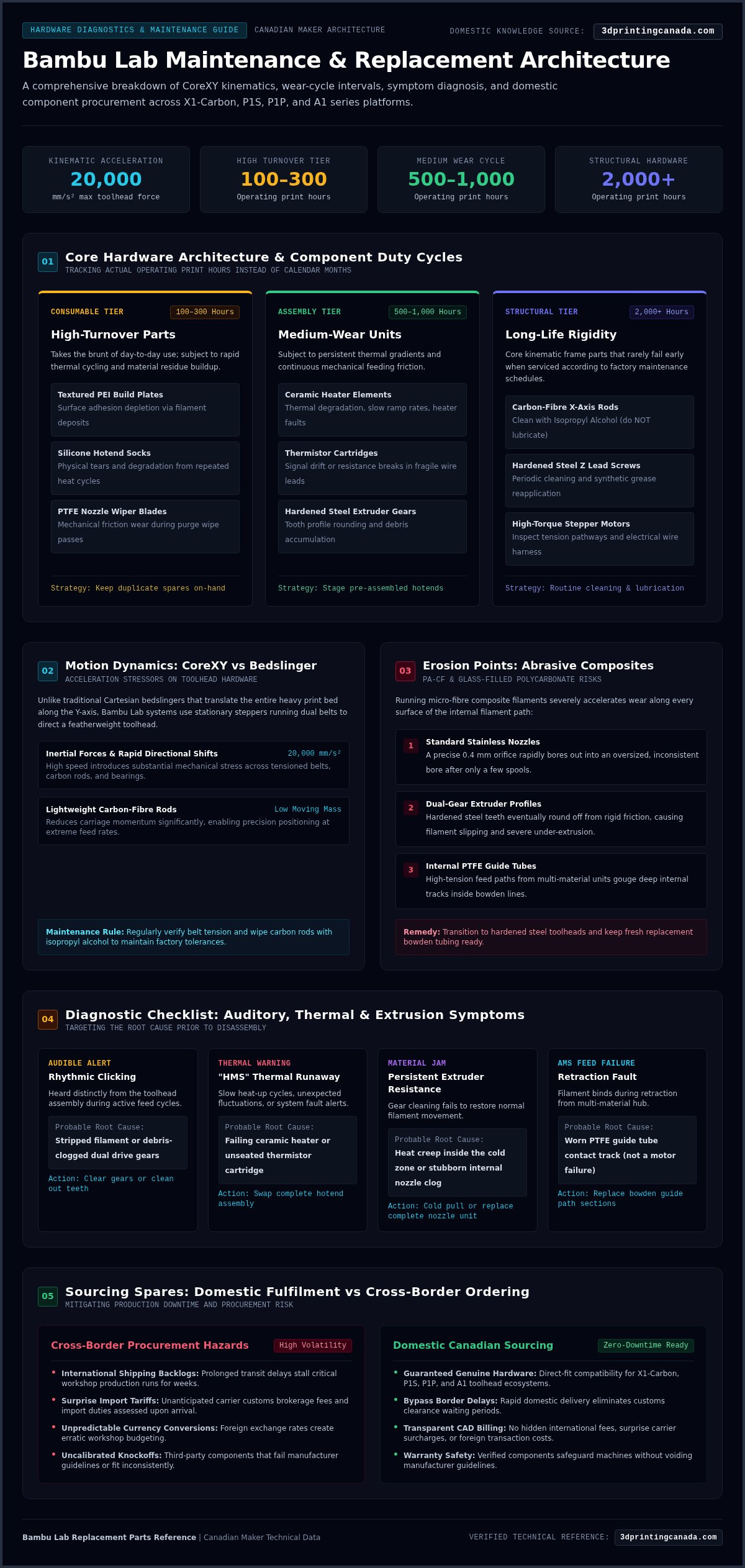
High-speed CoreXY mechanics completely transform how modern printers operate, pushing print heads at accelerations up to 20,000 mm/s². Unlike traditional Cartesian bedslingers that move the heavy print bed along the Y-axis, toolheads developed by Bambu Lab rely on lightweight carbon rods and high-tension belt pathways to achieve blisteringly fast turnaround times. Speed comes with mechanical trade-offs. The extreme inertial forces, rapid directional shifts, and localized friction place substantial stress on your motion systems, making routine maintenance schedules vital if you want to keep dimensional accuracy within factory tolerances.
Tracking actual print hours rather than calendar months gives you the best defense against unexpected failures. Sourcing dependable bambu lab replacement parts canada inventory beforehand ensures that when a mechanical component approaches its operating limit, you can swap it immediately without putting client jobs on hold.
Consumables Versus Long-Life Mechanical Components
To organize your workshop spares effectively, categorize components based on their expected duty cycles:
- High-Turnover Consumables (100-300 Print Hours): Textured PEI build plates, silicone hotend socks, and PTFE nozzle wiper blades take the brunt of day-to-day use. Build surfaces lose adhesion from residue buildup, while silicone socks tear or degrade under continuous thermal cycling.
- Medium-Wear Assemblies (500-1,000 Print Hours): Ceramic heater elements, thermistors, and hardened steel extruder drive gears experience steady thermal and mechanical stress. Keep full hotend assemblies staged so you can resolve electrical faults or physical jams in minutes.
- Long-Life Structural Hardware (2,000+ Print Hours): Carbon fiber X-axis rods, hardened steel Z-axis lead screws, and high-torque stepper motors rarely fail early. They need regular cleanings with isopropyl alcohol and proper synthetic lubrication rather than early replacement.
The Impact of Abrasive and Engineering Filaments on Hardware Longevity
Running composite filaments such as carbon-fibre nylon (PA-CF) or glass-filled polycarbonate dramatically accelerates hardware erosion. Standard stainless steel nozzles bore out rapidly under these abrasive micro-fibres, turning a precise 0.4 mm orifice into an inconsistent, oversized mess after just a few spools. Even hardened steel components eventually show wear along the tooth profiles of the dual-gear extruder, leading to under-extrusion and filament slipping.
Internal PTFE guide tubes also suffer hidden damage. High-tension feed paths, especially those routing from multi-material units, cause rigid engineering filaments to gouge deep internal tracks inside the bowden tubing. Inspecting these contact points frequently and keeping fresh tubing on hand prevents sudden feed failures mid-print.
Diagnosing Common Bambu Lab Failures: Which Replacement Parts Do You Need?
Blindly swapping hardware gets expensive fast. Pinpointing the exact physical symptom before opening your toolkit saves hours of troubleshooting and keeps you from ordering items you don't actually need. Because modern high-speed toolheads combine sensitive electronics with high-temperature components, prioritizing personal protection and safe 3D printer maintenance practices is essential before probing live circuits or handling hot assemblies.
When unexpected downtime strikes, sourcing verified bambu lab replacement parts canada makers rely on will get your printers running without long diagnostic delays.
Hotend and Extruder Diagnostic Checklist
Extrusion troubles usually announce themselves audibly. Listen for a rhythmic clicking from the toolhead; this usually indicates stripped filament or teeth clogged with debris inside the dual-gear extruder. If cleaning the gears doesn't resolve feeding resistance, examine the hotend for heat creep or stubborn internal clogs. Temperature fluctuations, slow heat-up times, or "HMS" thermal runaway warnings point directly to a failing ceramic heater element or an unseated thermistor cartridge. Swapping the entire complete hotend assembly often proves much faster than rebuilding delicate thermistor wires during time-sensitive projects.
AMS (Automatic Material System) Feeding and Retraction Faults
Filament retraction errors often stem from wear along the multi-material feed path rather than motor failure. Look for these specific stress points:
- Feeding Funnels: Abrasive filaments cut deep grooves into the plastic funnel entries over time, snagging filament tips during retractions and tripping optical sensors.
- Internal Hall Effect Sensors: Persistent "filament runout" warnings despite a full spool suggest fine filament dust has clouded the sensor board.
- Buffer Spring and PTFE Tubes: If the AMS clicks and repeatedly fails to retract, check the rear buffer spring tension and inspect the bowden tube for kinks or flattened internal walls.
Motion System and Bed Levelling Irregularities
Layer shifts, ghosting, or failed resonance calibrations show up when mechanical motion loses tension. Inspect the XY belts for fraying, and check the rear tensioner idler pulleys for bearing play. If first layers print inconsistently despite bed levelling routines, inspect the strain gauges beneath the heatbed or the toolhead eddy current sensors for micro-fractures. If complex board repairs or deep mechanical overhauls feel daunting, arranging specialized support through 3D printer repair services ensures your unit is rebuilt and recalibrated back to original factory specifications.
Bambu Lab Replacement Parts Compatibility Matrix: X1, P1, and A1 Series
Hardware compatibility across modern printer ecosystems can be confusing. While Bambu Lab uses a unified engineering philosophy, parts don't interchange freely across every chassis. Sourcing genuine bambu lab replacement parts canada requires knowing which components share platform architecture and which remain strictly locked to a specific model. Buying the wrong variant leads to frustrating assembly setbacks and delayed builds.
Toolhead and Hotend Interoperability Across Series
Hotends represent the biggest compatibility trap for users. While the bare hotend cores look similar between the flagship X1-Carbon and the P1 series (P1P and P1S), their complete pre-assembled assemblies use different wiring terminals. The X1-Carbon relies on micro-latch connectors wired to its advanced toolhead board, whereas the P1 series utilizes simpler multi-pin JST plugs.
The A1 and A1 Mini break away from CoreXY hotend designs entirely. They use an innovative quick-swap heating assembly secured by a single latch clip, making them completely incompatible with X1 or P1 enclosures. Both hardened steel and stainless steel variants exist across all platforms, but you must match the physical form factor to your exact machine series.
Extruder Assemblies, Cutters, and Filament Detection Sensors
Toolhead mechanicals feature a mix of cross-compatible components and model-exclusive electronics:
- Filament Cutters: The physical lever-arm cutter blades are universally cross-compatible across X1 and P1 printers, allowing you to stock a single pack for both platforms.
- Extruder Gearsets: The internal dual-gear drive assemblies swap seamlessly between P1 and X1 units. However, their outer plastic housing, mounting tabs, and integrated filament runout sensor boards differ.
- Toolhead Interface Boards: The electronics remain distinct. The X1-Carbon requires high-bandwidth connections for its micro-lidar and chamber sensors, meaning P1 breakout boards cannot substitute under any circumstances.
Build Plates, Surface Coatings, and Magnetic Alignment
Plate interchangeability depends on bed footprint and sensor integration. The X1-Carbon, P1P, and P1S all utilize an identical 256 x 256 mm magnetic print bed. You can freely alternate textured PEI, smooth high-temperature PEI, and dual-sided engineering sheets across all three machines, though X1 users must ensure third-party sheets include the printed alignment QR code for the micro-lidar check. The A1 Mini stands apart with its compact 180 x 180 mm bed, while the standard A1 shares the full-sized 256 x 256 mm format. Always verify your build dimensions before unboxing a fresh magnetic surface.
Sourcing Bambu Lab Parts in Canada: Domestic Stockists Versus Cross-Border Ordering
Ordering components across international borders often seems straightforward until the tracking updates freeze at customs. Sourcing verified bambu lab replacement parts canada inventory directly from domestic distributors eliminates unnecessary logistical friction, keeping your production schedules predictable and entirely under your control.
Navigating Customs, Tariffs, and Unexpected Shipping Delays
Cross-border ordering exposes your workshop to compounding delivery challenges:
- Carrier Brokerage Surcharges: International courier services regularly attach steep clearance fees on top of standard provincial sales taxes when clearing border checkpoints.
- Customs Bottlenecks: Packages routed through international postal channels can sit in holding facilities for days or weeks awaiting inspection, creating costly downtime.
- Unfavourable Exchange Rates: Foreign storefronts bill in foreign currency, leaving buyers vulnerable to credit card conversion margins and fluctuating exchange rates.
Relying on a domestic distribution network protects you from these surprises. Domestic shipments travel through familiar national carrier networks like Canada Post, FedEx, or UPS without unexpected import bills at your doorstep.
Warranty Validation and Genuine OEM Component Authenticity
The rise of high-speed 3D printing has brought an influx of unbranded clone parts across global marketplaces. Cheap imitation hotends frequently suffer from inconsistent thermal conductivity, inaccurate thermistor curves, and poor machining tolerances. At worst, an out-of-spec heater cartridge can short out delicate electronics on your toolhead board, turning a simple maintenance repair into an expensive board overhaul.
Purchasing genuine hardware through an authorized Canadian distributor safeguards your machine investment. Verified OEM components match factory specifications precisely, ensuring plug-and-play installation and reliable firmware calibration. When you need dependable maintenance items, explore genuine Bambu Lab accessories backed by straightforward local support and fast national shipping to keep your hardware running at peak performance.
Essential Spare Parts Kit: Building Your Workshop Inventory for Zero Downtime
Unplanned downtime costs money and disrupts project momentum. Keeping a tailored inventory of critical hardware on your workbench turns potential multi-day stoppages into brief, ten-minute pit stops. Organizing your reserve of bambu lab replacement parts canada makers rely on ensures you stay ahead of normal wear cycles before an active job fails.
Tier 1: Emergency Spares Every Owner Should Keep on Hand
Even casual hobbyists should keep an emergency kit within arm's reach. Focus on high-turnover components that face constant thermal stress or mechanical wear:
- Complete Hotend Assembly: Keep a pre-assembled unit with the heater and thermistor already seated so you can resolve catastrophic nozzle clogs instantly.
- Silicone Socks and Wipers: Replace torn heatblock covers and frayed wiper blades to maintain clean nozzle travel and thermal stability.
- Filament Cutters: Keep several replacement blades handy to avoid filament jams during multi-colour retractions.
- PTFE Tubing and Connectors: Retain spare bowden tube lengths and push-fit pneumatic connectors for quick filament feed fixes.
Tier 2: Production Farm and Heavy-Duty Maintenance Spares
Operating multiple printers under tight client deadlines demands a broader inventory. Stock spare hardened steel extruder drive gearsets to counter the grinding wear of composite filaments. Maintain backup thermistors, ceramic heater cartridges, and auxiliary cooling fans to swap out damaged electronics immediately. Keeping fresh XY timing belts, tensioner pulleys, and extra textured PEI plates in your workshop prevents simple motion fatigue from stalling critical production runs.
When unexpected equipment failures involve deep frame misalignments, sensor bus faults, or complex electrical rebuilds that exceed routine workshop maintenance, turning to expert 3D printer repair services in Canada gives you a dependable path back to factory-calibrated reliability.
Step-by-Step Calibration and Recalibration After Parts Replacement
Installing replacement components is only half the battle; proper recalibration locks in your dimensional accuracy. Once you secure a new part, follow this quick diagnostic routine:
- Run Automated Frequency Calibration: Execute a full vibration resonance sweep to tune input shaping to the fresh mass and belt tension of your rebuilt toolhead.
- Perform a Bed Levelling Sweep: Recalibrate bed mesh values to ensure optimal first-layer squish across new magnetic build surfaces.
- Tune Extrusion Flow Dynamics: Recalibrate pressure advance settings whenever you swap nozzle sizes or change hotend variants.
Stocking verified Bambu Lab accessories in Canada equips your print room with dependable components, letting you eliminate downtime and keep every printer producing flawless results.
Keep Your Workshop Running at Peak Production
Tackle printer downtime before it starts. Tracking machine wear cycles, diagnosing sensor and extrusion issues early, and stocking essential spares transforms potential multi-day stoppages into quick workbench fixes. Sourcing dependable bambu lab replacement parts canada makers trust ensures you skip customs delays, avoid surprise import brokerage fees, and keep active print jobs moving forward on schedule.
As an authorized distributor providing verified factory components, 3D Printing Canada delivers fast domestic dispatch nationwide without the friction of international border clearance. When complex mechanical faults or tricky electrical rebuilds push beyond routine workshop maintenance, our dedicated in-house repair services are ready to restore your machines to factory-level precision. Take control of your printing uptime today. Shop genuine Bambu Lab replacement parts and accessories across Canada to keep your creative momentum moving without interruption.
Frequently Asked Questions
Are Bambu Lab X1-Carbon and P1S replacement parts completely interchangeable?
No, they are not completely interchangeable. While both share the same 256 x 256 mm magnetic heatbed footprint, belts, and internal extruder drive gears, their electronic assemblies differ significantly. The complete hotend assemblies use different electrical connectors, with the X1-Carbon featuring micro-latch plugs and the P1S using multi-pin JST connectors. Their toolhead breakout boards and display interfaces are also model-specific and cannot be swapped.
How do I know if my Bambu Lab hotend needs a new nozzle or a full assembly replacement?
You only need a bare nozzle or hotend core if you are dealing with normal bore wear, poor layer squish, or standard filament clogs. If your printer triggers thermal runaway warnings, heats inconsistently, or reports broken thermistor wires, replacing the complete hotend assembly is the smarter move. A full pre-assembled unit includes the ceramic heating element, thermistor, and cooling fan, saving substantial bench repair time.
Why does my Bambu Lab AMS stop feeding filament, and which part usually causes it?
Feeding failures in an AMS usually stem from physical grooving inside the plastic feeder funnels or worn active extrusion wheels. Abrasive filaments cut notches into the funnel entry, causing the internal microswitch and hall sensors to misread filament movement. Additionally, flattened internal walls in the PTFE guide tubes create excessive friction that prevents the drive gears from pushing or retracting spools smoothly.
Do third-party replacement nozzles and hotends void my Bambu Lab manufacturer warranty?
Using third-party parts does not automatically void your entire printer warranty, but damage caused directly by those components won't be covered. If an aftermarket heater cartridge shorts out your toolhead board or causes thermal damage, manufacturer support will deny repair claims for those linked assemblies. Sourcing genuine bambu lab replacement parts canada inventory ensures your hardware remains fully compliant with official warranty standards and factory tolerances.
What spare parts should I keep on hand for a Bambu Lab A1 or A1 Mini?
Keep a reserve of quick-swap hotends, spare silicone heatblock socks, replacement filament wiper pads, and fresh cutter blades. The A1 series uses a proprietary clip-retained nozzle block rather than the CoreXY enclosed hotend, so always verify nozzle sizing before ordering. Having extra PTFE tubing segments and a spare textured PEI plate also helps prevent unexpected downtime during large print batches.
How often do Bambu Lab extruder gears need to be replaced when printing abrasive materials?
Standard stainless steel gears can show noticeable tooth wear after running just a few spools of abrasive composite materials like carbon-fibre or glow-in-the-dark filament. Hardened steel extruder gearsets last substantially longer, often handling hundreds of hours of continuous composite extrusion before slipping occurs. Inspect gear teeth regularly for flattened ridges or filament dust accumulation to catch feeding degradation early.
What are the risks of ordering Bambu Lab parts from international suppliers into Canada?
Ordering cross-border exposes makers to carrier brokerage surcharges, customs processing holds, and unpredictable foreign exchange conversion fees. A package stuck at the border can stall your workshop for weeks. Sourcing bambu lab replacement parts canada stockists provide eliminates border inspection friction, guarantees genuine OEM authenticity, and delivers transparent domestic pricing alongside dependable shipping and customer support.