
Why are you still paying surprise import duties and waiting weeks for overseas technical support on a tool that's supposed to speed up your workflow? If you are ready to buy 3D scanner Canada hardware, you shouldn't have to settle for international sellers who ignore your time zone. It's frustrating to invest thousands in professional equipment only to realize the support is a chatbot. We understand that you need a reliable partner who knows the difference between a hobbyist project and a high-stakes industrial reverse engineering job.
This guide is designed to cut through the technical noise and help you make a confident investment. You'll discover how to evaluate technical specifications like accuracy versus resolution, compare the latest handheld formats, and ensure your purchase includes local Canadian warranty support. We're breaking down the 2026 market to ensure you minimize downtime and successfully turn physical parts into precise CAD models. From checking laser safety regulations to choosing the right software for your specific application, we have the practical answers you need to get scanning right away.
Key Takeaways
- Distinguish between accuracy and resolution to ensure your hardware choice meets the precise tolerances required for professional reverse engineering projects.
- Compare the versatility of handheld scanners against the stability of desktop stations to find the format that best fits your specific production volume.
- Avoid unexpected border fees and shipping delays when you buy 3D scanner Canada hardware by sourcing from local experts with domestic inventory.
- Identify the right light source technology, such as blue laser or structured light, to successfully capture challenging dark or reflective surfaces.
- Secure your investment by prioritizing local Canadian warranty support and technical assistance to minimize downtime and keep your workflow moving.
Why Investing in a 3D Scanner is a Game-Changer in 2026
3D scanning has transformed from a futuristic novelty into a core pillar of modern Canadian engineering. In 2026, the technology has reached a tipping point where precision and speed are no longer locked behind enterprise-level price tags. If you decide to buy 3D scanner Canada hardware this year, you aren't just getting a tool; you're gaining the ability to replicate, modify, and archive physical objects with incredible fidelity. It's about taking control of your data and your production schedule.
Local businesses across the country are moving away from traditional manual measurements that often lead to human error. Instead, they're using high-resolution devices to organize complex reverse engineering workflows. This shift allows Canadian machine shops and design firms nationwide to digitize a legacy part in minutes. The 2026 market is dominated by devices that capture millions of points per second. This makes the barrier to entry lower than ever for professionals who need reliable data fast without the headache of international shipping delays.
The ROI of In-House 3D Scanning
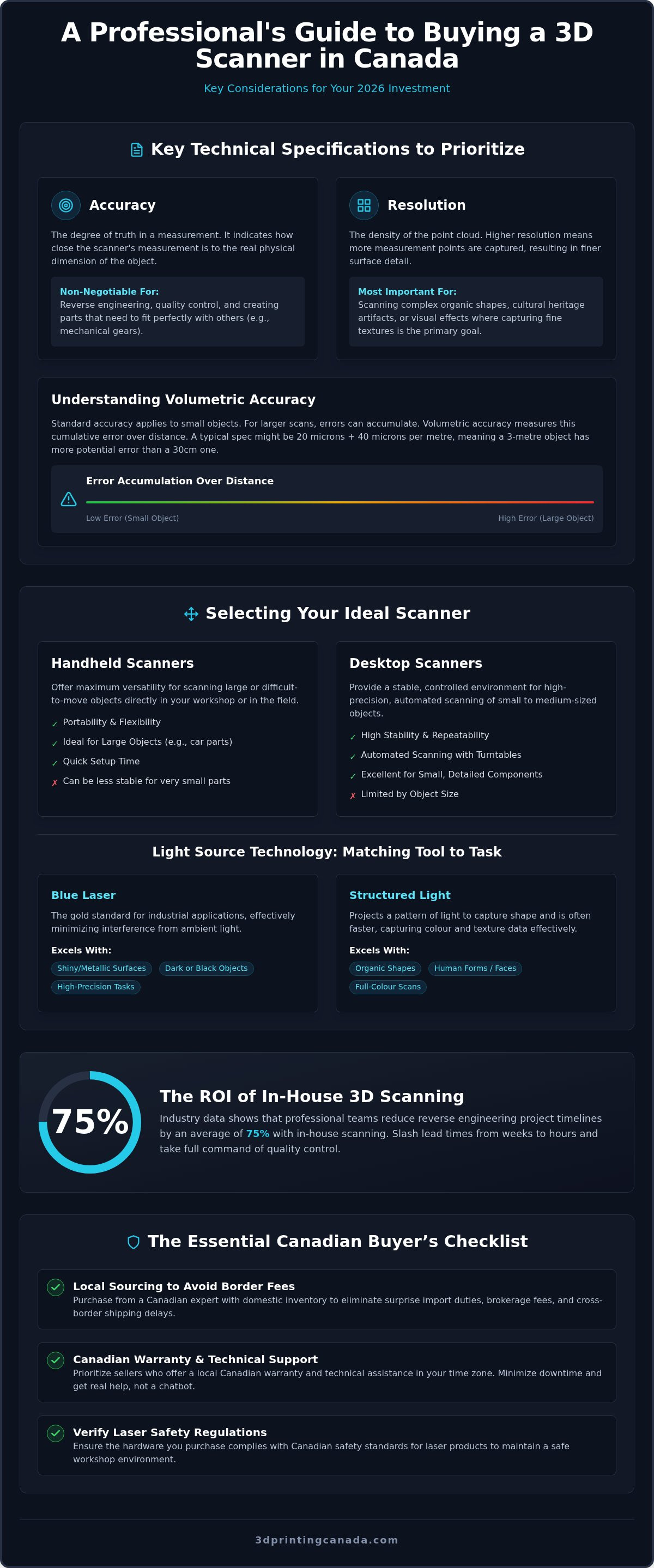
Bringing scanning capabilities in-house eliminates the friction of outsourcing. When you control the hardware, you slash lead times for replacement parts and custom fittings from weeks to hours. You also take full command of quality control; precision digital measurements allow you to compare a physical print or cast against the original CAD model to verify tolerances instantly. By moving these processes internally, Canadian firms realize that the equipment often pays for itself within the first few major projects. Industry data for 2026 indicates that professional teams reduce their reverse engineering project timelines by an average of 75% when using dedicated in-house scanning hardware.
Bridging the Gap Between Physical and Digital
The real magic happens when you integrate scan data into your CAD environment. Modern software makes it easy to turn raw mesh data into editable surfaces, creating a seamless bridge between a physical prototype and its digital twin. This synergy is particularly powerful for the Canadian "prosumer" economy, where designers use scanners to complement their existing 3D printing setups. For instance, many users who stock up on Bambu Lab accessories find that adding a scanner allows them to design perfect-fit modifications for their printers or create custom enclosures for legacy hardware. Whether you're a professional engineer or a dedicated maker, the ability to move fluidly between physical objects and digital models is the ultimate competitive advantage.
Key Technical Specifications to Prioritize Before You Buy
Before you commit to buy 3D scanner Canada equipment, you need to look past the marketing fluff. Technical specs can be confusing, but they dictate whether your project succeeds or fails. You'll often see accuracy and resolution used interchangeably, but they represent very different things. Accuracy is the degree of truth in a measurement, while resolution is the density of the point cloud. If you're reverse engineering a mechanical gear, high accuracy is non-negotiable. If you're scanning a statue for a movie prop, high resolution might be more important to capture fine surface textures.
Accuracy vs. Volumetric Accuracy
Small parts are relatively easy to scan with high precision. However, as the object size increases, errors can accumulate. This is where volumetric accuracy comes in. In a typical Canadian workshop, temperature fluctuations can cause slight expansions in metal parts or the scanner's own housing, affecting your results. Volumetric accuracy describes this cumulative error; for example, a professional handheld unit might offer a base accuracy of 20 microns with a volumetric deviation of 20 microns plus 40 microns per metre of object length. This means a three-metre scan will have significantly more potential error than a thirty-centimetre scan.
Light Sources and Surface Compatibility
Your choice of light source determines which materials you can scan without frustration. Blue laser scanners are the gold standard for challenging surfaces. They handle shiny chrome, dark plastics, and metallic finishes much better than white light. If you're working with organic shapes, structured light is often faster and captures colour data more effectively. If you're still struggling with a mirror-finish part, a quick dusting of scanning spray can turn that reflective surface into a matte one, allowing the sensors to track the geometry perfectly.
- Blue Laser: Best for industrial parts, machined steel, and black components.
- Structured Light: Ideal for human forms, heritage preservation, and rapid prototyping.
- Hybrid Systems: Some 2026 models combine both to handle diverse projects with a single tool.
Efficiency also depends on frames per second (FPS). A higher FPS allows you to move the scanner faster without losing tracking, which is vital for large-scale projects. Finally, ensure the output files, usually STL or OBJ, are compatible with your existing CAD suite or slicer. If you have questions about which specs fit your specific application, our team at 3D Printing Canada can help you navigate these technical hurdles. We focus on providing functional descriptions so you can buy 3D scanner Canada gear that actually performs in your specific environment.
Desktop vs. Handheld 3D Scanners: Selecting Your Ideal Format
Choosing the right physical format is the most critical decision you'll face when you prepare to buy 3D scanner Canada hardware. The choice isn't just about price. It's about whether you need the freedom to move around a large object or the automated precision of a fixed station. Both formats have evolved significantly by 2026. Handhelds are lighter and more powerful; desktops are more integrated and faster than ever. Your decision should be driven by the size of your parts and where the scanning actually happens.
The Case for Handheld Scanners
Handheld scanners are the ultimate problem solvers for large-scale engineering. If you need to digitize a piece of heavy machinery or a custom vehicle component that can't be moved, portability is mandatory. These devices excel at capturing complex, multi-angle geometries that a fixed scanner might miss. The ergonomics of 2026 models allow for extended use without fatigue, making them ideal for field work in diverse Canadian environments. For a deeper look at specific models, check out our guide on the best handheld 3D scanners in Canada to see how they stack up in real-world testing.
The Case for Desktop Scanners
Desktop scanners are the workhorses of the laboratory and the quality control centre. They typically feature automated turntables that rotate the object while the scanner stays fixed. This setup provides unmatched consistency for repetitive tasks. If you're scanning hundreds of small mechanical parts for inspection, a desktop unit minimizes human error. It creates a controlled environment where lighting and distance remain constant, ensuring your measurements are repeatable and your data is reliable for precision manufacturing.
Workflow and Maintenance in 2026
High-volume production environments often require a hybrid approach. While a professional handheld might cost more upfront, its versatility can often replace multiple specialized tools. Entry-level scanners are great for learning the ropes, but professional-grade hardware offers better self-calibration and more durable optics. In 2026, maintenance has become simpler; many units now feature internal sensors that alert you when the lenses need cleaning or the system requires recalibration. Keeping your optics dust-free is especially important in industrial settings where particulates can interfere with light sensors. Whether you choose the agility of a handheld or the stability of a desktop, ensure the format matches your most frequent scanning volume to maximize your return on investment.
The Essential Canadian Buyer’s Checklist: Support and Logistics
Selecting the right hardware is only half the battle. When you decide to buy 3D scanner Canada equipment, you must account for the logistical reality of moving high-precision optics across our borders. Many professionals get lured in by lower prices on international marketplaces, only to be hit with a massive bill from the Canada Border Services Agency (CBSA) before delivery. Beyond the initial cost, you need to consider who will help you when the calibration drifts or a sensor fails. A local partner provides a safety net that international sellers simply cannot match.
Why Buying Domestic Beats International Direct
The true cost of an international purchase often exceeds the local retail price once you factor in duties and taxes. For instance, the CBSA applies a 5% GST to items imported by mail, but in participating provinces, you'll be charged the full 13% HST instead. These taxes are calculated based on the value in Canadian funds, which can fluctuate. Buying domestically eliminates these surprise costs and ensures your scanner arrives without being stuck in a customs warehouse for weeks. Shipping a delicate instrument from Hamilton to Calgary is significantly safer and faster than crossing an ocean; it also ensures the device complies with the Radiation Emitting Devices Regulations (REDR) required for laser products in Canada.
Technical Support and Repair Ecosystem
Hardware is only as good as the support behind it. If your scanner goes down, sending it back to Europe or Asia for repair can result in months of downtime and exorbitant shipping fees. By choosing a Canadian vendor, you gain access to localized expertise and faster turnaround on consumables like scanning spray or tracking markers. It's also vital to ensure your provider offers comprehensive 3D printer repair services Canada to support your entire additive manufacturing workflow. Our technicians understand the specific challenges of the Canadian market, from varying workshop temperatures to the latest Health Canada regulations for medical-grade scans.
Accessing community resources and training is much easier when your mentor is in the same time zone. We don't just sell you a box; we provide the human support required to integrate these tools into your daily operations. If you are ready to secure a reliable scanning solution with local backing, browse our collection of professional 3D scanners today to find a tool that includes the dependable support your business deserves.
Why 3D Printing Canada is Your Trusted Partner for Scanning Technology
Choosing where to buy 3D scanner Canada equipment is a decision that impacts your workflow for years to come. At 3D Printing Canada, we've spent over a decade establishing ourselves as the national leader in additive manufacturing hardware. We aren't just a faceless big-box store. We're a team of enthusiasts and experts based in Hamilton, Ontario, who are genuinely invested in your project's success. Our role is to act as a knowledgeable mentor, helping you find the right technology without the corporate stiffness you'll find elsewhere.
Expertise You Can Count On
We understand that every professional has unique requirements. A machine shop in Quebec has different needs than a medical research facility in Alberta. This is why we offer personalized guidance to help you select the exact technology that fits your budget and precision needs. Our inventory goes far beyond scanners; we provide everything from high-performance filaments to Bambu Lab accessories to ensure your post-scan printing process is just as smooth as the capture. For those looking for a comprehensive overview of the market, our 3D scanner Canada pillar serves as a vital resource for choosing your scanning technology.
Fast National Shipping and Support
Reliability is the cornerstone of our business. We've built a logistics network that provides dependable national shipping to every province and territory, from the busiest urban centres to remote locations. When you buy 3D scanner Canada hardware through our shop, you're also buying into a support system that includes direct access to our skilled technicians. If you encounter a tracking issue or need advice on capturing a difficult surface, our team is just a call or email away. We provide the human support required to keep your business moving, minimizing the downtime that often comes with international purchases. We're proud to be a local resource that makes sophisticated technology feel approachable for every professional creator in the country.
Your success is our priority. By partnering with a local expert, you ensure that your investment in 3D scanning is backed by a team that actually cares about your results. We're here to help you bridge the gap between physical objects and digital innovation with tools you can trust. Ready to take the next step? Browse our full collection of 3D scanners today and find the perfect fit for your professional needs.
Take the Next Step in Your 3D Scanning Journey
Making the decision to buy 3D scanner Canada equipment is a major step toward professional independence and design precision. You've learned how to navigate technical specs like volumetric accuracy and why choosing a local partner is the only way to avoid surprise border fees. By focusing on the right light source and format for your specific applications, you're now ready to turn complex physical objects into perfect digital models.
Our team is ready. We provide expert 3D printer repair services and professional technical support based in Ontario to keep your equipment running at peak performance. With fast national shipping across the country, your next big project doesn't have to wait for international logistics. It's time to stop worrying about duties and start focusing on your designs.
Find the perfect 3D scanner for your project at 3D Printing Canada and take full control of your creative workflow. We can't wait to help you bring your ideas to life.
Frequently Asked Questions
Is it better to buy a 3D scanner in Canada or import one from the US?
Buying in Canada is the smarter choice to avoid surprise border fees and 13% HST charges on imports. When you buy 3D scanner Canada hardware domestically, you get a local warranty and a support team in your time zone. This eliminates the risk of your equipment being stuck in a customs warehouse or needing expensive international shipping for a simple calibration check.
What is the most important spec to look for when I buy a 3D scanner?
Accuracy is the most vital specification because it determines the reliability of your measurements for engineering. While resolution helps with surface aesthetics, professional projects require a device that can maintain tight tolerances. Ensure you check the volumetric accuracy rating if you plan on scanning objects over one metre in length to avoid cumulative measurement errors during your reverse engineering workflow.
Can I use a 3D scanner for reverse engineering automotive parts?
Professional scanners are essential for automotive reverse engineering, allowing you to digitize engine components or custom body kits with ease. Handheld units are the preferred format here because they let you reach into tight spaces like wheel wells or interior cabins. Using a blue laser scanner ensures you can capture dark plastics and metallic paint without needing messy developer sprays for every part.
Do I need a high-end PC to run 3D scanning software in 2026?
You definitely need a robust workstation with a high-end dedicated GPU and at least 32GB of RAM to handle 2026 scanning software. Processing raw point clouds into a clean mesh is a heavy task that can stall a standard laptop. A powerful setup ensures that your real-time tracking stays fluid, which prevents the scanner from losing its position during a complex capture.
What is the difference between accuracy and resolution in 3D scanning?
Accuracy tells you how "correct" a measurement is, while resolution tells you how much "detail" is captured. High resolution creates a dense point cloud that looks great, but without high accuracy, those points might not be in the right physical location. For mechanical parts, accuracy is your priority; for artistic archives or heritage preservation, resolution is often the primary focus.
Are there handheld 3D scanners that can capture dark or shiny surfaces?
Blue laser technology is the best solution for capturing dark or reflective surfaces that standard structured light scanners often miss. These lasers are less sensitive to surface finish, making them ideal for scanning shiny chrome or black automotive parts. If you are still seeing "holes" in your data, using a temporary matte scanning spray can help the sensors track the surface perfectly.
Does 3D Printing Canada provide technical support for the scanners they sell?
We provide comprehensive technical support for every scanner we sell through our dedicated team in Hamilton. When you buy 3D scanner Canada gear from us, you aren't just getting a box; you're gaining a partner who can help with everything from initial setup to advanced software troubleshooting. We also offer repair services to ensure your hardware stays in peak condition for years.
How much should I expect to spend on a professional-grade 3D scanner in Canada?
Professional scanners in the Canadian market vary widely, usually starting around C$1,000 for prosumer handhelds and reaching over C$130,000 for high-end metrology systems. Your specific budget should be determined by the level of accuracy your project demands and the size of the objects you need to capture. Investing in a higher-tier unit often pays for itself through reduced post-processing time.