
What if your strongest 3D print was also the reason your printer ended up in the repair shop? It is a common frustration for makers from coast to coast. You want the incredible rigidity and sleek matte finish that only carbon fibre composites offer, but you are likely tired of dealing with chewed-up brass nozzles and stubborn bed adhesion failures. Finding reliable carbon fiber filament Canada shouldn't mean sacrificing your hardware or settling for subpar results.
This 2026 guide helps you master the complexities of printing with these advanced composites while showcasing the best materials available for Canadian professionals and hobbyists. You will learn how to select the right polymer for your specific mechanical needs, set up your printer to avoid permanent damage, and achieve the professional-grade surface finishes your projects deserve. We provide the technical knowledge and hardware solutions required to turn these abrasive materials into dependable, high-performance parts without the headache. From choosing between Nylon and PETG bases to installing hardened components, you will gain the confidence to push your printer to its absolute limit.
Key Takeaways
- Learn how to balance structural stiffness and ease of use by selecting the right base polymer, whether you need the simplicity of PLA or the chemical resistance of PETG.
- Protect your printer from the "brass killer" effect by upgrading to hardened steel or tungsten carbide nozzles before you start printing with abrasive composites.
- Secure high-quality carbon fiber filament Canada from local sources to eliminate surprise customs fees and ensure you have access to dependable national technical support.
- Optimize your final results with essential pre-print techniques, including thorough filament drying and selecting specific slicer settings that maximize part strength.
- Utilize professional repair services as a reliable safety net to keep your hardware running smoothly while you transition to advanced, high-performance materials.
What is Carbon Fiber Filament and Why Use It?
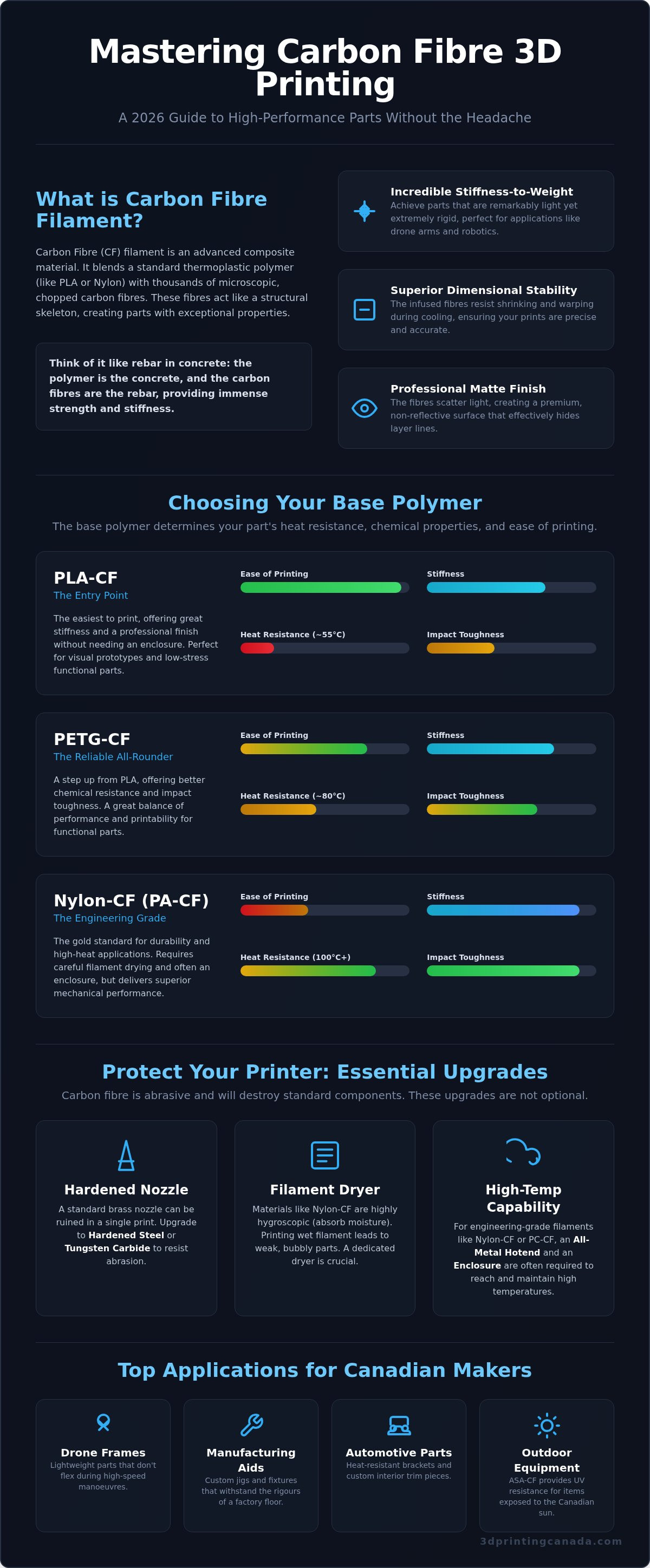
Imagine upgrading your prints from flexible plastic to something that feels like structural engineering. That is the power of using carbon fibre composites. At its core, carbon fibre filament is a blend where a standard polymer like PLA or Nylon acts as a "matrix" for thousands of microscopic, chopped carbon fibres. These tiny strands act like rebar in concrete. They provide a structural skeleton that prevents the part from stretching or bending under load. When you source high-quality carbon fiber filament Canada makers often find that their functional prototypes finally have the rigidity required for real-world testing.
The most significant advantage is the stiffness-to-weight ratio. You get parts that are incredibly light yet remarkably stiff. This makes it a go-to for anything that moves, from drone arms to robotic components. Beyond strength, these materials offer superior dimensional stability. Pure polymers tend to shrink and warp as they cool, but the infused fibres resist this movement. This means your large-scale prints stay flat on the bed and your bolt holes line up perfectly every time. Plus, the aesthetic is hard to beat. The fibres scatter light, creating a premium matte finish that makes layer lines almost invisible.
The Science of Fibre Reinforcement
To understand why these materials perform so well, we need to look at how they are made. If you are curious about the raw material, you can read more about What are Carbon Fibers? to see how they are processed. In 3D printing, we use "short-strand" fibres. These strands increase the tensile modulus, or stiffness, of the plastic significantly. However, there is a trade-off. While the part becomes stiffer, it also becomes more brittle. It won't bend, but it might snap under a sudden, heavy impact. Carbon fibre filament is a composite material consisting of a thermoplastic matrix reinforced with microscopic chopped carbon fibres to enhance mechanical properties.
Top Applications for Canadian Makers
Canadian makers are using these materials to solve complex problems across various industries. Whether you are a professional engineer or a dedicated hobbyist, finding the right carbon fiber filament Canada offers is the first step toward industrial-grade results. Because of the high heat resistance and rigidity, it is perfect for:
- Drone Frames: Lightweight parts that don't flex during high-speed manoeuvres.
- Manufacturing Aids: Creating custom jigs and fixtures that can withstand the rigours of a factory floor.
- Automotive Components: Heat-resistant brackets or interior trim pieces that look and feel like factory parts.
- Outdoor Equipment: Using ASA-CF for items that need to survive the Canadian sun without warping or degrading from UV exposure.
- Custom Cycling Parts: Developing specialized brackets or lightweight mounts for road and mountain bikes. If you appreciate the engineering behind high-performance materials, Pedalinx Bike Shop offers a look at how carbon fibre is utilized in professional-grade cycling equipment.
Comparing Base Polymers: PLA-CF vs. PETG-CF vs. Nylon-CF
Picking the right base polymer is what separates a successful project from a melted mess. While the carbon fibres provide the stiffness, the "matrix" holding them together determines how your part reacts to heat, chemicals, and stress. If you are looking for carbon fiber filament Canada, you first need to decide which plastic backbone fits your application. Each base material offers a unique set of trade-offs that impact both the printing process and the final part's performance.
PLA-CF is the undisputed king of ease. It prints exactly like standard PLA but results in parts that feel significantly more rigid and look professional. You don't need an enclosure, making it the perfect entry point. PETG-CF serves as the reliable all-rounder. It adds chemical resistance and better impact toughness than PLA, though it can be slightly stringier to print. For those tackling industrial challenges, Nylon-CF (PA-CF) is the gold standard for durability and heat resistance. Finally, Polycarbonate-CF (PC-CF) sits at the pinnacle, offering the highest heat deflection temperatures and structural integrity for the most demanding environments.
Performance Metrics and Trade-offs
The biggest differentiator is the Heat Deflection Temperature (HDT). PLA-CF typically softens around 55°C, making it unsuitable for a hot car interior. In contrast, PC-CF can often withstand temperatures exceeding 140°C. You also have to consider hygroscopy. Nylon-CF is essentially a sponge for moisture; it requires a dedicated filament dryer to prevent steam bubbles and poor layer adhesion. PLA-CF and PETG-CF are more forgiving but still benefit from being kept dry. If you are new to these materials, you might want to check out our broader guide on 3D printer filament Canada to understand the basics before diving into composites.
Choosing the Right Material for Your Project
Think about the environment your part will live in. If it's going outside in the Canadian sun, ASA-CF is your best bet because it resists UV degradation and weathering. If you need a part that won't deform under constant pressure, prioritize the high modulus of a CF-infused material over the flexibility of something like TPU. For those looking to push their machines to the limit, we recommend browsing our curated collection of high-performance filaments to find the exact match for your next build.
Essential Hardware Upgrades for Printing Carbon Fiber
Carbon fibre is essentially sandpaper in filament form. If you try to run it through a standard brass nozzle, you will quickly run into trouble. Brass is a soft metal. The micro-fibres in the filament act like a file, grinding away the internal diameter of the nozzle. Within just a few hours of printing carbon fiber filament Canada, a 0.4mm brass nozzle can easily widen to 0.6mm or more. This ruins your extrusion accuracy and leaves you with inconsistent, messy prints that lack dimensional precision.
To survive this abrasive environment, you need hardened components. Hardened steel is the most common choice because it is affordable and much tougher than brass. However, it has poor thermal conductivity. For those who want the best performance, tungsten carbide or ruby-tipped nozzles offer extreme durability with better heat transfer. Don't forget your extruder gears. If your printer uses plastic or brass gears to push the filament, the carbon fibres will chew through them. This leads to slipping, under-extrusion, and eventually a total failure to feed material through the hotend.
Nozzle Selection and Thermal Conductivity
While 3D printing uses small amounts, tungsten carbide is a vital industrial resource; to see how large-scale scrap is valued, check out Carbide Kings.
Hardened steel nozzles do not transfer heat as efficiently as brass. You will usually need to increase your print temperature by 5 to 15 degrees Celsius to compensate for this thermal lag. If you find this temperature jump causes issues with stringing or cooling, consider plated copper nozzles with hardened inserts for better thermal stability. We recommend using a 0.6mm nozzle for most composite projects to significantly reduce the risk of the fibres clumping together and causing clogs. This slightly larger diameter allows the chopped fibres to flow through the orifice without creating the "log jam" effect common with 0.4mm tips.
Extruder and Build Plate Maintenance
Reliable extrusion requires more than just a tough nozzle. Upgrading to a dual-drive hardened extruder ensures that the gears have a firm grip on the filament without wearing down over time. For the build surface, PEI sheets are the gold standard for achieving excellent adhesion with carbon fibre composites. If you are a Bambu Lab user, check out our guide on Bambu Lab accessories Canada to find specific hardened gear and nozzle kits designed for your machine. A direct-drive system is also highly recommended. It provides a shorter, more constrained path that helps maintain consistent pressure with these stiffer materials. If the transition to hardened hardware feels overwhelming, our repair services are available to help you install these upgrades correctly, ensuring your machine is ready for high-performance duty.
Mastering the Print Process: Pro Tips and Troubleshooting
Even if your spool of carbon fiber filament Canada arrives vacuum-sealed, don't assume it is ready for the printer. Moisture is the silent enemy of high-performance composites. When water trapped inside the filament hits the hotend, it turns to steam, creating microscopic voids and a fuzzy surface finish. For materials like Nylon-CF or PETG-CF, pre-drying your filament for 6 to 12 hours is a mandatory step for professional results. Once the material is dry, your slicing strategy becomes the next priority. Instead of simply increasing infill density, add extra wall loops. Four or five walls will provide more structural rigidity than 100% infill ever could. Use the Gyroid infill pattern; it offers isotropic strength and prevents the nozzle from crossing over previously printed lines, which reduces the chance of clogs or "blobs" caused by fibre buildup.
First layer calibration is equally vital. You want the perfect "squish" to ensure the part stays put, but don't smush the nozzle too close to the bed. If the gap is too tight, the chopped fibres can't escape the nozzle efficiently, leading to immediate clogs. Aim for a slightly higher first-layer height than you would use for standard PLA to give those fibres room to breathe.
Temperature and Speed Calibration
Finding the sweet spot for temperature is a balancing act. While you might be tempted to use a fast 3D printer Canada enthusiasts use for speed benchys, composites require a more patient approach. Printing too fast prevents the chopped fibres from settling correctly within the polymer matrix. Aim for speeds between 30 and 60mm/s to ensure maximum interlayer bonding. Always run a temperature tower for every new brand. The goal is to find the lowest temperature that still provides excellent layer adhesion, as excessive heat can increase "ooze" and stringing. Keep your cooling fan at a minimum, often 0 to 20%, for materials like Nylon and PC to prevent warping and internal stresses.
Storage and Moisture Control in Canada
Our local environment presents unique challenges. During humid Canadian summers, a spool of Nylon-CF can absorb enough moisture to ruin a print in just a few hours of exposure. Even in our dry winters, the relative humidity in a heated room can still fluctuate enough to affect sensitive materials. Invest in a dedicated dry box that allows you to print directly from a controlled environment. If you notice your Nylon-CF is popping or stringing excessively, re-dry it at 80°C for at least 8 hours. This restoration process is essential for maintaining the mechanical integrity of your parts.
If you are struggling with consistent extrusion or hardware clogs, book a session with our technical team to get your machine professionally calibrated for advanced composites.
Where to Buy Carbon Fiber Filament in Canada
Buying high-performance materials shouldn't feel like a gamble. When sourcing carbon fiber filament Canada professionals often look for more than just a low price; they look for a dependable supply chain. Ordering from within the country means you avoid the headache of surprise customs duties and long border delays that can stall a project for weeks. It also means you are dealing with a team that understands the specific challenges of our environment, from the dry winters to the humid summers discussed earlier. We have curated the largest selection of CF filaments in the country to ensure we have a solution for every budget.
For industrial applications where precision is non-negotiable, 3DXTech offers top-tier engineering grades. If you are a Bambu Lab user, we are an official accessory provider, offering seamless compatibility and hardened components for your machine. For everyday functional prototyping, our 3D Printing Canada house brand provides an excellent balance of performance and value. We don't just sell you the spool and walk away. We act as a complete partner in your success. If your transition to composites leads to hardware wear or a stubborn clog you can't clear, our in-house technical team is here to help.
Fast National Shipping and Local Support
Reliability is our priority. We offer national shipping to every province, ensuring that whether you are in a major city or a remote town, your high-performance materials arrive quickly. Buying from a local retailer means you have access to expert support in your own time zone. If you need assistance with extruder maintenance or want to upgrade your machine to handle these "brass killers" safely, our 3D printer repair services Canada team can guide you through the process. We provide the peace of mind that comes with knowing a knowledgeable mentor is just a phone call away.
Value and Bulk Ordering for Small Businesses
For small businesses and engineering firms, managing material costs is essential for maintaining healthy margins. We offer volume purchasing options that allow you to save on high-cost filaments when you stock up for large projects. Choosing the right spool size is also a key factor. While 0.5kg spools are great for testing new polymers, 1kg options offer better long-term value for continuous production runs. Don't let hardware fears hold your creativity back. Shop the full Carbon Fiber Filament collection today and start building parts that are as tough as your designs.
Level Up Your Prints with Industrial Strength
Mastering composites is a major milestone for any maker. You now understand that success depends on matching the right base polymer to your project and protecting your machine with hardened hardware. Whether you are building lightweight drone frames or high-stiffness factory jigs, the right carbon fiber filament Canada source makes all the difference. Don't let the fear of a clogged nozzle or a worn-out extruder gear hold you back from exploring these high-performance materials.
As an authorized Bambu Lab retailer with expert technical repair support, we provide more than just spools. We offer the hardened upgrades and the local expertise required to keep your printer running smoothly regardless of the material. With fast national shipping, your next engineering-grade project is closer than you think. Take the leap and transform your creative process with parts that offer unmatched rigidity and a professional matte finish.
Browse Canada’s Largest Selection of Carbon Fiber Filaments today and start building with confidence.
Frequently Asked Questions
Is carbon fiber filament stronger than standard PLA?
Yes, it is significantly stiffer but not necessarily stronger in terms of impact resistance. While standard PLA might bend or deform under load, carbon fibre versions remain rigid and hold their shape. This makes it ideal for parts that must maintain their dimensional accuracy under stress. However, this stiffness often comes at the cost of toughness; the material can snap rather than flex when it reaches its limit. It's a trade-off between rigidity and flexibility.
Do I need a special nozzle to print carbon fiber filament?
You absolutely need a hardened nozzle to handle the abrasive nature of this material. Standard brass nozzles are too soft and will widen their internal diameter within a few hours of use. We recommend upgrading to hardened steel, tungsten carbide, or ruby-tipped nozzles. These materials resist the "sandpaper" effect of the micro-fibres, ensuring your extrusion remains consistent and your print quality doesn't degrade over time or cause messy clogs.
Does carbon fiber filament ruin 3D printers?
It won't ruin your machine, but it will cause rapid wear on standard components. If you don't upgrade your nozzle and extruder gears, you'll experience under-extrusion and poor print quality very quickly. By installing hardened parts, you turn your printer into a composite-ready machine. If you do experience hardware issues after a long run, our repair services are always available to get your equipment back into top shape and ensure everything is calibrated.
What is the best carbon fiber filament for beginners in Canada?
PLA-CF is the best starting point for anyone looking for carbon fiber filament Canada. It prints with the same ease as standard PLA but provides a beautiful matte finish and increased part rigidity. You won't need a heated enclosure or specialized bed adhesives to get great results. It allows beginners to experiment with the aesthetic and structural benefits of composites without the steep learning curve associated with advanced materials like Nylon or Polycarbonate.
Can I print carbon fiber on a Bambu Lab P1S or X1C?
Both the Bambu Lab P1S and X1C are excellent for composites. The X1C is ready to go out of the box because it includes a hardened steel nozzle and gears. For the P1S, you'll need to swap the standard stainless steel nozzle for a hardened one to prevent wear. As an official accessory provider, we stock all the necessary parts to make your machine fully capable of printing carbon fiber filament Canada projects.
Is carbon fiber filament abrasive to the extruder gears?
Extruder gears are definitely at risk when printing abrasive filaments. Standard brass or stainless steel gears will eventually lose their "teeth" as the carbon fibres grind them down. This leads to the filament slipping and causing failed prints. Swapping to hardened steel extruder gears is a vital upgrade for anyone planning to run large volumes of composite material regularly. It ensures reliable feeding and prevents the frustration of mid-print extrusion failures.
How should I store carbon fiber filament to prevent moisture issues?
You should store it in a sealed dry box or a vacuum-sealed bag with plenty of desiccant. Carbon fibre filaments, especially Nylon and PETG variants, are highly hygroscopic and will absorb moisture from the Canadian air quite quickly. Wet filament leads to steam bubbles, poor layer adhesion, and stringing. For the best results, print directly from a dry box to keep the material at an optimal humidity level throughout the entire printing process.
What are the health and safety considerations when printing with carbon fiber?
Proper ventilation is the most important safety consideration. While the carbon fibres themselves are trapped in the plastic during printing, the base polymers can release VOCs that you shouldn't breathe in. Use an enclosure with a filter if possible. Additionally, be careful when sanding finished parts; the fine carbon dust can irritate your skin and lungs, so always wear a mask and eye protection during post-processing to avoid any direct contact with micro-particles.