
The fastest 3D printer in the world is useless if it's sitting idle while you wait three weeks for a proprietary nozzle to clear customs. While the latest 3D printers Canada has to offer in 2026 boast incredible speeds of 500mm/s, the real winners are the machines that prioritize reliable uptime and local accessibility. You've likely felt the frustration of buying a cutting-edge model only to realize the smart features require a degree in computer science just to level the bed. We know you want a printer that simply works the moment it's unboxed.
This comprehensive guide breaks down the complexities of AI-driven hardware and multi-material systems like the Bambu Lab X2D or Creality K2 series. We'll show you how to maximize your ROI with high-speed hardware while avoiding the hidden costs of international shipping and duties. From hobbyist setups to professional workstations, you'll discover how to secure a future-proof machine backed by local Canadian expertise and parts. Whether you are looking for your first machine or upgrading a production fleet, we have done the research to ensure your next investment is a successful one.
Key Takeaways
- Learn how 2026 AI-assisted error detection and auto-recovery features are making 3D printing more reliable and accessible for Canadian creators.
- Discover the latest 3D printers Canada offers that balance engineering-grade FDM strength with the high-speed efficiency required for modern projects.
- Compare the 2026 lineups from industry leaders to find the perfect match between out-of-the-box performance and deep hardware customization.
- Apply our step-by-step selection framework to identify the ideal build volume and material compatibility for your specific professional goals.
- Understand how sourcing hardware locally eliminates cross-border duty surprises while providing the peace of mind of in-house technical support and repairs.
The Evolution of 3D Printing in Canada: What’s New for 2026?
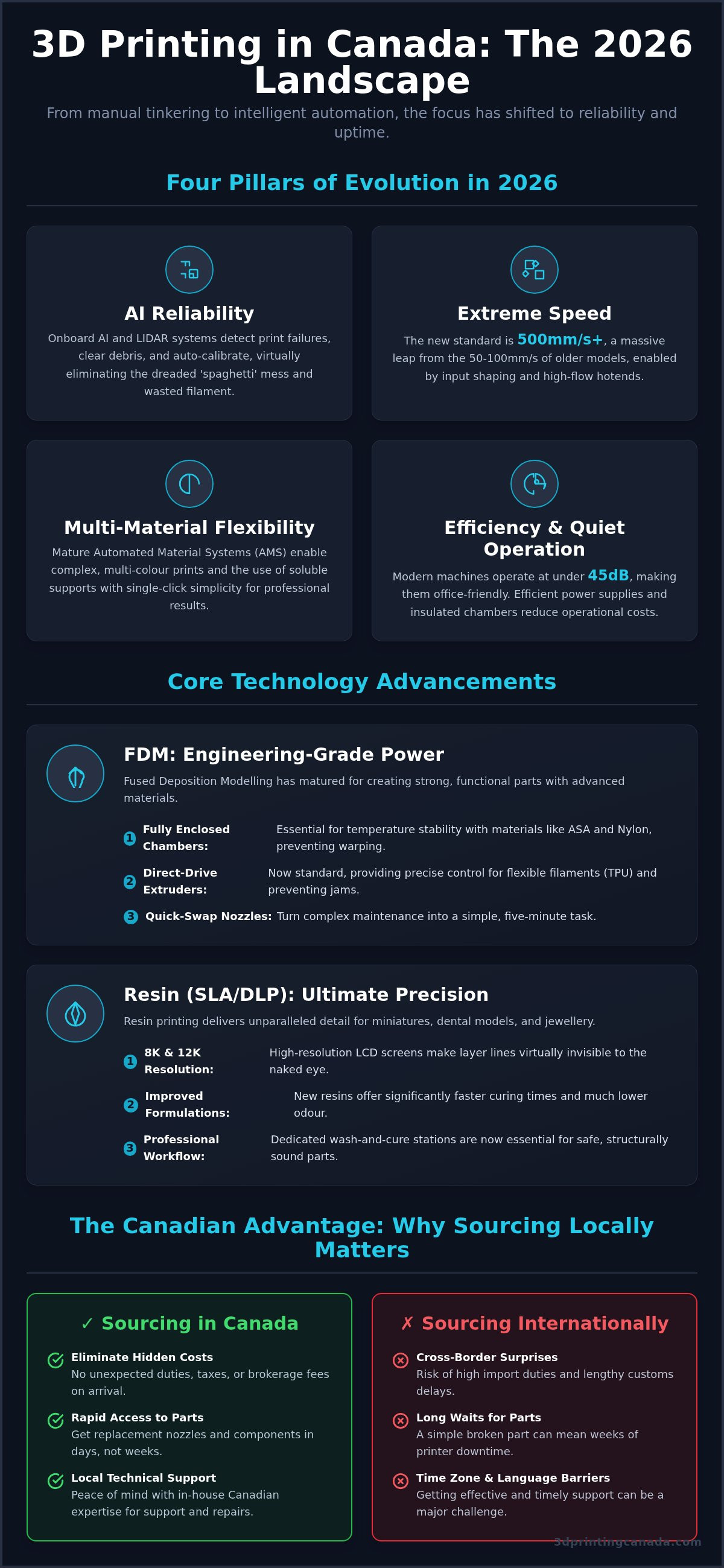
The landscape of 3D printing in Canada has shifted dramatically this year. While previous years focused on raw speed, the latest 3D printers Canada offers in 2026 emphasize intelligence and autonomy. Small businesses across the country are moving away from 'project' printers that require constant tinkering. Instead, they are investing in hardware that functions as a reliable production tool. The Evolution of 3D Printing has moved from manual calibration to total automation, allowing users to focus on design rather than maintenance. This evolution is driven by four pillars: AI reliability, extreme speed, multi-material flexibility, and environmental efficiency.
AI Integration and Smart Sensors
Modern sensors have finally solved the 'spaghetti' problem. In 2026, on-board cameras and AI processors detect print failures in real-time, pausing the job before you waste half a roll of filament. These systems analyze the print bed for debris and ensure the nozzle is clear before every start. Advanced LIDAR systems and flow calibration now handle the tedious task of first-layer perfection, compensating for bed irregularities without human intervention. This means less time scraping beds and more time finishing projects. AI-driven print monitoring is the biggest time-saver of 2026.
High-Speed Hardware Standards
Speed is no longer a luxury feature. The latest 3D printers Canada stocks now reach speeds exceeding 500mm/s as a standard benchmark. This leap from the 50-100mm/s speeds of older generations is made possible by 'input shaping' algorithms that cancel out vibrations. These algorithms allow the machine to move faster while maintaining a crisp surface finish. However, mechanical stability is only half the battle. To actually achieve these results without losing part strength, you must use high speed filament Canada specifically formulated for rapid extrusion. Using standard filament at these speeds often leads to brittle parts because the plastic doesn't have enough time to melt properly.
Multi-material systems (AMS) have matured into robust tools for complex, colourful designs. These systems allow you to print soluble supports or multi-colour prototypes with a single click. Beyond aesthetics, 2026 models have realized significant gains in energy efficiency and noise reduction. Many now operate at under 45 decibels, making them quiet enough for a shared office or a home studio. High-efficiency power supplies and insulated build chambers also help reduce the overall cost of operation, which is a major win for small-scale production hubs across the country.
Core Technologies Defining the Latest 3D Printer Models
The technology powering the latest 3D printers Canada has reached a tipping point where industrial capability meets desktop convenience. We are seeing a move away from generic hobby machines toward specialized tools designed for specific material properties. In 2026, the hardware is more robust, the software is smarter, and the user experience is significantly more refined. It's no longer about just making a shape; it's about making a functional, durable part on the first try.
FDM (Fused Deposition Modelling) in 2026
FDM technology has matured into a powerhouse for engineering-grade parts. Many of the newer models come standard with fully enclosed chambers. This isn't just for noise; it's essential for maintaining the ambient temperature required to prevent warping in materials like ASA and Nylon. Direct-drive extruders have also become the default. This is a massive win if you are working with TPU filament Canada. These extruders provide the precise tension needed for flexible materials, preventing the jams common in older Bowden systems. Modern toolheads now feature quick-swap nozzles, making maintenance a five-minute task rather than an afternoon project.
Resin Printing: Precision Meets Speed
For those focused on miniatures or dental models, resin (SLA/DLP) advancements have been game-changing. The transition to 8K and 12K screens means layer lines are virtually invisible to the naked eye. Beyond resolution, 2026 resins are formulated for faster curing and significantly lower odour. This makes them much more viable for use in Canadian homes, though proper ventilation remains a safety priority. To get the best results, a dedicated wash-and-cure station is no longer optional. It is the heart of a professional workflow that ensures your prints are safe to handle and structurally sound.
The emergence of hybrid systems has also started to shake up the 2026 consumer market. These machines often combine 3D printing with light laser engraving or CNC capabilities, offering a versatile "all-in-one" workshop for creators with limited space. While specialized machines still lead in raw performance, these hybrids provide incredible value for makers who need a bit of everything. Regardless of the tech you choose, the build plate matters. The debate between materials has largely settled on textured PEI for its incredible adhesion and "pop-off" release. While glass still has its place for perfectly flat bottom surfaces, PEI is the standard for the newest arrivals because it simply works. If you are ready to see these technologies in action, you can browse our latest arrivals to find a machine that fits your specific workflow.
Comparing the Giants: Bambu Lab vs. Creality vs. Prusa in 2026
The battle for the top spot on your workbench has matured significantly this year. It's no longer a simple race for raw speed. Instead, the latest 3D printers Canada offers are judged on their ecosystem reliability and long-term support. Choosing between these three giants requires you to decide if you want a "plug and play" appliance or a machine that allows for deep customization. Each brand has carved out a specific niche that serves different segments of the Canadian maker community.
The Bambu Lab Ecosystem
Bambu Lab remains the undisputed leader for users who prioritize uptime over tinkering. The X2D and P2S models have solidified their dominance by removing the guesswork from the printing process. Their Automatic Material System (AMS) is the primary reason for this success. It allows for seamless multi-colour prints without the mechanical failures that plagued older multi-extrusion setups. While the ecosystem is more "closed" than its rivals, you can easily find high-quality Bambu Lab accessories Canada through specialized local retailers. This ensures you have access to hardened nozzles and replacement build plates without waiting for international shipping or duty surprises.
Creality’s 2026 Innovation
Creality has moved beyond its reputation as a budget-only brand with the K2 series. Models like the K2 Plus and K2 Pro have closed the performance gap with impressive AI-driven features and robust enclosures. They remain a favourite for makers who enjoy organizing and customizing their rigs. Because Creality has such a massive global community, finding third-party upgrades or community-designed fixes is incredibly easy. If you are on a specific budget but want a machine that can grow with your skills, Creality still offers the best path for hands-on learning and hardware modification.
Prusa continues to hold the title for long-term reliability and ethical manufacturing. The Prusa CORE One+ and the large-scale XL models are built for professionals who need a machine to run for thousands of hours without a hiccup. Unlike their competitors, Prusa remains committed to open-source hardware and software. This means your printer won't become obsolete if a manufacturer stops supporting a specific cloud service. For Canadian businesses that need a dependable workhorse with a clear ROI and local repairability, Prusa is often the safest long-term bet. Their commitment to modularity ensures that even older machines can often be upgraded to the latest standards without buying a whole new unit.
How to Select Your Ideal 3D Printer: A Step-by-Step Framework
Selecting from the latest 3D printers Canada stocks requires more than just picking the fastest machine. It's about matching a workflow to your specific goals. Don't let a flashy spec sheet distract you from the practicalities of daily use. Follow this framework to ensure your investment pays off in high-quality prints rather than technical headaches.
- Step 1: Identify your primary use case. Functional parts for automotive or household repairs require the strength of FDM. Aesthetic models and miniatures demand the precision of resin.
- Step 2: Determine your build volume. A standard 256mm cube handles most projects. However, larger prototypes will require a large-format machine to avoid splitting models into multiple pieces.
- Step 3: Evaluate your workspace. Resin setups need dedicated ventilation and space for post-processing. FDM machines are more flexible but still require a stable, level surface to minimize vibrations.
- Step 4: Check for Canadian support. Verify that parts and technical advice are available within the country to avoid long wait times.
- Step 5: Compare the total cost of ownership. Factor in the price of specialized filaments, replacement nozzles, and potential 3D printer repair services Canada to understand the true long-term investment.
Matching Printer to Project
For tabletop gaming and highly detailed figurines, 8K or 12K resin printers are the clear choice. They capture textures and sharp edges that FDM technology simply cannot replicate. If your work involves functional automotive parts or household tools, look toward FDM machines capable of handling ASA or Nylon. Prioritize build plate size for large-scale prototyping. If you need a machine that handles a bit of everything, shop our latest 2026 arrivals to find a versatile model that fits your workshop.
The Canadian Advantage: Support and Repairs
Buying from a domestic retailer is a strategic move that saves you from the hidden nightmare of cross-border duty fees and international shipping delays. More importantly, it gives you direct access to a 3D printer technician Canada can trust. Even the most advanced 2026 hardware requires maintenance to stay in peak condition. Having local experts who understand the nuances of Bambu Lab and Creality systems ensures your downtime is measured in hours, not weeks. Keep your hardware running smoothly by performing regular nozzle checks and bed calibrations as part of your routine.
Shop the Latest Arrivals at 3D Printing Canada
Finding the latest 3D printers Canada offers shouldn't feel like a gamble. At 3D Printing Canada, we curate our New Collection with a focus on real-world performance and long-term reliability. Our in-house technicians personally vet every brand we carry, from Bambu Lab to Creality, ensuring they meet the high standards required for Canadian workshops. This rigorous testing means that when you buy from us, you aren't just getting a box. You're getting a machine we know inside and out, backed by people who actually use them.
Featured 2026 Models
Our current lineup features the most advanced FDM models capable of hitting the 500mm/s benchmark with ease. For creators looking to bridge the gap between physical objects and digital design, we've included top-tier 3D scanners specifically chosen for reverse engineering projects. These tools allow you to digitize complex geometries with industrial precision. Best of all, every machine in our collection is ready-to-ship from our central hub to any province. You get your hardware quickly without the headache of cross-border customs delays or surprise duty fees.
Beyond the Printer: Your Creative Partner
We believe that a printer is only as good as the support behind it. That's why we back our community with comprehensive technical repair services. Whether you need a simple part replacement or a complex calibration, our technicians are here to keep your production line moving. We also maintain a massive inventory of filaments and accessories, so you'll never be stuck waiting for a specific colour or material to finish a job. Our goal is to be more than just a retailer. We want to be your partner in creative success.
Don't just buy a tool; invest in a community of experts. We invite you to explore our resources and connect with other Canadian makers who are pushing the boundaries of what's possible in 2026. When you're ready to upgrade your workshop with a machine that just works, come see why we are the trusted choice for hobbyists and professionals alike across the country. Take a moment to explore our full range of latest 3D printers and accessories and start your next project today.
Ready to Build Your 2026 Workshop?
The 3D printing landscape has never been more exciting or accessible. You now have access to 500mm/s speeds and AI-driven reliability that practically eliminates the frustration of failed prints. Choosing between the out-of-the-box ease of Bambu Lab or the deep customization of Creality depends on your specific goals, but the right machine is finally within reach. By sourcing the latest 3D printers Canada offers from a local partner, you avoid the sting of surprise duties while gaining a team of experts ready to support your journey.
We vet every brand for reliability and maintain a massive inventory of parts to ensure your creative flow is never interrupted. Take the next step toward your professional or hobbyist goals with confidence. Our team provides fast nationwide shipping and expert Canadian technical support to keep your workshop running at peak performance. It's time to stop tinkering with outdated technology and start producing. Browse the latest 2026 3D printer collection and find the perfect match for your next big idea. We can't wait to see what you create.
Frequently Asked Questions
What is the best 3D printer for beginners in Canada for 2026?
The Bambu Lab A1 series and the Creality K2 SE are currently the top choices for beginners in 2026. These models prioritize a "plug and play" experience, removing the need for manual bed leveling or complex assembly. You can start your first print within minutes of unboxing. They offer a perfect balance of reliability and affordability, making them the best gateway into the world of the latest 3D printers Canada has available this year.
How much should I expect to pay for a high-quality 3D printer in 2026?
High-quality 3D printers in 2026 vary in price depending on their build volume and specialized features like multi-material systems. Entry-level machines are very accessible, while professional-grade units with enclosed chambers and AI monitoring sit in a higher bracket. You should evaluate your budget based on the long-term value of features like high-speed printing and automated error detection. Investing in a robust ecosystem often pays for itself by reducing wasted filament and failed projects.
Are the latest 3D printers difficult to set up and use?
Modern 3D printers are significantly easier to use than models from even two years ago. Most 2026 hardware features fully automated calibration, including Z-offset adjustment and vibration compensation. These smart features mean you don't need to be a mechanical engineer to get a perfect first layer. AI-driven monitoring even watches your prints for you, pausing the machine if it detects a problem, which makes the entire process much more approachable for new users.
Where can I get my 3D printer repaired in Canada if it breaks?
You can access expert 3D printer repair services through our national network at 3D Printing Canada. We have in-house technicians who specialize in diagnosing and fixing common issues for major brands like Bambu Lab and Creality. Instead of shipping your machine back to an international manufacturer, you can rely on local support to get your production line back up and running. This local access ensures faster turnaround times and eliminates the hassle of customs.
Do 2026 3D printers require special filament for high-speed printing?
Yes, using high-speed filament is essential if you want to take full advantage of 500mm/s printing speeds. Standard filaments often can't melt fast enough to keep up with the rapid movement of the toolhead, which leads to weak or brittle parts. High-speed variants are formulated to flow more consistently at higher temperatures. Matching your material to your hardware's capabilities ensures that your fast prints remain as strong and durable as those printed at slower speeds.
What is the difference between FDM and Resin printers in the current market?
FDM printers use a spool of plastic filament and are best for functional, durable parts like tools or brackets. Resin printers use liquid photopolymer and are the gold standard for high-detail projects like tabletop miniatures or jewellery moulds. While FDM is generally cleaner and easier for large objects, resin offers a level of precision that FDM cannot match. Your choice depends on whether you value structural strength or intricate aesthetic detail for your creative projects.
Can I use AI features on older 3D printer models via upgrades?
You can add certain smart sensors to older models, but full AI integration usually requires the processing power found in modern 2026 motherboards. Upgrading an older machine with a high-definition camera or a filament runout sensor is possible and helpful. However, features like real-time "spaghetti" detection and automated flow calibration are often baked into the latest 3D printers Canada offers. For most users, upgrading to a new machine provides a more seamless and reliable AI experience.
How long does shipping take for 3D printers within Canada?
Shipping times for 3D printers within Canada are typically very fast when you order from a domestic hub. Most orders are processed and dispatched quickly, reaching major provinces within a few business days. By avoiding international carriers, you don't have to worry about your machine being held up at the border or hit with unexpected brokerage fees. We prioritize getting your hardware to you efficiently so you can start your next project without unnecessary delays.