
Did you know that the 2026 benchmark for the fastest 3d printer canada can slash your production time by a staggering 80 percent compared to machines from just a few years ago? It's a massive leap forward that changes the game for Canadian makers and professionals who need results now. High-speed printing is no longer a luxury; it's the new standard for anyone looking to stay competitive.
We've all felt the frustration of watching a print head crawl across the bed for twelve hours, only to find ghosting or ringing artifacts ruining the final finish. It's even worse when a specialized part fails and you realize the replacement is stuck at a border crossing for weeks. You want raw velocity, but you also need reliability and local support you can count on.
This guide will help you choose a high-speed machine that delivers professional surface finishes at 500mm/s and beyond. You'll learn how to bypass complicated firmware setups and maintain your equipment using accessories and repair services sourced right here at home.
We'll compare the top performers from Bambu Lab and Creality, examine the mechanics of CoreXY systems, and identify the high-flow filaments required to keep your production line moving at record pace.
Key Takeaways
- Learn to distinguish between 2026 speed tiers, moving beyond raw travel speed to focus on the acceleration rates that actually slash production times.
- Identify why CoreXY architecture and Input Shaping are essential for maintaining professional quality while searching for the fastest 3d printer canada.
- Evaluate the ecosystems of industry leaders like Bambu Lab and Creality to find the perfect balance between automated ease and mechanical performance.
- Recognize the importance of high-flow filaments and proactive maintenance to prevent nozzle starvation and belt wear at high velocities.
- Realize the benefits of utilizing local Canadian support and repair services to avoid the high costs and long delays of international shipping.
Benchmarking Speed: The 2026 Standard for Canadian Makers
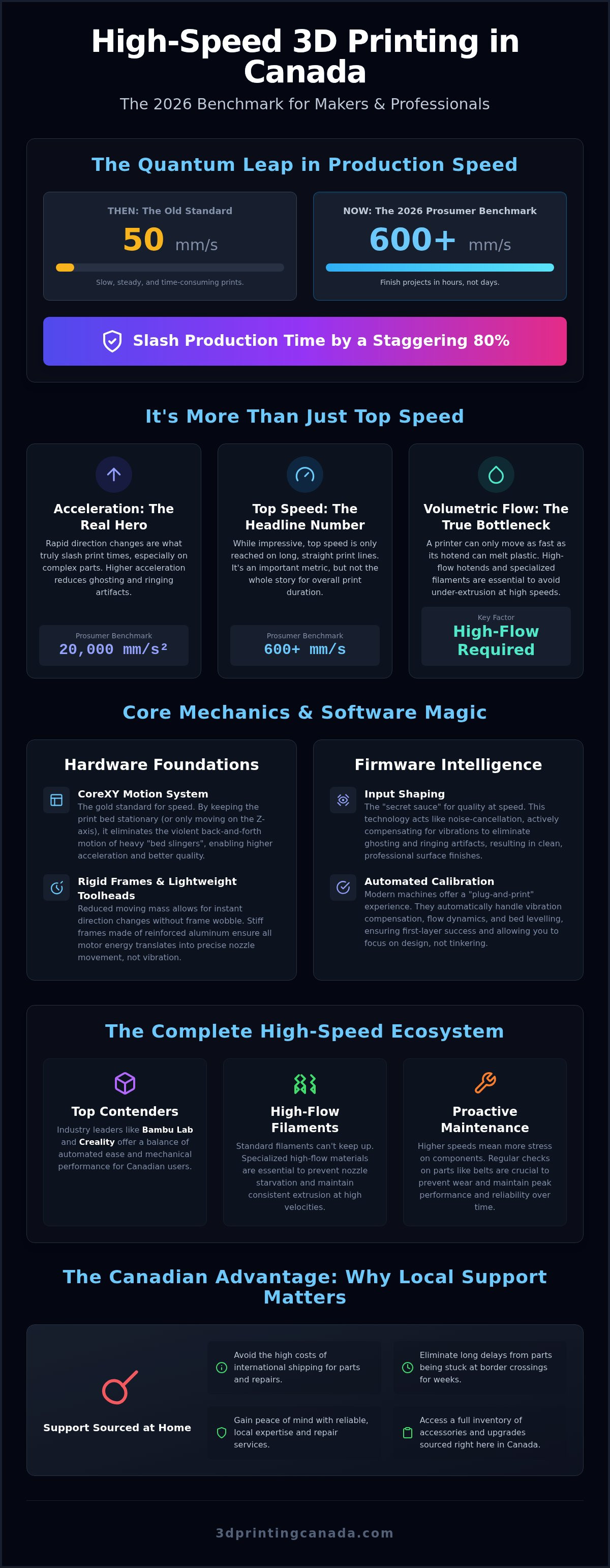
The days of "slow and steady" at 50mm/s are officially over. In 2026, the Canadian 3D printing community has redefined what "fast" looks like. If you're hunting for the fastest 3d printer canada has to offer, you'll notice two distinct tiers. Entry-level machines now comfortably hit 300mm/s, while prosumer models push past 600mm/s. This isn't just about showing off; it's about finishing a project in two hours instead of ten. You can now produce high-quality prototypes and functional parts in a fraction of the time it took just a few years ago.
Success isn't just about the finish line. It starts with the first layer. Modern machines prioritize "First Layer Success" to ensure you don't waste time on failed prints. High-speed tech in 2026 uses sophisticated sensors to verify the bed level and adhesion before the print head even starts its sprint. This reliability is what allows professionals to organize their workflow without constantly hovering over the machine.
Acceleration vs. Top Speed: What Actually Saves Time?
Many users focus on the top speed listed on the box, but acceleration is the real hero. A printer boasting 20,000mm/s² acceleration will finish a small, complex part much faster than a machine with a higher top speed but sluggish pick-up. Rapid direction changes are where quality is won or lost. If the printer can't decelerate and accelerate instantly, you'll see ghosting and ringing. Understanding 3D printing speed requires looking at how hardware handles these shifts. Volumetric Flow Rate is the true bottleneck for speed because your hotend must be able to melt plastic as fast as the motors move.
The 2026 Out-of-the-Box Experience
Forget the "tinker-heavy" kits that required a weekend of assembly and a degree in mechanical engineering. Today's high-speed machines are plug-and-print wonders. They arrive nearly fully assembled with automated calibration routines that handle everything from vibration compensation to flow dynamics. This shift allows Canadian hobbyists to realize their goals faster, often scaling from a single machine to a small production farm in months. You can now focus on design and creativity while the hardware handles the technical heavy lifting. High-speed printing has become an accessible tool for anyone ready to scale their output.
The Mechanics of Velocity: Why Modern Printers Are 10x Faster
Achieving the title of the fastest 3d printer canada has to offer isn't just about cranking up the motor voltage. It's about a fundamental shift in how machines move. In 2026, the industry has largely moved away from heavy, vibrating components in favour of rigid frames and ultra-lightweight toolheads. This reduction in moving mass is critical. When a toolhead weighs less, it can change direction instantly without the momentum causing the frame to wobble. Modern firmware like Klipper manages these complex motions with surgical precision, calculating thousands of micro-steps per second to keep the nozzle exactly where it needs to be.
Rigidity is the backbone of velocity. A flimsy frame acts like a spring, absorbing energy and releasing it as unwanted vibration. High-speed printers now utilize reinforced aluminium or carbon fibre components to ensure that every bit of motor energy goes into moving the nozzle, not shaking the desk. This mechanical stability is what allows prosumer machines to maintain professional surface finishes even while screaming along at 600mm/s.
CoreXY vs. Cartesian: Choosing Your Motion System
CoreXY architecture has become the gold standard for high-speed performance. Unlike traditional Cartesian printers where the bed moves back and forth (the Y-axis), CoreXY keeps the bed stationary or moving only on the Z-axis. This means you aren't throwing a heavy print and a heated plate around at high velocities. This stationary bed design is especially important for engineering-grade materials that require a stable, enclosed environment. While this setup is often preferred for speed, modern "bed slingers" like the Bambu Lab A1 have utilized advanced vibration compensation to remain surprisingly competitive for hobbyist applications.
Software Magic: Input Shaping and Pressure Advance
Input Shaping is the secret sauce that makes 2026 speeds possible. Think of it as noise-cancelling headphones for your printer. Sensors "listen" to the mechanical resonances of the machine and then generate inverse movements to cancel out those vibrations. This eliminates the ghosting artifacts that used to plague fast prints. Pressure Advance works alongside this by managing the "ooze" inside the hotend. It ensures that even at 500mm/s, your corners remain sharp and your layers stay consistent. If your machine starts losing that out-of-the-box precision, our 3D printer repair services can help dial your motion system back into peak performance.
Bambu Lab vs. Creality: Comparing Canada’s Top High-Speed Contenders
The rivalry between Bambu Lab and Creality has fundamentally changed the Canadian market. It's often called the "Battle for the Benchie," where manufacturers compete to see who can produce a high-quality 3D model in the shortest time possible. For anyone hunting for the fastest 3d printer canada, these two brands are likely at the top of your list. Bambu Lab offers a streamlined, proprietary experience that prioritizes ease of use, while Creality continues to champion open-source flexibility and rapid hardware iteration.
Choosing between them often comes down to your workflow. Do you want a machine that acts like a high-end appliance, or do you prefer a platform you can modify and grow with? Both companies have pushed the 2026 speed benchmarks to levels we once thought impossible for consumer hardware. However, speed is only useful if you can keep the machine running. We've seen that the availability of local parts and expert support is what truly determines long-term success for Canadian makers.
Bambu Lab: The Enclosed Speed Kings
Bambu Lab's P1S and X1 series have set the 2026 gold standard for enclosed speed, comfortably reaching benchmarks of 500mm/s and beyond. These machines are designed for those who want to start printing immediately without spending hours tweaking firmware settings. The AMS (Automatic Material System) is a standout feature, allowing for complex multi-colour prints at high velocities without the usual manual hassle. Because these systems are proprietary, having a dependable source for Bambu Lab accessories Canada is vital. You don't want your production stopped because you're waiting on a specific nozzle or cable to cross the border.
Creality Canada: The Open-Source Speed Challengers
Creality has responded to the speed challenge with the K1 Max and the Ender-3 V3 series. These machines offer an incredible price-to-performance ratio for budget-conscious makers. If you're a user who likes to tinker, modify, or upgrade your hardware, Creality remains a top choice. Their ecosystem allows for more granular control over the printing process, which is a major advantage for those who want to customize their machines for specific engineering tasks. The K1 series, in particular, provides raw velocity that rivals the most expensive models on the market. Because these machines are so popular across the country, finding replacement parts like belts and hotends is quick and easy, ensuring your downtime remains minimal.
Beyond the Printer: High-Flow Filaments and Maintenance for Speed
Even if you own the fastest 3d printer canada has available, your results will suffer if you're using the wrong "fuel." Standard PLA often "starves" the nozzle at speeds over 300mm/s. The heater simply can't transfer thermal energy into the plastic fast enough to maintain a consistent flow. This leads to under-extrusion, weak layer bonds, and a dull, matte finish where you expected a professional gloss. To keep up with 2026 hardware, you need materials specifically designed to melt and flow at high velocities. Just as using the correct filament is essential for print quality, choosing the right digital file type is crucial for sound; you can visit HiFi Centre to learn more about the best audio quality formats for your home system.
The Canadian climate adds another layer of complexity to your workflow. Our dry winters and humid shoulder seasons mean your filament storage must be airtight. Moisture trapped inside the plastic turns to steam the moment it hits the hotend. At 600mm/s, those tiny steam explosions cause gaps in your print that ruin structural integrity. Keeping your workspace organized and your materials dry is the only way to ensure your high-speed projects don't fail halfway through.
Selecting High-Flow Filament in Canada
High-flow (or "Hyper") filaments are engineered with a lower melt viscosity. This allows them to reach volumetric flow rates of 20mm³/s or higher without clogging the extruder. When you're printing at these speeds, you'll burn through spools faster than ever before. We recommend bulk buying your 3D printer filament Canada to ensure you have consistent batches for long production runs. Always dry your PETG or high-flow PLA for at least four hours before a big project to maintain a perfect surface finish.
Preventative Maintenance for High-Velocity Hardware
Speed puts immense stress on every mechanical joint. Belt tensioning is no longer a "once a year" task; it's a monthly requirement for maintaining 2026-tier accuracy. Loose belts cause rounded corners and ghosting that software can't always fix. You should also keep a close eye on your nozzle. High-flow filaments often contain additives that can erode standard brass nozzles faster than expected. Switch to a hardened steel nozzle if you plan on running abrasive materials at high speeds to prevent your aperture from widening over time.
Friction is the ultimate enemy of velocity. Regularly clean and lubricate your linear rails or rods to keep the motion system silent and smooth. If you notice your machine struggling or making new grinding noises, don't ignore it. You can shop our full range of high-flow filaments and maintenance parts to keep your hardware running at peak performance.
Why Local Support Matters for High-Speed 3D Printing in Canada
Buying the fastest 3d printer canada offers is an exciting investment, but the real test begins after the first few hundred hours of operation. High-speed hardware pushes components to their absolute limits. Motors run hotter, belts stretch faster, and nozzles erode under the pressure of high-flow extrusion. When something inevitably needs attention, the "hidden costs" of international shipping and import duties can quickly turn a budget-friendly deal into a financial headache. Waiting weeks for a specific sensor to clear customs means your production line sits idle while your competitors keep moving.
Choosing a local partner ensures you aren't just buying a box; you're securing a support system. Professional maintenance is a necessity for machines running at 600mm/s. Local expertise helps you identify the root causes of artifacts like ghosting or ringing that software calibration might miss. Instead of shipping a bulky machine back to another country, you can rely on experts who understand the nuances of the Canadian market and climate. This helps you organize your maintenance schedule around your project deadlines rather than a shipping carrier's tracking page.
Expert Repair vs. DIY Troubleshooting
While many hobbyists enjoy the challenge of a repair, complex CoreXY systems often require a more specialized touch. Tensioning dual belts or aligning a high-speed toolhead is a precise science. If your business depends on uptime, calling a 3D printer technician Canada can save you hours of trial and error. Professional diagnostic services identify issues before they lead to catastrophic hardware failure. Sourcing your Bambu Lab and Creality parts domestically means you can get back to work in days, not weeks. Utilizing 3D printer repair services Canada keeps your gear in peak condition without the stress of international logistics.
Joining the Canadian High-Speed Community
Local shops serve as more than just retail outlets; they are hubs for innovation and knowledge sharing. Whether you need advice on the latest high-flow PETG settings or help troubleshooting a Klipper configuration, a local community of experts is your best resource. Fast national shipping from a central Canadian hub ensures that urgent filament and replacement parts arrive when you need them most. Don't let a snapped belt or a clogged nozzle derail your creative momentum. It is time to realize your production goals with confidence. Ready to upgrade your workshop? Explore the fastest 3D printers in Canada today and experience the difference that local support makes.
Ready to Accelerate Your Creative Workflow?
High-speed printing has shifted from a niche hobbyist goal to a baseline professional requirement. By prioritizing acceleration over raw travel speed and matching your machine with high-flow materials, you can finally realize your production goals without sacrificing quality. Whether you choose the automated precision of Bambu Lab or the open-source flexibility of Creality, the fastest 3d printer canada offers is only as good as the local support standing behind it.
As an authorized retailer for both Bambu Lab and Creality, we provide the high-performance hardware and specialized accessories you need to stay at peak velocity. We offer Canada-wide fast shipping on all high-flow filaments and provide on-site technical repair services for all major brands to keep your downtime to a minimum. Don't let project delays hold you back. Shop the Fastest 3D Printers and Accessories at 3D Printing Canada and start printing at the speed of your imagination today.
Frequently Asked Questions
What is the fastest 3D printer available in Canada in 2026?
The current leaders in the race for the fastest 3d printer canada are the Bambu Lab X2D and the Creality K2 series. These machines comfortably exceed the 2026 benchmark of 500mm/s, with some models pushing closer to 600mm/s. While raw speed is impressive, these printers also utilize AI monitoring and LiDAR sensors to ensure that quality stays consistent at these extreme velocities. This balance of speed and precision is what sets modern hardware apart.
Can I upgrade my old 3D printer to be high-speed?
You can upgrade an older machine by installing Klipper firmware and a high-flow hotend, but mechanical limits often remain. Older Cartesian frames lack the rigidity needed to handle the vibrations of 500mm/s+ printing without significant ghosting. While you can certainly improve your print times, reaching 2026 prosumer speeds usually requires a dedicated high-speed architecture like CoreXY. It's often more cost-effective to invest in a modern machine designed for these stresses from the ground up.
Does high-speed printing reduce the strength of the parts?
High-speed printing can reduce part strength if the plastic doesn't have enough time to melt and bond properly. This is known as nozzle starvation. Using high-flow filaments and increasing your hotend temperature helps maintain structural integrity at 600mm/s. When your settings are dialed in correctly, the difference in strength between a slow print and a high-speed print is negligible. Always perform a flow rate test to find the sweet spot for your specific material.
Where can I find Bambu Lab accessories and parts in Canada?
You can find a comprehensive selection of Bambu Lab accessories and replacement parts right here at 3D Printing Canada. As an authorized retailer, we stock everything from proprietary nozzles and build plates to AMS components and belts. Sourcing your parts domestically avoids the long wait times and unpredictable duties associated with international shipping. This ensures your high-speed workflow stays uninterrupted so you can focus on your next project without worrying about hardware downtime.
What filament is best for 600mm/s printing?
Specialized Hyper or High-Flow filaments are the best choice for printing at 600mm/s. These materials have a lower melt viscosity, which allows them to flow smoothly through the nozzle even at extreme speeds. Standard PLA often struggles to keep up, leading to under-extrusion and weak layers. For professional results, look for high-flow PLA or PETG-HF. These filaments are specifically engineered to maintain a consistent finish and strong layer adhesion during rapid production runs.
Is a CoreXY printer better than a Cartesian printer for speed?
CoreXY printers are generally superior for speed because the print bed remains stationary or only moves vertically. In a Cartesian "bed slinger," the printer must throw the weight of the bed and the printed part back and forth, which creates massive inertia at high speeds. CoreXY designs use a lighter toolhead and a rigid frame to minimize this momentum. This allows for the high acceleration rates required to be considered the fastest 3d printer canada in today's market.
Do high-speed 3D printers require more maintenance?
Yes, high-speed machines require more frequent maintenance because the increased velocity puts more stress on mechanical parts. You'll need to check belt tension and lubricate linear rails more often than you would with a slower printer. High-flow nozzles also tend to wear out faster, especially when using abrasive filaments. Staying on top of these small tasks prevents larger hardware failures. Regular preventative care is the secret to keeping your machine running at 500mm/s+ for the long term.
Are there professional 3D printer repair services in Canada for fast machines?
3D Printing Canada provides professional, in-house technical repair services for all major high-speed brands, including Bambu Lab and Creality. We are the only service of its kind in the country with the expertise to handle complex motion system calibrations and firmware issues. Whether your CoreXY belts need professional alignment or your hotend requires a specialized upgrade, our technicians ensure your gear is returned to peak performance. Using a local service saves you the massive cost of international shipping.