
Your 3D printer is only as reliable as the spare parts and filament sitting on your shelf when a deadline hits at midnight. Finding high-quality 3D printing supplies Canada can deliver quickly shouldn't feel like a gamble with international shipping rates or surprise duties at the border. We have all been there; staring at a clogged nozzle or a brittle spool of PLA, realizing the replacement is stuck in a warehouse three time zones away.
It is frustrating to pause your creativity because of a simple lack of preparation. We want to help you avoid that downtime and keep your machines running. This guide provides the ultimate checklist to stock your Canadian workshop for 2026. You will learn exactly what to keep in your inventory, from versatile PETG and TPU filaments to the professional maintenance tools that stop hardware failures before they start. We are covering everything from essential consumables to the workspace safety gear needed to keep your prints sharp and your workshop running without a hitch.
Key Takeaways
- Identify the core filaments every workshop needs, including why PLA remains the reliable gold standard for Canadian makers.
- Discover the essential post-processing tools, such as specialized scrapers and pliers, required to transform raw prints into professional finished products.
- Build a proactive maintenance kit with the critical 3D printing supplies Canada experts use to prevent hardware failure and minimize downtime.
- Master effective storage solutions like dry boxes and desiccant to protect your materials from humidity and ensure consistent print quality.
- Learn the logistical benefits of sourcing from domestic authorized resellers to avoid unexpected duties and capitalize on faster national shipping.
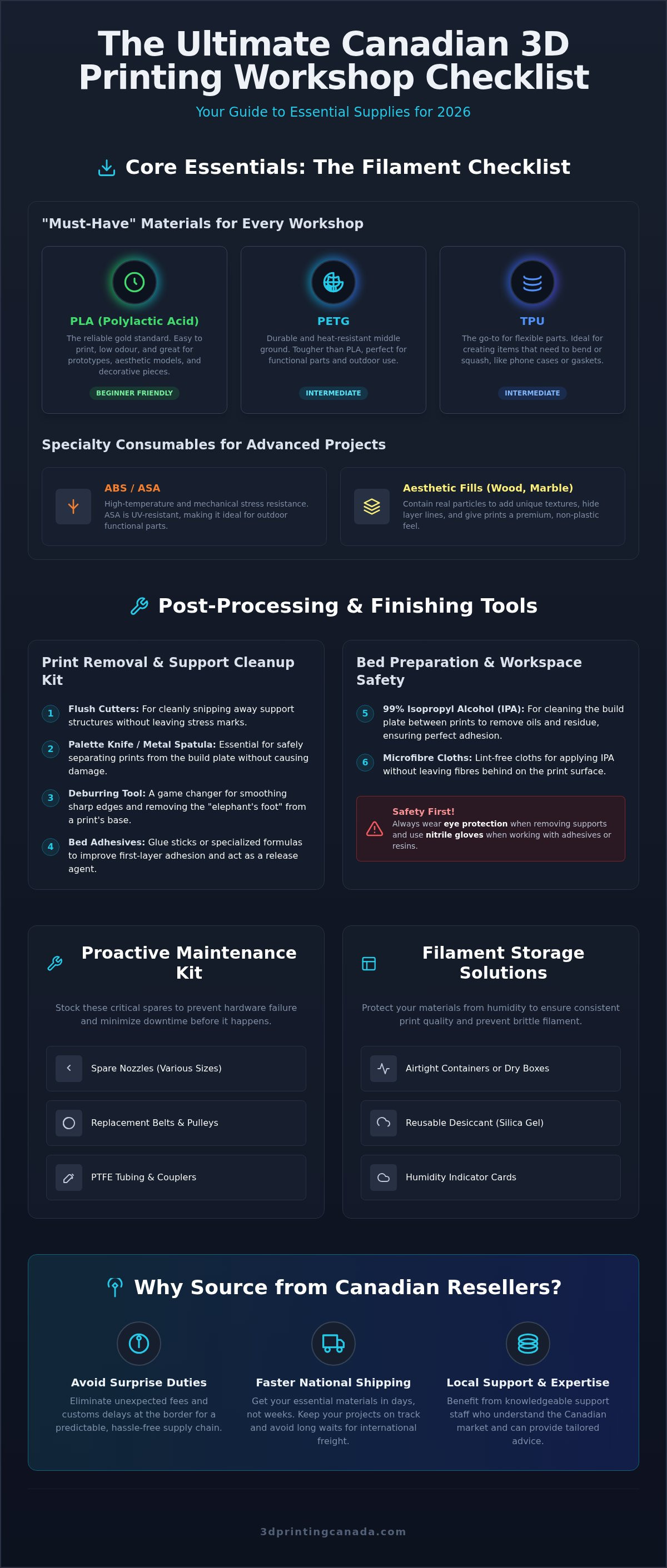
Core Essentials: The 3D Printer Filament Checklist
Think of filament as the "ink" of your 3D printing setup. Without it, your machine is just a fancy paperweight. When you're stocking up on 3D printing supplies Canada, your choice of material determines whether your project succeeds or ends up in the scrap bin. Most modern printers use 1.75mm diameter filament, but always double-check your machine's specifications before you buy. Using 2.85mm in a 1.75mm extruder is a recipe for an immediate jam. With over 800 filament varieties available, the options can feel overwhelming, but focusing on the basics first will save you hours of frustration.
The "Must-Have" Materials for Your First Month
Success starts with the right foundation. For most beginners, that foundation is Polylactic Acid (PLA). It's the gold standard because it doesn't require a heated chamber, emits almost no odour, and resists warping. It's perfect for aesthetic models, prototypes, and decorative pieces. We print with this stuff daily, and it remains the most reliable way to get a win early in your journey. It's forgiving, accessible, and comes in every colour imaginable.
Once you've mastered PLA, move to PETG. It offers a durable middle ground between PLA and more industrial plastics. It's tougher, heat-resistant, and handles outdoor environments much better. Because it's a bit "stringier" than PLA, it requires slightly different retraction settings and a bit more patience. We recommend starting with PLA filament Canada to build your confidence before tackling more complex materials. If your project needs to bend or squash, TPU (Thermoplastic Polyurethane) is your go-to for flexible parts like phone cases or gaskets.
Specialty Consumables for Advanced Projects
Eventually, your projects will demand more than just standard plastics. If you need parts that can survive a hot car interior or heavy mechanical stress, look toward ABS or ASA. These materials offer high-temperature resistance but require an enclosure to prevent warping. ASA is particularly useful because it's UV-resistant, making it the top choice for functional outdoor parts that won't degrade in the sun. It's a staple for automotive or marine applications.
For those looking to add a unique aesthetic, wood-fill and marble filaments provide incredible textures that hide layer lines. These often contain actual wood fibres or stone particles, giving your prints a premium feel. Finally, if you're running a modern, high-speed machine, ensure you're using high-speed filaments. These are formulated to melt and flow rapidly, keeping up with the blistering pace of 2026 hardware without sacrificing layer adhesion. Choosing the right material ensures your 3D printing supplies Canada inventory matches the capabilities of your machine.
Post-Processing and Finishing Tools You Actually Need
A common mistake for new makers is thinking the work ends when the printer beeps. In reality, the post-processing stage is where a raw plastic shape becomes a finished part. If you want your projects to look professional and function correctly, you need a dedicated set of tools to handle the cleanup. We've seen many hobbyists try to use kitchen knives or bare hands to remove prints, which usually leads to damaged build plates or, worse, a trip to the emergency room. Having the right 3D printing supplies Canada on hand makes this final stage safer and far more satisfying.
Start with a sturdy palette knife or a thin metal spatula. These are essential for separating prints from the bed without gouging the surface. For those using glass beds, this is a non-negotiable tool. You also need a bottle of 99% Isopropyl Alcohol (IPA) and a stack of microfibre cloths. Finger oils are the silent killer of bed adhesion; a quick wipe down between every print ensures your next project stays firmly in place. Finally, never skip the safety gear. Snipping off support structures with flush cutters can send sharp plastic shards flying. Wear eye protection every time you clean a model, and keep nitrile gloves nearby if you're working with adhesives or resins.
The Print Removal and Support Cleanup Kit
Removing supports is an art form that requires the right instruments. High-quality flush cutters are your best friend here. They allow you to get close to the model's surface to snip away plastic without leaving large white stress marks. For smoothing out the "elephant's foot" or sharp edges on the bottom of a print, a deburring tool is a game changer. It swivels to follow the contour of your part, shaving off excess material in seconds. If you're working with tricky materials like PETG or ABS, keep a glue stick or specialized bed adhesive in your kit. These act as both an anchor for the first layer and a release agent to protect your build plate from bonding too permanently.
Finishing Supplies for Professional Results
To achieve an injection-moulded look, you need to master the art of sanding. Keep a variety of sandpaper grits in your workshop, ranging from 120 for heavy material removal to 600 for a smooth, paint-ready finish. If you plan to colour your prints, a high-build filler primer is the secret to hiding layer lines. For larger projects that won't fit on a single build plate, you'll need reliable adhesives. Cyanoacrylate (super glue) is perfect for PLA, but two-part epoxies are better for heavy-duty functional assemblies. If you're looking to upgrade your toolkit, browse our full range of 3D printing supplies Canada to find the exact tools our technicians use daily.
Maintenance Spares: Keeping Your Printer in Optimal Condition
Every 3D printer has a "honeymoon phase" where everything works perfectly, but mechanical wear is inevitable. If you're running your machine daily, parts like nozzles, belts, and fans will eventually need attention. Don't wait for a total breakdown to order your 3D printing supplies Canada. Building a proactive "Spare Parts Box" ensures that a simple component failure doesn't turn into a week of downtime while you wait for a delivery. We've seen many makers lose momentum because they didn't have a two-dollar part on hand when they needed it most.
Nozzles are the most frequent replacement item. While a standard 0.4mm brass nozzle is great for detail, having a 0.6mm nozzle is a game changer for large functional prints. It allows for thicker layers and wider lines, significantly reducing print times without a massive loss in quality. If you're moving into abrasive materials like carbon fibre or glow-in-the-dark filament, you must switch to hardened steel. Brass is too soft and will wear out after just one or two spools of abrasive material, ruining your print accuracy.
Keep an eye on hidden failure points like PTFE tubing and pneumatic connectors. In many hotends, the tube sits directly against the nozzle. Over hundreds of hours, the heat causes the end of the tube to char and deform, leading to mysterious clogs. Replacing a few centimetres of tubing and a worn-out connector is a quick fix that solves most extrusion issues. However, if you're facing deep motherboard errors or complex mechanical misalignments, it's often more efficient to use professional 3D printer repair services Canada rather than risking further damage with a DIY attempt.
Essential Hardware Spares Checklist
- Replacement Nozzles: Keep a mix of brass for standard PLA and hardened steel for anything abrasive.
- Silicone Socks: These keep your heat block insulated and prevent stray filament from sticking to the heater.
- Eccentric Nuts and Belts: Periodically check for "slop" in your motion system. Keeping a spare belt ensures you can fix a snap immediately.
Bambu Lab Specific Accessories and Parts
Owners of modern high-speed machines have unique needs. Because these printers move so fast, they require high-quality components that can handle the vibration and heat. Check out our guide on Bambu Lab accessories Canada to see which upgrades actually improve performance. Keeping spare PEI build plates and hardened steel gear assemblies in your inventory is essential if you want to take full advantage of what these machines can do with industrial filaments. Proactive maintenance is the secret to consistent, high-quality output.
Workspace Safety and Filament Storage Solutions
Your environment plays a massive role in print quality, often more than the printer itself. While we've discussed materials and tools, where you keep those 3D printing supplies Canada matters just as much. Canada's climate presents a unique challenge; we face bone-dry winters and humid, sweltering summers. Most filaments are hygroscopic, meaning they act like a sponge for moisture in the air. If you've ever heard a tiny popping sound at the nozzle or noticed excessive stringing on a previously perfect profile, your filament is likely wet.
Moisture absorption doesn't just cause aesthetic issues. It weakens the structural integrity of your parts. To combat this, use airtight storage containers with plenty of desiccant. Vacuum-sealed bags are a cost-effective start, but a dedicated dry box allows you to print directly from a humidity-controlled environment. For those working with engineering-grade materials like Nylon or PETG, a commercial filament dryer is a mandatory investment to keep your spools in peak condition. It's a small price to pay to avoid failed multi-day prints.
Safety is the other half of a professional workspace. Materials like ABS and ASA release Volatile Organic Compounds (VOCs) that require active ventilation or HEPA filtration. For businesses using 3D printers, adhering to WHMIS and Canada Occupational Health and Safety Regulations is mandatory to ensure a safe working environment. Ensure your print centre has a local exhaust system or is situated in a well-ventilated area. Don't forget fire safety; every workshop should have a smoke detector and a fire-suppression blanket nearby. It's about protecting your investment and yourself.
Filament Storage for the Canadian Climate
During a humid summer, a spool of PLA can become saturated in less than 48 hours. You'll know it's time to dry your material if you see bubbles in the extruded plastic or if the filament becomes unusually brittle. While DIY solutions like modified food dehydrators work, commercial dryers offer more precise temperature control for sensitive materials. Organize your library by material type and keep a log of when each spool was opened to stay ahead of moisture issues.
Setting Up a Safe and Ergonomic Print Centre
A stable foundation is critical for high-speed printing. Place your machine on a heavy, level surface to reduce vibrations that cause ghosting or ringing in your prints. Good lighting is also essential; bright LED strips allow you to monitor the first layer closely and catch failures before they waste a half-kilogram of plastic. Finally, practice disciplined cable management. Use zip ties or cable chains to ensure the moving bed or toolhead never snags on a loose wire during a long job. If you need to upgrade your environment, shop our full range of 3D printing supplies Canada to find professional-grade storage and safety solutions.
Navigating the Canadian 3D Printing Supply Ecosystem
Buying from massive international marketplaces often looks cheaper on the surface, but the hidden costs of importing into Canada quickly stack up. Between brokerage fees, surprise duties, and the three-week wait for a package to clear customs, that "bargain" spool of filament often becomes a major headache. When you source your 3D printing supplies Canada domestically, you're not just buying a product; you're buying predictable logistics and local accountability. We prioritize fast national shipping because we know a stalled project is a lost opportunity. Dealing with a local partner means your orders arrive in days, not weeks, and you won't get hit with unexpected invoices at your doorstep.
Beyond logistics, being an authorized reseller for brands like Bambu Lab and Prusa means your warranty actually has teeth. If a component fails within the warranty period, you deal with experts here in Canada rather than trying to coordinate a return to a factory overseas. This reliability is why we've spent over 10 years building our reputation as a dependable partner for makers across the country. As your workshop grows, you might even consider integrating advanced tech like a 3D scanner Canada to reverse-engineer parts or create custom fits for existing objects. Building a relationship with a domestic supplier ensures you have the support needed to scale your creative ambitions.
Why Procurement Expertise Matters
We understand that schools, libraries, and industrial businesses have specific procurement needs that mass marketplaces can't handle. Whether it's processing formal purchase orders or organizing bulk shipments of resin and filament, we speak your language. Buying in bulk doesn't just save on unit costs; it ensures material consistency across large-scale projects. Avoid the "cheap clone" trap found on global sites. Those unbranded parts often lack quality control and can lead to thermal runaway or destroyed extruders, costing you far more in repairs than you saved on the initial purchase.
Leveraging Expert Support and Repairs
The biggest advantage of a domestic ecosystem is access to human expertise. We aren't just a warehouse; we're a team of technicians who print daily and test every product we sell. If your checklist isn't enough to solve a persistent bed-levelling issue or a complex firmware bug, our national repair services provide the ultimate safety net. You can access guides and troubleshooting tips from people who've encountered the same challenges you're facing right now. This peer-to-peer support turns a simple transaction into a long-term partnership that keeps your machines running at their best.
Build Your Future-Ready Workshop Today
Success in 2026 depends on having a reliable domestic supply chain that keeps your printer running without the headache of international shipping delays. You've seen how the right filament choices and proactive maintenance spares can transform your workflow from a series of frustrations into a consistent creative process. Protecting your materials from the Canadian climate and having a backup plan for hardware issues ensures you're always ready for the next big project. Building this foundation now means less time troubleshooting and more time bringing your ideas to life.
We are here to support that journey as your dependable partner. With over 800 filament varieties in stock and expert technical support from real printers who use these tools daily, we have everything you need to succeed. As an authorized Bambu Lab reseller with over a decade of expertise, we provide the reliability you deserve. Shop the Full Range of 3D Printing Supplies in Canada today and build a workshop that never stops. Your next great creation is just one print away, and we can't wait to see what you build.
Frequently Asked Questions
What are the absolute bare minimum 3D printing supplies I need to start?
The absolute bare minimum includes a spool of PLA filament, a metal spatula for print removal, and 99% Isopropyl Alcohol for bed cleaning. You'll also want flush cutters to snip away support material. Starting with these basics allows you to produce successful prints immediately without overcomplicating your workspace. As you gain experience, you can expand your 3D printing supplies Canada kit to include specialized maintenance tools.
How much should I expect to spend on initial supplies in Canada?
You should budget between C$100 and C$150 for your initial 3D printing supplies Canada beyond the cost of the printer. This range covers a few high-quality spools of PLA, a basic post-processing tool kit, and essential cleaning supplies. While you can find cheaper individual items, investing in reliable consumables early on prevents failed prints and saves you money on wasted material in the long run.
Is it cheaper to buy 3D printer filament in bulk?
It is significantly cheaper to buy filament in bulk if you have a high-volume project or a favourite colour. For instance, a 5kg spool of PLA often costs around C$90, which is a lower price per kilogram than buying five individual 1kg spools. Bulk purchasing is an excellent strategy for schools or businesses that go through material quickly and want to ensure colour consistency across multiple prints.
How do I know if my 3D printer filament is food safe?
Identifying food-safe filament requires checking the manufacturer's technical data sheets for FDA or Health Canada compliance. However, even if the plastic is safe, the 3D printing process creates tiny ridges where bacteria can grow. Under the Canada Consumer Product Safety Act, the responsibility for safety lies with the maker. We recommend using food-safe epoxy coatings if you plan on using printed items for food contact.
Where can I find 3D printer repair services if my hardware fails?
If your hardware fails and you aren't comfortable with a DIY fix, you can find professional 3D printer repair services right here at 3D Printing Canada. Our experienced technicians handle everything from clogged extruders to complex motherboard issues. Seeking expert help ensures your machine is calibrated correctly and prevents the accidental damage that often happens during amateur repair attempts.
Do I really need a filament dryer in Canada?
A filament dryer is highly recommended in Canada, particularly during the humid summer months. While our winters are dry, summer humidity can ruin a spool of PETG or Nylon in just a few days. A dryer removes the moisture that causes popping sounds and poor surface finish. It is a vital tool for anyone who wants to maintain consistent print quality year-round.
What is the best way to store 3D printing supplies to make them last?
The best way to store your supplies is in airtight plastic bins with rechargeable desiccant packs. This setup keeps moisture away from your filament and protects your tools from dust. For long-term storage, vacuum-sealed bags are even more effective. Keeping your workspace organized and your materials dry ensures that your spools remain fresh and ready to print even months after being opened.
Are Bambu Lab accessories compatible with other 3D printer brands?
Most Bambu Lab accessories, such as their proprietary hotends and nozzles, are designed specifically for their machines and won't fit other brands. However, their filaments and some build plates can be used with other printers if the dimensions match. To get the best performance and ensure your warranty stays valid, it's always safest to use genuine parts designed for your specific printer model.