
Why does the most versatile 3D printing filament PETG feel like a sticky, stringy nightmare the second you hit "print"? You've likely heard that PETG is the "Goldilocks" material, offering the durability of ABS without the difficult fumes. Yet, when you're dealing with "hairy" stringing or a first layer that welds itself to your bed, it doesn't feel very balanced. We understand that you want functional, professional parts without the headache of constant failed prints or messy cleanup.
We'll help you master the technical specs and hardware requirements needed to achieve dimensionally accurate, strong functional prints every time. This guide explores the latest 2026 developments, from high-flow blends to the re-released Bambu Lab PETG with its impressive 75 MPa bonding strength. You'll learn how to optimize your settings for consistent results and where to find reliable spools from a trusted Canadian source. Let's turn those frustrating nests of plastic into the tough, reliable components your projects deserve.
Key Takeaways
- Learn to calibrate your nozzle and bed temperatures correctly to ensure your hardware is perfectly tuned for 3d printing filament petg.
- Understand why PETG is the ideal material for Canadian summer heat, providing better thermal resistance than PLA for functional automotive parts.
- Master the "lay, don't squish" first layer technique to achieve perfect bed adhesion and avoid damaging your print surface.
- Solve persistent stringing issues by optimizing retraction and travel speeds for the latest high-speed printer models.
- Compare standard, matte, and specialty blends to select the perfect finish and strength profile for your specific engineering project.
What is PETG Filament? Understanding the Goldilocks of 3D Printing
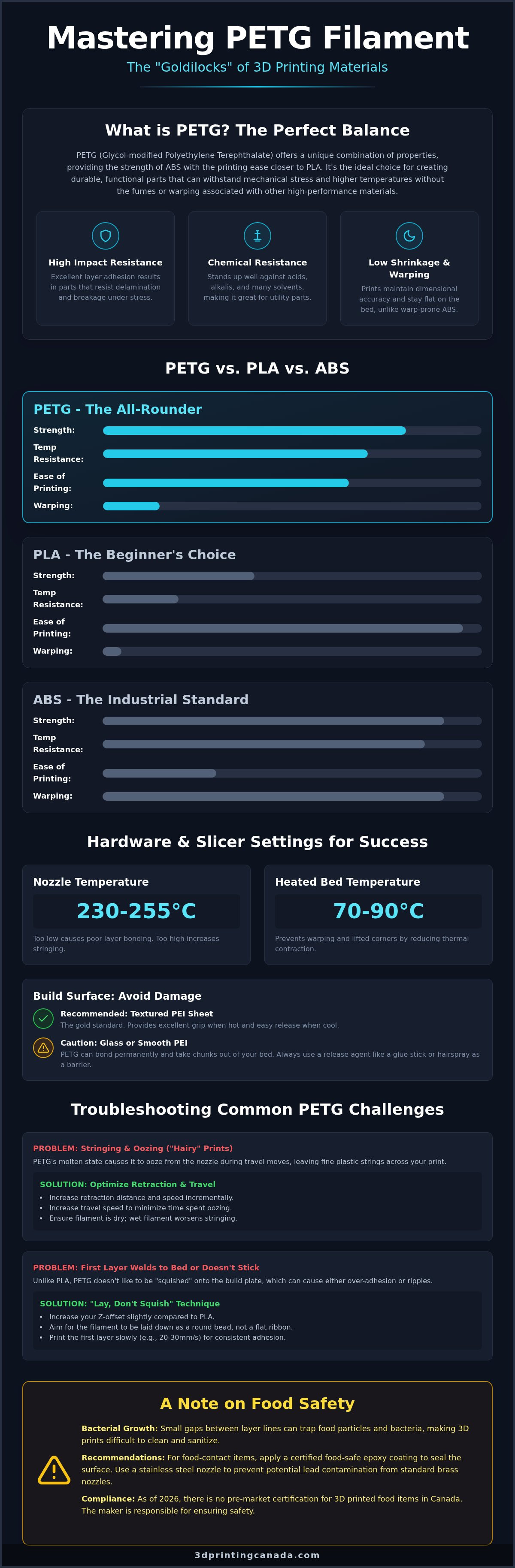
Think of 3d printing filament petg as the reliable middle ground for your workshop. It earns its "Goldilocks" reputation by offering a perfect balance of properties. While PLA is easy to print but often too brittle for mechanical use, and ABS provides strength but requires an enclosure and smells like a tire fire, PETG sits comfortably in between. It gives you the durability of a functional plastic without the warping headaches or toxic fumes typically associated with high-performance materials.
The secret lies in its chemistry. This material is a glycol-modified version of Polyethylene terephthalate (PET), which is the same plastic used in water bottles and food containers. Adding glycol (the "G" in PETG) prevents the plastic from crystallizing during the printing process. This modification makes the filament less brittle and much clearer than standard PET. It also lowers the melting point just enough to make it manageable for most consumer-grade machines while maintaining excellent thermal stability.
In 2026, we see this material used for everything from heavy-duty mechanical brackets to UV-resistant outdoor gear. It's the go-to choice for Canadian makers who need parts that can survive a hot summer day inside a car or the constant vibration of a drone frame. If you need a part that actually works and lasts, this is usually where you start.
The Chemical Advantages of PETG
One of the biggest wins with PETG is its exceptional layer adhesion. Because the layers bond so effectively, the resulting parts have high impact resistance and rarely delaminate under stress. It also boasts impressive chemical resistance. It stands up well against acids, alkalis, and many solvents, making it ideal for lab equipment or garage organizers. Unlike styrene-based plastics, PETG has very low shrinkage. This means your prints stay flat on the bed and maintain their intended dimensions without the aggressive warping that ruins ABS projects.
Is PETG Food Safe?
The question of food safety is a common point of confusion. While the raw PETG resin is often compliant with Health Canada standards, the 3D printing process itself introduces risks. Small gaps between layer lines can act as breeding grounds for bacteria that are nearly impossible to clean out. As of August 2026, Health Canada and the Canadian Food Inspection Agency do not provide specific pre-market certifications for 3D printed items. Responsibility falls on the manufacturer to ensure products don't leach harmful chemicals under the Canada Consumer Product Safety Act. If you're printing kitchen tools, we recommend applying a food-safe epoxy coating and using a stainless steel nozzle to prevent lead contamination from standard brass hardware.
Hardware Requirements: Preparing Your Printer for PETG Success
Getting your hardware ready for 3d printing filament petg is about more than just cranking up the heat. While it's easier to handle than ABS, PETG has a specific set of thermal demands that can catch you off guard if you're coming from a PLA-only background. Success starts with understanding how your printer interacts with this sticky, durable material.
Most Canadian filament brands perform best with nozzle temperatures between 230°C and 255°C. If you go too low, you'll see poor layer bonding; too high, and the stringing becomes unmanageable. Your heated bed is equally critical. Set it between 70°C and 90°C to prevent thermal contraction, which causes those frustrating lifted corners. Stick with a standard brass nozzle for basic PETG, but switch to hardened steel if you're experimenting with Carbon Fibre blends. PETG is surprisingly abrasive once you add those fibres. Regarding enclosures, they aren't strictly necessary for success. However, if you're printing in a drafty room or during a cold Canadian winter, an enclosure helps maintain a stable ambient temperature for more consistent results.
Build Surface Protection: Avoiding the 'Chunk' Issue
PETG is famous for its "over-adhesion." It can bond so aggressively to glass or smooth PEI that it takes a chunk of the bed surface with it when you remove the part. We always recommend using a release agent like a glue stick or hairspray. In this context, the glue acts as a barrier to help you pop the print off safely rather than just an adhesive. For the best experience in 2026, textured PEI sheets remain the gold standard. They provide the perfect grip when hot and release the part almost effortlessly once cooled. You can find these and other reliable Bambu Lab accessories to upgrade your current setup.
Extruder and Cooling Settings
Because PETG stays molten longer than PLA, it tends to "ooze" during travel moves. You'll need to tune your retraction settings carefully to combat this. Direct drive extruders usually need about 1.0mm to 1.5mm, while Bowden setups might require 6mm or more. If you're struggling to dial this in or your hardware isn't cooperating, our professional 3D printer repair services can help calibrate your extruder for peak performance. Finally, remember the 20% fan rule. Too much cooling kills PETG part strength. Keep your fan speed low to ensure the layers have enough time to fuse into a solid, unbreakable part.
PETG vs. PLA vs. ABS: Which Material Should You Choose?
Choosing the right spool often feels like a balancing act between printing ease and final part performance. If you're currently weighing your options, 3d printing filament petg is likely your strongest contender for any project that needs to actually do something. Thermal resistance is a major deciding factor for Canadian makers. While a PLA phone mount might melt into a sad puddle on your car's dashboard during a humid July afternoon, PETG remains rock solid. With a glass transition temperature sitting around 80°C, it's the reliable choice for automotive accessories and sunny windowsills alike.
PLA remains the undisputed king of fine detail. It's the best choice for intricate figurines or architectural models where aesthetics are the only concern. However, PETG takes the crown for pure utility. The difference is most obvious in how the materials fail. PLA is stiff and brittle; it snaps under load. PETG is ductile and forgiving; it flexes. This ability to absorb impact and bend without breaking makes it the superior choice for clips, latching mechanisms, or structural brackets.
Odour is another critical consideration for the home hobbyist. Printing ABS or ASA in a living space is a challenge due to the release of styrene fumes, which require heavy filtration or dedicated venting. PETG is a much safer indoor alternative. It's virtually odourless during the print process, allowing you to run your machine in a home office or workshop without a headache.
The Functional Breakdown
Selecting the right plastic depends entirely on the final environment of your print. Use this quick guide to decide which material belongs on your build plate:
- PLA: Best for decorative models, early-stage prototypes, and low-stress toys where visual detail is the priority.
- PETG: Ideal for waterproof containers, mechanical hinges, and outdoor signs that face UV exposure and moderate heat.
- ABS/ASA: Reserved for extreme high-heat environments exceeding 80°C or parts that require professional chemical vapour smoothing.
While PETG is an excellent choice for durable outdoor 3D prints, those looking for professional-grade backyard installations like sunrooms or glass railings can click here to learn more about Muskokify's outdoor living solutions.
Cost and Availability in Canada
Pricing used to be a major barrier for PETG users, but those days are gone. Standard PETG has become nearly as affordable as PLA, with most high-quality 1KG spools now priced within a very narrow margin of each other. To maximize your value, we recommend buying 3D printer filament in bulk. This approach significantly reduces your cost per spool and helps you save on national shipping fees across Canada. Regarding environmental impact, PETG is technically recyclable as a #7 plastic, though it's rarely accepted in municipal curbside programs. PLA is industrially compostable, which makes it a better choice for temporary models or disposable prototypes.
Mastering the Print: Troubleshooting Common PETG Challenges
Even with a perfectly calibrated machine, 3d printing filament petg can occasionally behave like a diva. The most common mistake beginners make is treating it exactly like PLA. If you try to "squish" your first layer into the bed to force adhesion, you'll likely end up with a globby mess stuck to your nozzle instead. PETG prefers to be "laid" onto the surface. Increase your Z-offset by a tiny margin, roughly 0.02mm to 0.05mm, to give the material room to breathe as it exits the nozzle. This simple adjustment prevents the filament from being dragged around by the heater block.
Stringing is the other legendary hurdle. Because PETG has high melt strength, it doesn't like to stop flowing. To combat those fine, hairy wisps, you need to find the sweet spot between retraction distance and travel speed. On the high-speed printers common in 2026, fast travel moves (300mm/s or higher) help "snap" the filament string before it can form. If you notice your prints look dull or matte when they should be shiny, try slowing down your outer wall speed. Dropping to 40-60mm/s allows the plastic to cool slowly, which preserves the characteristic PETG gloss and improves aesthetic quality.
Moisture Management: The Silent Print Killer
Canada's varied climate presents a unique challenge for PETG users. This material is highly hygroscopic, meaning it greedily absorbs moisture from the air. Whether it's a humid summer in the Maritimes or a damp basement in British Columbia, wet filament will ruin your day. You'll know you have a problem if you hear tiny popping or crackling sounds at the nozzle. This is actually steam escaping the plastic. It leaves behind a rough, pitted surface finish and significantly weakens the part. Always dry your spools in a dedicated filament dryer at 65°C for at least 6 hours before a critical print. Keeping your filament in a sealed dry box with fresh desiccant is the only way to ensure consistent results year-round.
Bambu Lab Specific Optimization
If you're running a Bambu Lab machine, the Automatic Material System (AMS) makes switching between colours a breeze, but it requires some attention. Ensure your spools are properly seated and spinning freely to avoid load errors. You can find specialized Bambu Lab accessories Canada like improved spool rings or silica gel inserts to keep your AMS running smoothly. For the best performance, don't just rely on generic profiles. Run a manual flow rate calibration and tune your Pressure Advance settings. This ensures that even at high speeds, your corners stay sharp and your extrusions remain consistent. If you find yourself consistently struggling with hardware jams or calibration errors, browse our collection of high-quality 3D printing filaments to ensure your material isn't the weak link in your workflow.
Choosing Your PETG: From Standard Spools to Specialty Materials
Selecting the right spool of 3d printing filament petg depends entirely on your project's final environment. While standard PETG is the reliable workhorse for glossy, vibrant functional parts, the 2026 market offers specialized blends that solve specific engineering hurdles. Standard PETG remains a top choice for its incredible layer bonding. For example, the latest Bambu Lab PETG Basic formulations now reach bonding strengths of 75 MPa. This makes it nearly impossible to break along the layer lines when printed correctly.
If you find the traditional glossy finish too "plastic" for your taste, Matte PETG is the perfect alternative. It uses additives to scatter light, which effectively hides layer lines and provides a premium, non-reflective look. For those pushing the limits of their machines, High-Flow PETG is essential. It's specifically formulated for the fast 3D printers that have become the Canadian industry standard. These blends melt more consistently at high speeds, preventing the under-extrusion gaps that often ruin rapid prints.
Engineering tasks often require the added stiffness of Carbon Fibre (CF) PETG. This material isn't just about looks; the carbon fibres increase dimensional stability and reduce the already low shrinkage of the base plastic. It's the go-to material for drone frames and mechanical housings where flex is the enemy. Just remember that CF blends are abrasive and require a hardened steel nozzle to prevent hardware damage.
Selecting the Right Diameter: 1.75mm vs. 2.85mm
In the modern Canadian 3D printing landscape, 1.75mm has become the undisputed standard. Almost all current consumer and prosumer machines are built for this diameter because it offers better control over extrusion and retraction. We still see 2.85mm used in legacy industrial machines, but it's increasingly rare. No matter which diameter your printer requires, always prioritize spools with a precision tolerance of +/- 0.03mm. This level of consistency ensures that your flow rate remains steady during 30-hour prints, protecting you from the frustration of mid-print failures caused by diameter fluctuations.
Specialty Blends for Professional Projects
When standard materials aren't enough, professional blends provide targeted solutions for complex environments. Glass Fibre (GF) PETG offers extreme impact resistance, making it ideal for rugged outdoor equipment that needs to survive a Canadian winter. If you're designing electrical enclosures, Flame Retardant PETG adds a necessary layer of safety and compliance. For electronics assembly, ESD-Safe PETG prevents static discharge from destroying sensitive components. These materials turn your 3D printer from a hobbyist tool into a legitimate manufacturing centre for specialized industrial parts.
Ready to Level Up Your Functional Prints?
Mastering PETG is a rite of passage for any maker looking to move beyond decorative models into the world of functional engineering. By dialling in your Z-offset and respecting the material's thermal needs, you've already cleared the biggest printing hurdles. Success comes down to those small adjustments, like slowing down your outer walls for that signature gloss and keeping your spools bone-dry. In our varied Canadian climate, moisture management is the secret weapon for consistent, professional results.
Choosing the right 3d printing filament petg transforms your machine from a hobbyist tool into a high-output production centre. Whether you need the stiffness of carbon fibre or the sleek look of a matte finish, we have the specialized materials to match your ambition. We provide fast nationwide shipping across Canada and expert-vetted brands to ensure you never have to guess about quality. Our team offers comprehensive support for Bambu Lab and Creality machines to help you troubleshoot any hardware hiccups along the way.
Shop Premium PETG Filament at 3D Printing Canada to start your next functional project with confidence. Your most durable prints yet are just one perfect first layer away.
Frequently Asked Questions
Does PETG filament need a dry box?
Yes, a dry box is essential because PETG is highly hygroscopic. It absorbs moisture from the air much faster than other materials. In humid Canadian summers, even a few days of exposure leads to popping sounds and rough surface finishes. Storing your spools in a sealed container with desiccant or using an active filament dryer ensures the plastic remains dry. This simple step prevents the steam bubbles that cause structural weaknesses.
Why is my PETG print so stringy?
Stringing happens because PETG has high melt strength and doesn't stop flowing easily when the extruder stops. You can fix this by increasing your travel speed and fine-tuning your retraction settings. Moist 3d printing filament petg also causes internal pressure that forces plastic out of the nozzle during moves. Try drying your spool at 65°C for 6 hours. If wisps persist, lower your printing temperature by 5°C to reduce the material's fluidity.
Can I print PETG on a cold bed?
No, printing PETG on a cold bed is a recipe for failure. The material requires a heated surface between 70°C and 90°C to stay adhered and prevent the corners from warping. Without heat, the plastic contracts too quickly as it cools, causing the print to pop off mid-way. If your printer doesn't have a heated bed, you'll find it nearly impossible to get successful results. Stick with PLA if you don't have bed heating.
Is PETG as strong as ABS?
PETG is often stronger than ABS regarding impact resistance and layer adhesion. It's less likely to shatter or delaminate under stress. However, ABS has a higher heat deflection temperature. While PETG starts to soften around 80°C, ABS can withstand environments up to 105°C. If you need a part for a hot engine bay, ABS is better. For most structural brackets and outdoor tools, PETG is the superior and much easier-to-print choice.
What is the best nozzle for Carbon Fibre PETG?
You must use a hardened steel nozzle when printing with Carbon Fibre blends. Standard brass nozzles are too soft. They'll wear down within a few hundred grams of printing, leading to inconsistent extrusion and ruined hardware. A 0.6mm nozzle is also a smart choice for CF-PETG. The larger diameter helps prevent the tiny carbon fibres from clogging the tip. This ensures a smoother flow during long engineering projects and prevents frustrating mid-print jams.
Will PETG ruin my glass build plate?
Yes, PETG can permanently damage a glass build plate if you don't use a release agent. It bonds so effectively to glass that it can pull out chunks of the surface as the print cools. Always apply a thin layer of glue stick or hairspray before you start. This creates a necessary barrier that allows the part to release safely. Alternatively, switch to a textured PEI sheet for a much more reliable experience.
How do I get PETG to stick to the bed?
Achieving great adhesion with 3d printing filament petg requires a bed temperature of 70°C to 80°C and a clean surface. Use isopropyl alcohol to remove finger oils before printing. Unlike PLA, don't "squish" the first layer into the bed. Raise your Z-offset slightly so the filament is laid down gently. If you still have trouble, a textured PEI sheet or a specialized 3D printing adhesive will help the material bond to the surface.
Is PETG filament UV resistant for outdoor use?
Yes, PETG is naturally UV resistant and handles outdoor exposure much better than PLA. It won't become brittle or lose its colour quickly when left in the sun. This makes it an ideal choice for garden tools, outdoor signage, and drone components. For those who need larger-scale branding solutions, you can explore 13oz Vinyl Banners from Banner 4 Sale to ensure your displays are as durable and professional as your 3D printed hardware. While ASA offers even higher UV protection, PETG provides a great balance of weather resistance and ease of use for most Canadian backyard projects. It remains stable even in fluctuating temperatures.